


 Shkruar nga Aleksander Olech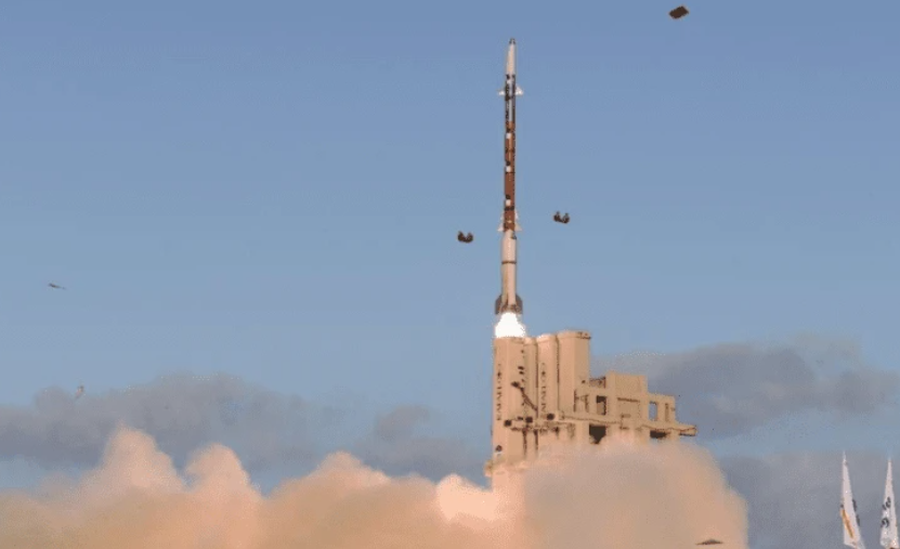
Athens is radically changing its military strategy by investing over 3 billion euros in an integrated air and missile defense architecture. Through the purchase of advanced Israeli systems, this program aims to counter modern threats, such as drones and coordinated attacks, not only from Turkey, but also from other regional challenges...
Greece is no longer simply purchasing stand-alone systems to meet specific needs. Athens is building an integrated air and missile defense architecture, designed for a battlefield dominated by drones, high-precision weapons, and massive coordinated attacks.
The approval of more than 3 billion euros for the “Achilles Shield” confirms that this transformation has now moved from political declarations to practical implementation. The Greek Government Council for Foreign Affairs and Defense approved armament programs with a total value of 4.2 billion euros.
More than 3 billion euros will be allocated for the “Achilles Shield,” which aims to become the new foundation of Greek air and missile defense. Athens plans to buy three additional Israeli systems.
The Spyder AiO will be responsible for dealing with short-range threats, the Barak MX will cover the intermediate layer of defense, while the David's Sling will provide protection against longer-range missiles.
This entire architecture will be connected through a new command and control system, supported by artificial intelligence and modern radars. The importance of this decision does not lie only in the systems themselves.
Greece aims to connect sensors, strike systems and command structures into a single architecture, capable of gathering information, analyzing threats and choosing the most appropriate response.
In modern warfare, the effectiveness of air defense depends not only on the missiles, but also on the speed with which the entire system can detect and engage the target. This decision also has a practical reason.
Greece still has the Russian Tor-M1 and Osa-AK systems in use, but their maintenance has become increasingly difficult since the start of Russia's large-scale war against Ukraine.
Access to spare parts is limited, cooperation with Moscow has practically ended, and existing systems are becoming obsolete. For this reason, Athens was forced to make a strategic decision and opted for Israeli solutions.
From "PULS" to "Achilles' Shield"
The new program should be seen in conjunction with the agreement signed in April for the purchase of the PULS missile artillery system. The contract, worth around 656 million euros, includes precision-guided missiles and loitering munitions.
Some of the launchers are expected to be deployed on Greek islands in the Aegean, which Turkey has been demanding for years to be demilitarized. The “PULS” system gives Greece a greater long-range strike capability, while the “Achilles Shield” aims to create a defensive layer.
Athens aims to neutralize incoming drones and missiles, while maintaining the ability to hit launchers, command posts, and logistical targets at greater distances. This is no longer a purchase of stand-alone platforms.
Greece is building a complete and integrated system. For this reason, cooperation with Israel is structural and not merely transactional. Both countries are deepening military ties, conducting joint exercises, and expanding industrial cooperation in the defense sector.
Israel is also involved in training Greek pilots in Kalamata. In addition, Greece, Cyprus and Israel are discussing the creation of a rapid reaction unit to protect critical infrastructure, including offshore gas extraction plants.
Israeli systems are very attractive to Athens because they have been tested in real combat conditions, can be delivered more quickly, and may prove more economical than some European alternatives. On the other hand, reliance on Israel also creates a dependence on Israeli technology, ammunition, and technical support.
This should be kept in mind, especially at a time when the Israeli defense industry is facing increasing demand and the needs of ongoing military operations.
Turkey remains a key part of the equation
Greece officially argues that its cooperation with Israel is not directed against any third country. However, Turkey remains a key element in these strategic calculations. Ankara is rapidly expanding its missile capabilities, drone fleet and defense industry, while disputes over maritime borders, Cyprus and the militarization of the Greek islands remain unresolved.
The rapprochement between Greece and Israel accelerated after the 2019 agreement between Turkey and Libya, which Athens considered a direct challenge to its interests in the Eastern Mediterranean. Since then, cooperation with Israel has become an increasingly important part of the Greek response to the rise of Turkish military power.
This is not to say that every Greek purchase should be interpreted solely through rivalry with Ankara. The wars in Ukraine and the Middle East have shown that European states need stronger defenses against drones, cruise missiles, and ballistic threats.
However, in the case of Greece, the development of Turkish military capabilities clearly accelerates decision-making. There is also the risk of a regional arms race. A stronger Greek air defense shield could strengthen deterrence, but it could also serve as a justification for Turkey to develop new systems aimed at penetrating it.
Ankara is already investing heavily in ballistic missiles, unmanned aerial vehicles, and long-range, high-precision weapons. As a result, one side's defense modernization could spur the expansion of the other's offensive capabilities.
The “Achilles Shield” is just one part of a much broader modernization program. Greece has also approved the purchase of three C-390 Millennium transport aircraft, Hellfire missiles for Apache helicopters, and sonar systems for frigates.
In total, Athens plans to spend around 28 billion euros on modernizing the armed forces by 2036 and currently dedicates around 3.5 percent of GDP to defense.
It is clear that Greece is not just preparing for a traditional conflict with planes, ships and armored vehicles. It is adapting to a high-intensity battlefield, where drones, missiles, electronic warfare and the speed of data processing will determine military superiority.
The agreement on the PULS system was the offensive element of this transformation. The “Achilles Shield” represents its defensive pillar, together creating the basis of Athens’ new military strategy./ Pamphlet from “Defense24”






Lini një Përgjigje