


 Shkruar nga Pamfleti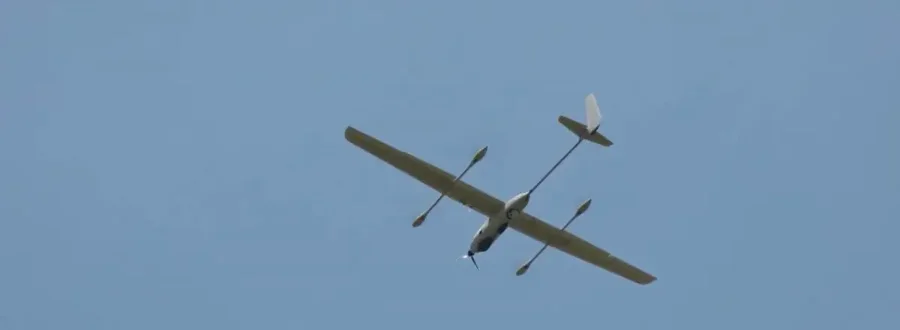
The United States has a new ace up its sleeve. Marines from the 12th Littoral Combat Team used the Stalker VXE30 reconnaissance drone during Resolute Dragon 25, a bilateral military exercise held in cooperation with Japan a few days ago near Hijudai, Oita Prefecture.
This small, vertical take-off and landing unmanned aerial vehicle (UAV), manufactured by Edge Autonomy, is designed for high autonomy and flexible deployment. The US Marine Corps tested the drone during maneuvers with Tokyo, demonstrating that it has additional capabilities for use in the turbulent Indo-Pacific scenario.
Edge Autonomy itself describes the VXE30 as a drone designed to enhance missions in various environments.
The system offers excellent stability, multiple payload configuration options, and fantastic landing accuracy.
It is also designed to operate on both batteries and propane fuel cells and offers a communication range of up to 160 km.
As Defense Blog explained, the Stalker VXE30 drone offers several operational advantages for forces deployed on the front lines.
The platform weighs 19.5 kg when running on batteries and slightly less when filled with fuel.
It can stay in the air for up to four hours on batteries and up to eight hours using its hybrid fuel cell system.
With a wingspan of 16 feet and a top speed of 58 mph, the VXE30 can operate at altitudes ranging from 300 feet above the ground to a density altitude of 12,000 feet, depending on mission requirements.
Edge Autonomy further emphasizes that the device is designed to combine the mobility of a transportable system with the durability and payload performance more commonly found in larger UAV platforms.
A new "wild card" for the US Navy
The system also includes automatic centralized tire inflation, dual redundant batteries, and a VTOL launch and recovery system, reducing the need for external equipment in challenging or improvised operating environments.
During the demonstration, the drone was operated by Marines from the 12th Marine Coast Guard Regiment, part of the 3rd Marine Division. This unit has played a critical role in the Marine Corps’ modernization efforts, particularly in adapting to Indo-Pacific scenarios that require distributed operations and rapid deployment of sensors in contested maritime areas.
With the deployment of the VXE30 Stalker during Exercise Resolute Dragon 25, the US Marines are confirming their desire to strengthen their technological and operational capabilities in an increasingly central area of the global geopolitical landscape.
The Indo-Pacific today represents one of the main fronts of global competition, where speed of action, flexibility and information superiority can make the difference.
In this context, systems such as the compact, versatile and highly autonomous VXE30 are poised to become essential tools not only for surveillance and reconnaissance, but also for real-time tactical support. / Adapted from Il Giornale/








Asi nen menge...ha ha ha nga Italishtja. Nuk egziston si fjali nga ne..