


 Shkruar nga Pamfleti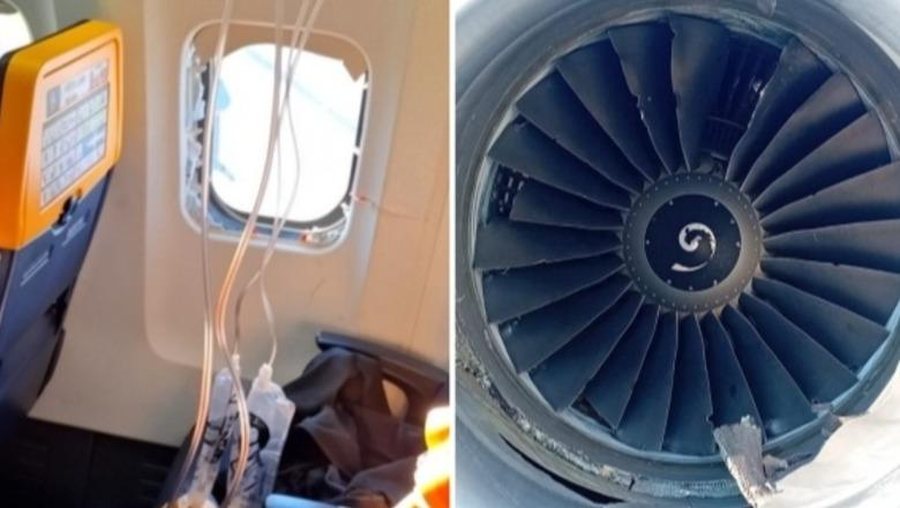
Aviation authorities in Europe and the United States will try to determine in the coming weeks whether the Ryanair flight incident requires one or more structural changes to the aircraft, such as reviewing the design and durability of windows and strengthening the fuselage structure, or whether the separation of one of the engine blades, which caused a passenger to almost be sucked out of the plane, is more related to inspections and maintenance, which would not require major design changes.
poTenTial
This is explained to Corriere della Sera by two Western sources who are aware of the first internal hypotheses at the European Aviation Safety Agency (EASA), the US Federal Aviation Administration (FAA) and the National Transportation Safety Board (NTSB), the independent investigative agency under the US Department of Transportation.
The requirement to change the design of a part of the aircraft is currently considered a "remote" possibility, partly because similar cases have been very rare. However, it remains a scenario that technical experts are forced to consider.
Flight
On the morning of 10 July, Ryanair flight FR1879 (operated on a Boeing 737-800) from Thessaloniki to Memmingen was forced to turn back shortly after take-off after one of the 24 blades on the right engine broke off, damaging the engine interior. Several fragments hit the fuselage, shattering a window. As a result of the decompression, a 61-year-old passenger was partially pulled out of the aircraft, but was rescued by his wife and other passengers.
INVESTIGATIONS
The investigation, led by the North Macedonian authorities, is being conducted with the participation of Greek counterparts, the European Aviation Safety Agency (EASA), the US National Transportation Safety Board (NTSB), Boeing (the aircraft manufacturer) and CFM International (the engine manufacturer). According to sources, the investigation is still in its initial stages, so there is no main lead yet.
Sources point out that it is extremely rare for an engine blade, worth around a million dollars, to detach so cleanly. The investigation file will also examine two previous cases with a dynamic almost identical to that of the Ryanair flight.
The case of 2016
The first case occurred on August 27, 2016, during Southwest Flight 3472 from New Orleans to Orlando. A blade on the left engine of a Boeing 737-700 (also powered by CFM International) broke off due to metal wear. The shock wave and blade fragments struck the side of the aircraft, damaging its fuselage just above the left wing attachment point and causing the cabin to depressurize. There were no injuries in that incident.
Case of 2018
The second incident occurred on April 17, 2018, and also involved a Southwest Airlines Boeing 737-700. During the climb to an altitude of 32,000 feet (9,906 meters), a blade on the left engine broke off due to metal wear. The impact destroyed the front of the engine and metal fragments, moving at very high speed, hit the fuselage, breaking a cabin window (near seat 14A). As a result of the decompression, a passenger was partially pulled out of the aircraft and died from her serious injuries.
What happened next?
It is precisely the degree of similarity of the Ryanair incident to these two previous cases that will determine the approach that regulatory authorities will follow.
After those accidents, the US National Transportation Safety Board (NTSB) ordered Boeing to redesign the structure of the engine cowlings of Boeing 737 aircraft, so that even in the event of an engine blade detaching, the outer cowling parts would remain fixed and not turn into 'projectiles' that could hit the fuselage.
The NTSB also made it mandatory that, after the engines had completed a certain number of flight cycles, ultrasonic inspections and jet checks be performed on all CFM56-7B engine blades, the engine model involved in these incidents.
Directions for the future
The NTSB has also asked the US Federal Aviation Administration to work with manufacturers to analyze the durability of passenger cabin windows against impacts from high-speed fragments caused by engine failures.
However, the agency has not ordered the replacement of existing windows. With thousands of aircraft in service, such an intervention would be almost impossible to accomplish within a reasonable timeframe. Instead, it has set stricter standards for window durability, which will be applied during the certification of future commercial aircraft models.
Attention to Ryanair flight
However, according to sources, the way the incident on the Ryanair flight occurred could change this approach. If the investigation shows that the case presents new risks, authorities could seek to intervene, to a greater or lesser extent, in the structure of the aircraft currently in use.
According to data provided to the Corriere della Sera newspaper by the specialized platform Cirium, 5,982 Boeing 737 aircraft equipped with CFM56-7B engines are currently in service, meaning a total of 11,964 engines of this model are in use. Meanwhile, around 400 other aircraft of the same type are currently out of service./ Corriere della Sera








Lini një Përgjigje