


 Shkruar nga Pamfleti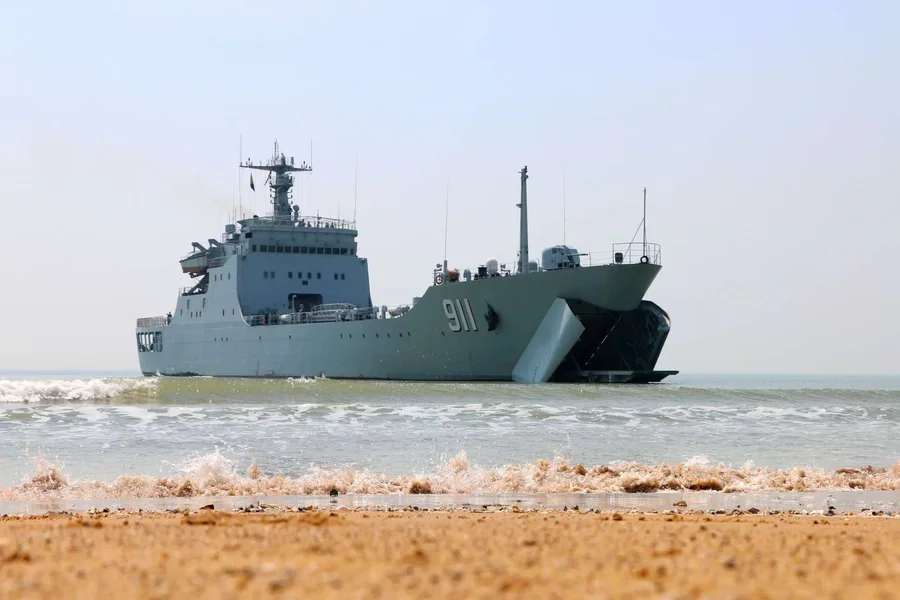
The Chinese Type 072A landing ship, categorized among large amphibious warfare tank carriers, can transport up to 10 tanks, 250 fully armed troops, two medium helicopters and four landing craft...
A Type 072A amphibious assault ship, which is owned by China, has raised the alarm in Taiwan and is considered a real war threat.
The amphibious ship has approached the northern coast of Taiwan, while the 072A has sparked a new debate over Beijing's amphibious warfare capabilities.
According to Focus Taiwan, the ship was spotted within 60 nautical miles northeast of Keelung, marking an unusually close approach that Taiwan's military sees as part of intensifying gray zone activities by China.
Taiwan's Ministry of National Defense (MND) stated that the ship did not enter Taiwan's immediate area, but confirmed that the armed forces had closely monitored its movements with naval, air and land assets.
Taiwan's Navy Chief of Staff, Chiang Cheng-kuo, acknowledged that the ship's location, northeast of Keelung, puts it within reach of vital infrastructure. Experts have noted that the maneuver appears to be designed to test Taiwan's surveillance and response measures, sending a broader message about Beijing's ability to undertake amphibious operations near Taiwan's major population centers.
The Chinese Type 072A landing ship, categorized among large tank carriers for amphibious warfare, has a displacement of 3,770 metric tons and can carry up to 10 tanks, 250 fully armed troops, two medium helicopters, and four landing craft.
Compared to similar amphibious platforms such as the older Type 072II ships or the smaller Yuting-class ships, the Type 072A offers significantly higher lifting capacity and operational versatility.
Its ability to transport helicopters extends its reach beyond the immediate landing zone, providing added flexibility for the rapid insertion of troops or equipment deep into the ground.
Former Air Force Institute of Technology officer Lin Yu-feng told Focus Taiwan that any landing force deployed from this ship could directly threaten critical military and government facilities in Taipei's Dazhi District, including the Ministry of National Defense and the Joint Operations Command Center.
This scenario highlights Taiwan's vulnerability to multi-domain amphibious operations that could bypass traditional coastal defenses and strike strategic targets deep inland.
Su Tzu-yun, a researcher at the Institute for Defense and National Security Research, noted that while Taiwan must maintain vigilance and readiness to respond, its armed forces must also avoid excessive maritime pursuit that could exhaust the fleet's resources over time.
The MND indicated that it would continue to respond proportionately and adaptively to such movements, using joint intelligence, surveillance and reconnaissance systems to maintain situational awareness.
The maneuver raises larger questions about China’s long-term stance on amphibious warfare and its potential to coerce Taiwan through psychological pressure and gray-zone tactics. With regional actors increasingly wary of these naval maneuvers, this observation reinforces the critical need for Taipei to adapt coastal defenses, improve early warning systems, and deepen regional security cooperation to deter potential amphibious invasions.
Taiwan's military must now weigh how to counter such threats while avoiding depleting its own naval and surveillance assets.
As the balance of power in the Taiwan Strait shifts, each new maneuver serves as a stark reminder that the threat of amphibious assault remains at the core of Taiwan's security concerns, a reality that will continue to shape its defense planning in the years to come. / Adapt Pamphlet/








Lini një Përgjigje