


 Shkruar nga Pamfleti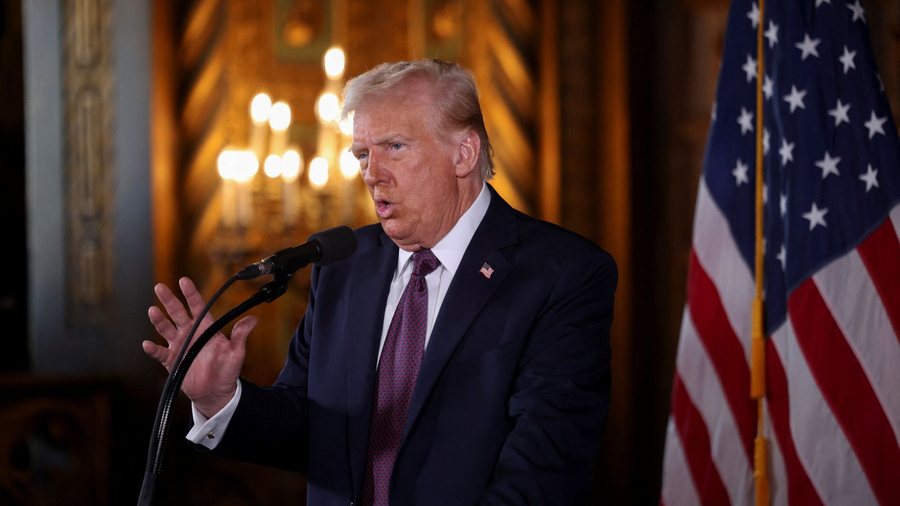
Trump proposed buying Greenland and the Panama Canal by force — and threatened to squeeze Canada economically if it didn't get his way.
US President-elect Donald Trump's threat to turn the world's second largest country, Canada, into part of the United States through "economic force" represents the most serious threat to Canadian sovereignty since the War of 1812.
That conflict, fought over three years, saw the Americans launch 10 separate land incursions into Canada before a peace treaty was ratified in 1815.
The idea that the US would seek to annex its northern neighbor, like the War of 1812 itself, has been consigned to the mists of time, but Trump has now made territorial expansion a key part of his presidency.
In the guise of 19th-century US presidents who bought land or bulldozed their way to the continent's west coast, Trump proposed buying Greenland and the Panama Canal by force — as well as threatening to squeeze Canada economically if it was not done as he said.
" Canada and the United States: That would really be something. We don't need their cars. You know, they make 20% of our cars... we don't need their lumber. We have fields massive lumber ... we don't need their dairy products. We have more than they have ," the president-elect said at his press conference at Mar-a-Lago.
Trump did not campaign on annexing Canada, but since winning the election he has regularly floated the idea of making Canada the "51st state."
In Canada, leaders and analysts have simply laughed their way through the response — or characterized his behavior as a "negotiation tactic."
Outgoing Prime Minister Justin Trudeau dismissed his ineffective charm offensive with these words on X: " There is no way in hell that Canada will become part of the United States ."
Leaders of the country's other major parties have also issued statements in defense of Canadian sovereignty.
Trump's joke is turning into an existential crisis. Canada's 40 million people live, for the most part, within 100 miles or more of the US border, and they have done very well in their relationship with America.
This year, Canada will post a trade surplus of $70 billion, made up of some things Trump mentioned at the press conference (lumber and cars) and some things he didn't (oil and gas), reports "SkyNews".
Canada also gets a good deal from its security partnership with the US. While Americans buy tanks and airplanes and nuclear submarines, Canadians invest their money in schools (among the best in the world), medical care (comprehensive and publicly funded) and pensions (generous and well invested).
Trump called Canadians "good neighbors" at his press conference, but the real estate mogul knows weakness when he sees it and seems prepared to make his neighbors suffer. It poses crucial questions as Canadians prepare for the federal (general) election in the spring. How much pain are they willing to endure?
Meanwhile, Germany and France have warned Donald Trump against any attempt to "move borders by force" after the incoming US president said he was prepared to use economic tariffs or military force to take control of Greenland. administered by Denmark.
In a hastily called televised statement, German Chancellor Olaf Scholz said Trump's remarks had caused "confusion" among European leaders.
" The principle of the inviolability of borders applies to every country - whether it is in the east or in the west - and every country must respect this, whether it is a small country or a very powerful country ," Scholz said, TheGuardin reports. .
Earlier, the French Foreign Minister, Jean-Noël Barrot, said that Europe will stand up for international law.
" There is no question of the EU allowing other nations in the world, whoever they are, to attack its sovereign borders ," he said.
Barrot added on France Inter radio that, while he did not believe the US would "invade" Greenland, we have entered an era that is seeing the return of the rule of the fittest.
For its part, Denmark has said it is open to dialogue with Trump to work together to address his legitimate security concerns when it comes to Greenland, rejecting any threats or coercion. Greenland was a Danish colony until 1953, but is now a self-governing territory of Denmark and in 2009 achieved the right to seek independence through a vote.
Danish politicians hope a confrontation can be avoided by a meeting between top officials from Denmark and the US to discuss any updates required to the many post-World War II security agreements signed by the two countries. The US has a military base in Greenland, Pituffik Space Base (formerly Thule Base), first established in 1941. It provides critical early warning systems needed to monitor Russian activity. Other bases were abandoned in the 1970s. But with the melting of the ice around Greenland, the possibility of opening new trade routes has transformed the importance of the Arctic.
In an hour-long news conference on Tuesday, Trump refused to rule out using military force to take the Panama Canal and Greenland, and also suggested he intended to use "economic force" to make Canada part of the US.
Danish Prime Minister Mette Frederiksen said on Tuesday that she could not imagine Trump's ambitions leading to US military intervention in Greenland. In 2019, she called Trump's demand that Greenland be put up for sale "absurd". Since then there has been a collective decision by the Danish government to try to calm the situation./ Pamphlet



Lini një Përgjigje