


 Shkruar nga Pamfleti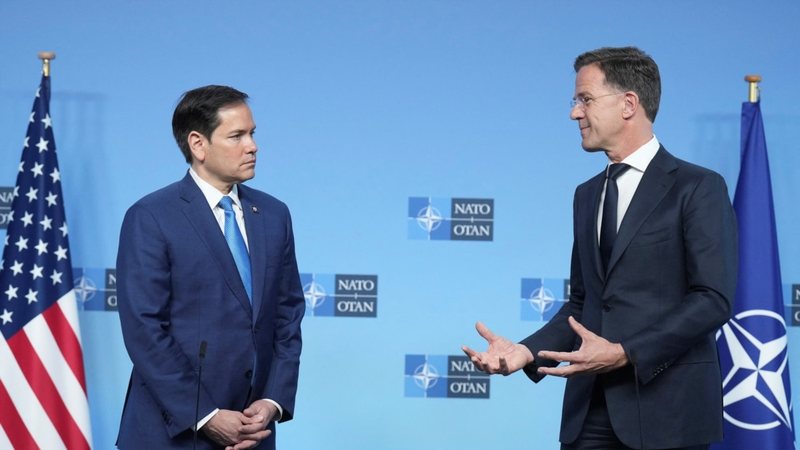
US Secretary of State Marco Rubio said on Thursday that the Trump administration is committed to staying in NATO and called on the 32 member countries of the military alliance to commit to increasing spending in order to strengthen its defense.
Speaking after arriving at a two-day meeting of NATO foreign ministers in Brussels, Rubio said the United States is "more active than ever" in the alliance. He sought to reassure allies worried that US President Donald Trump is damaging transatlantic relations.
"President Trump has made it clear that he supports NATO. We will stay in NATO," Rubio said before entering the meeting.
"We want to leave this meeting having clearly understood that we are on a real path where every NATO member is committed and is fulfilling the promise to reach 5 percent of spending. This includes the US," he said.
Ahead of the meeting, NATO chief Mark Rutte also sought to allay concerns about Trump's commitment to the alliance, saying that, in his view, the US commitment to NATO "is absolutely clear."
"I know there have been some harsh statements. I know there have been allies, for example, on this side of the Atlantic who have been concerned about the long-term commitment of the US to NATO," Rutte said on April 2.
"I know there has been harsh rhetoric. I know there have been allies, for example, on this side of the Atlantic, who are concerned about the long-term commitment of the US to NATO," Rutte said.
"The Americans have repeatedly said: 'We are committed to NATO. We are committed to Article 5,'" he added, referring to the alliance's commitment to collective defense.
"I am absolutely convinced that this alliance will continue to exist with the US. Their commitment is absolutely clear," Rutte said.
NATO allies are determined to present a united front to oppose Russia's full-scale invasion of Ukraine, but European allies are feeling their efforts are being marginalized.
In seeking a quick ceasefire agreement, Washington has suggested that Ukraine may have to make territorial concessions. The US has also taken steps to resume dialogue with Russia.
Rubio could face questions from allies who are alarmed, angry and confused by President Donald Trump's administration's moves to improve relations with Russia and its verbal attacks on longtime transatlantic partners.
Based on what they have seen and heard since Trump took office in January, European officials have expressed deep concerns about the future role of the US in the Western military alliance.
Rubio is likely to be pressured to explain Trump's expressed desire to make NATO ally Canada the 51st U.S. state, as well as his attempt to annex Greenland, which is an autonomous territory within the Kingdom of Denmark, another NATO ally.
Rubio arrived in Brussels on April 3. He will be accompanied in Brussels by the newly confirmed US ambassador to NATO, Matt Whitaker.
He is expected to convey the message that European allies should increase defense spending and share more of the financial burden.
In June, NATO leaders are expected to decide whether to raise the defense spending target for each member from the current minimum of 2 percent of gross domestic product.
The Trump administration has floated the idea of a minimum of 5 percent of gross domestic product. Meanwhile, Rutte is pushing the idea that each ally commit to spending at least 3.7 percent on defense as soon as possible, and have regular reports on progress.
But some European allies will be hesitant to commit quickly to large defense spending, given that they are facing slow economic growth and rising budget deficits.
Sybiha is expected to brief her counterparts on the latest information regarding the situation on the battlefield.
Ukraine's membership in the alliance is not on the agenda at the moment, but most European allies are interested in at least ensuring that American weapons will continue to be sent to Ukraine and that NATO's training mission for Ukrainian soldiers will continue to operate.
So far, everything is continuing as before. There has been no change in the position of American troops on NATO's eastern flank.
What has changed, however, is that the US no longer chairs the Contact Group for the Defence of Ukraine, known as the Ramstein Group, which coordinates military support for Kiev. The UK chaired the group's last meeting in February, and the next meeting, scheduled for April 11, could be co-chaired by the UK and France./ REL


Lini një Përgjigje