


 Shkruar nga Pamfleti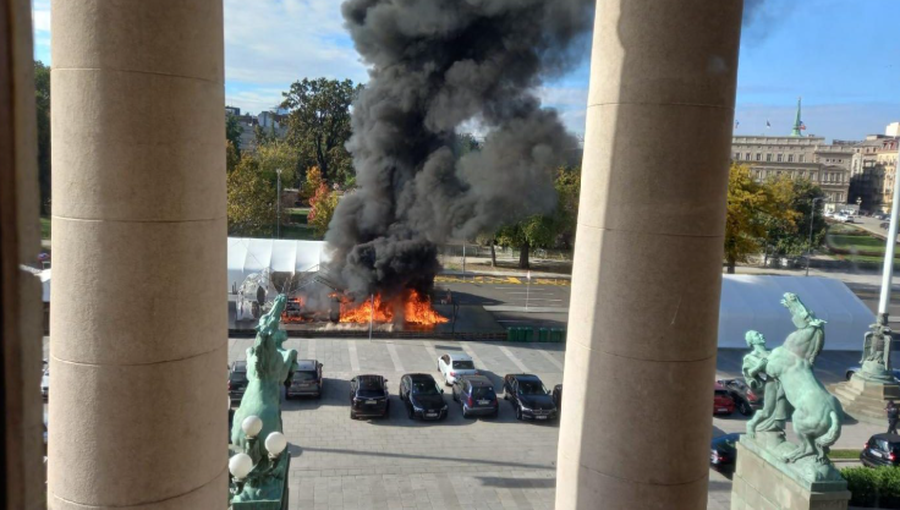
Flames and bullets in front of the Serbian Parliament; Belgrade burns, the state is silent...
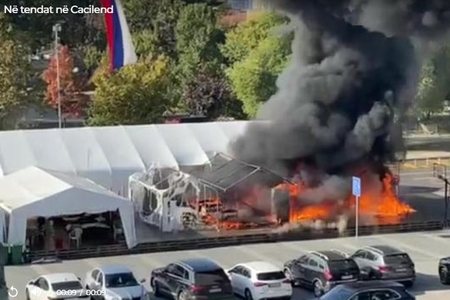
Belgrade woke up this morning to scenes resembling a war scene; huge fires, gunshots, panic and a delayed reaction from the state. All of this happened in the heart of the Serbian capital, in front of the Serbian Parliament building, in the area known as "Ćačilend", a tent camp that has long become a symbol of resistance, protest and also urban anarchy. The fire broke out at around 10:17 am and engulfed several tents, while gunshots were also heard at the same time.
According to initial reports, one person was shot in the leg, while at least one other person was detained by police. Authorities stated that the cause of the fire was an exploding gas cylinder, but witnesses at the scene and opposition figures cast serious doubt on this version.
According to them, the area has long been outside the full control of state institutions, with the presence of armed individuals and elements that behave like a "state within a state."
What makes the situation even more alarming is the location of the incident; in front of one of the most important state buildings in Serbia. This is not just a matter of public order, but a profound issue of national security. When tents are burned and people are shot in front of the Parliament, we can no longer talk about isolated incidents, but about a clear symptom of the degradation of the state and institutional authority.
The Serbian media and public are divided in their reactions; some consider the incident to be a result of negligence and lack of control, while others see it as a reflection of the deep political and social tensions that have gripped Serbia.
The "Ćačilend" camp has been established by protesters, activists, but also by various groups seeking space for their causes. In this social mosaic, an institutional control or oversight mechanism has often been lacking.
The opposition has accused the government of negligence and deliberate silence. According to them, the presence of weapons in such a public space, in a place loaded with political symbolism, is an indication that the state either will not, or cannot, act. This is a dangerous message for public opinion and for stability in the region, especially when Belgrade expects to play a key role in the negotiations on Kosovo, in relations with the EU, and in the stability of the Balkans.
In terms of symbolic and political consequences, this event is not just an urban incident, but a national alarm. A state that does not guarantee order and security in front of its Parliament cannot claim to have the capacity to lead regional dialogues or be a factor of stability in the Balkans. Albania and other countries in the region should read this event as a signal that Serbia is in a moment of internal tension, which may also manifest itself in its foreign policy.
So far, neither President Vučić nor the Ministry of Interior have come up with a full response, which only adds to the uncertainty and doubts about the state's capacity and will to control the situation.
Serbia is burning in front of the Parliament. The fire may be extinguished, but the wound it causes to the institutions is deep and open./ Pamphlet






Dmth kjo ngritja e tendave qenka zeje e ketyre sllave qe na ngriten edhe nje ne Tirane. Pra cfare na Kurdistan ne me kelyshet e tyre të UDB u ra vete ne koke.