


 Shkruar nga Pamfleti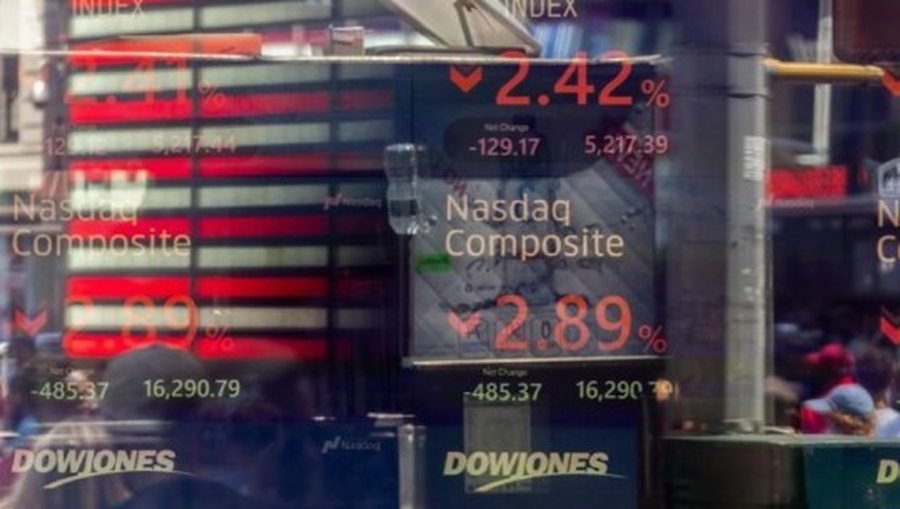
Japanese shares rose on Tuesday, leading gains in financial markets across Asia, after a surprise drop in stock markets following the previous day's global sell-off*.
Earlier, European shares also recovered some of their losses.
Japan's Topix index closed 9.3% higher and the Japanese yen stabilized at around ¥145.70 against the dollar after strengthening sharply in recent weeks. The Nikkei 225 of heavy technology companies rose 10.2%.
European shares posted steady growth, with the region-wide Stoxx Europe 600 index improving by 0.2%. U.S. futures** show signs of a modest rebound when markets open in New York. The contracts, which track the S&P 500 and Nasdaq 100, traded 0.8% higher.
The return to relative calm comes as global markets tumbled in recent days amid fears that the Federal Reserve has been too slow to respond to signs that the US economy is 'cooling off' and that it may be forced to move quickly to reduce of interest rates, to follow the pace of international financial markets. Japan's stock market was hardest hit, falling more than 12% on Monday, days after a surprise rate hike by the Bank of Japan.
Tuesday's dramatic recovery in Tokyo was so intense that trading in Nikkei and Topix futures was automatically suspended during Tuesday's morning session.
“A big down day, then a big up day. No one has ever experienced such a crazy market," said Takeo Kamai, head of execution services at CLSA in Tokyo.
"While the market has recovered strongly, the biggest uncertainty remains – whether the Bank of Japan can raise rates again this year and whether the Fed will cut them."
The global sell-off has been worsened by the so-called yen trade problem, in which traders took advantage of Japan's low interest rates to borrow yen and buy riskier assets.
"Fundamentally, nothing significant has changed for the Japanese economy." said Ray Sharma-Ong, head of investment solutions for Southeast Asia at Abrdn.
The effects carried over to other Asian markets. South Korea's Kospi index rose 4.2% on Tuesday. Taiwan's stock index, which had its worst sell-off on record on Monday, closed 3.4% higher while chipmaker TSMC rose 8%.
Asian markets had "overreacted" to US economic risks and geopolitical tensions in the Middle East, South Korean government officials said. They pledged to take swift action to stabilize the market in the event of excessive volatility. In Seoul, chipmakers Samsung Electronics and SK Hynix rose 2.2% and 4.4% respectively.
On Tuesday, a broad range of stocks in Tokyo rose, led by soy sauce maker Kikkoman, whose shares rose more than 20%. Car maker Honda rose more than 14% and semiconductor equipment maker Tokyo Electron rose more than 16%.
The BoJ's interest rate hike last week pushed the yen higher and triggered a three-day selloff in stocks, culminating in Monday's dramatic decline. By Monday's close, the Topix had lost all of its gains for the year after hitting an all-time high on July 11.
Traders and analysts scrambled to explain the extremeness of Monday's selloff. "There must be some forced or technical selling as the fundamentals did not change by 11-12% over the weekend," said Kiran Ganesh, multi-asset strategist at UBS. He added that he saw a sharp selloff as a buying opportunity.
Others, including Nicholas Smith, Japan strategist at CLSA, pointed to the exaggerated influence of algorithmic trading programs, which may have specifically responded to the yen's recent sharp move higher.
"It seems like they are related to the yen," Smith said. "After all the excitement about the prospects of artificial intelligence (AI), it now appears that AI may have gotten us into this mess." /Monitor






Lini një Përgjigje