


 Shkruar nga Andi Bushati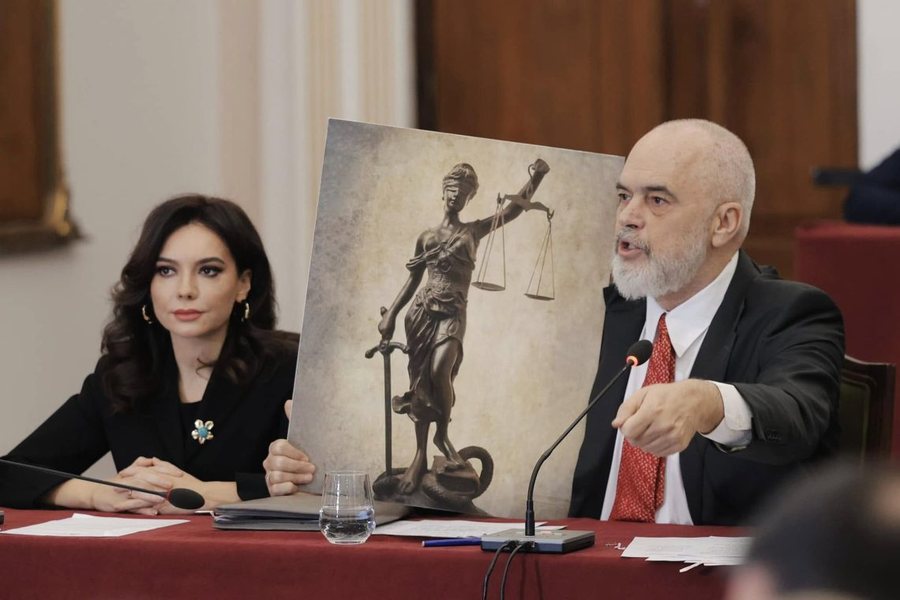
Edi Rama himself creates such "mis en scene" to use for his own political purposes of the day. This could also be the case with the recent controversy with the justice system.
Almost the only controversy that Edi Rama produced during his vacation, withdrawn to his villa in Dhërmi, was the attack on an administrative judge, who had dared to make a decision against the next action to free up public spaces.
By suggesting that Klarent Demiri might have been lured by bribery to protect a “land of the khan”, the prime minister automatically incited the fury of his political opponents and media critics, who saw this attack as a brutal intervention against independent justice. These reactions were also increased by the fact that this was a repeated refrain during the summer. The chief executive had done the same thing with the Shkodra prosecutor, Elsa Gjeli, for the demolition of buildings in Theth and Demir’s colleague, Hazbi Balliu, who decided to block the confiscation of a palace by the government.
In fact, these rants by Edi Rama are far from being alarming, as his opponents or critics present them. I do not say this simply as a defender of the idea that judicial decisions should be criticized or prejudiced. That is true. So, just like anyone else, the prime minister of a country has the right to disagree with a court decision, to express his disapproval in words, despite the fact that he may be formally obliged to implement it. There is no debate here.
But personally, I see what was considered Rama's offensive against justice as a ridiculous attempt that should be ignored. And this for at least three reasons.
First, because such an episode, with much more dramatic proportions, also took place when SPAK requested the arrest of Erion Veliaj and the court formalized it. Everyone remembers how, in early February, the prime minister played the role of the upset one, published dozens of statuses and videos and acted in that scene where he banged his fists on the table, calling Lali's file a "detective novel" compiled by some "off-the-rails" prosecutors.
The climax of the drama came when he shed tears over the fate of Ajola Xoxa's son, saying: "The judge has reached the point of sentencing the mother of a 6-year-old child to house arrest after the father was taken there (to prison - Lapsi.al note). The question is not only who takes and picks up this child from school, but who and how gives this child something to eat"? And in the end he also cried over the plight of the capital: "... the judge has signed to remove the head from the shoulders of the Tirana municipality. Leaving a capital city practically without direction, with 1001 jobs a day, without a trial. This is about a strange investigative process. Very strange...".
We are all witnesses to what happened next. Rama went along with SPAK, stripped Erion of all his titles, refused to delegate his people to the head of the municipality, and purged all his supporters from the parliamentary group. He was so harsh in this sweep that many suspected that the imprisonment, if not ordered by him, was at best coordinated with him. So now, nine months later, we can rightly ask how real was the "attack on justice" of early February? Was it simply a theater to mask the real prisoner of his dolphin? Did it have any effect on intimidating the justice system, which, surprisingly, was more courageous against Erion Veliaj?
This episode is enough to prove that Edi Rama himself creates such "mis en scene" to use for his own political purposes of the day. This could also be the case of the latest controversy with the people of justice. He himself knows that neither Demiri, nor Gjeli, nor Balliu can prevent his sudden order to launch a Maoist-type action throughout the territory. But he has a part of his being that cannot develop politics without having enemies. And perhaps that is why he needs such fake debates. In an environment where he has asphyxiated the opposition to the point of extinction, where he has corrupted the media to the point of perversion, he needs to sell society a contradiction. And that is why he produces unnecessary debates that do not need to bother anyone who digs deeper to understand their purpose.
But there is a third, perhaps more important reason not to sound the alarm, after every fireworks released on the market, that the prime minister is intimidating justice. In fact, he has already caught it. The most important decisions of the high and constitutional courts, the acrobatic twists of SPAK to punish the highest officials for their slightest sins, best prove this. Therefore, whoever blows the trumpets of catching justice, after every fruitless controversy, in fact only brings grist to Rama's mill. He shakes the illusion that the system is still uncaptured, that there are still spaces left within it that need to be protected.
Of course, no one can say for sure whether the three figures who were anathematized by the prime minister acted on their own convictions or not. But even if so, they are few, negligible few, to continue the debate about the risk of the prosecution and judiciary being captured.
This process has already been completed, so it is completely pointless to pay attention to the stones that Edi Rama throws into the river from time to time. ©Lapsi.al






Lini një Përgjigje