


 Shkruar nga Pamfleti
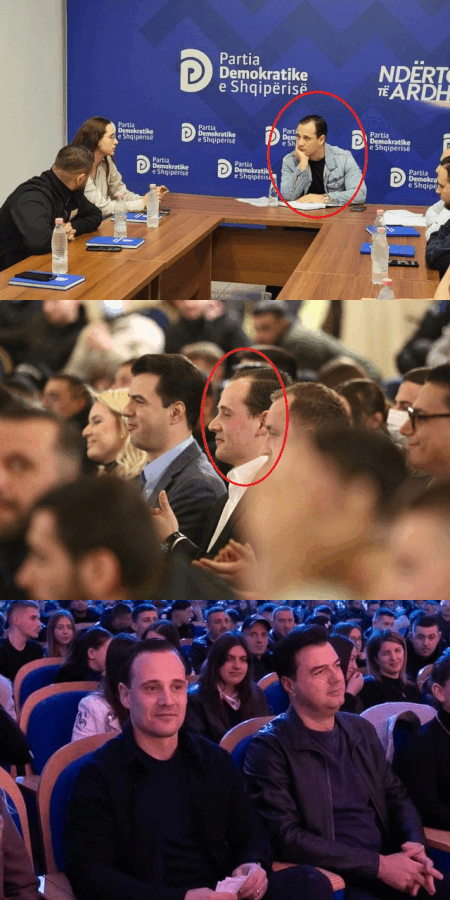
The elected MP of the Democratic Party, Klevis Balliu, has stated that the new Criminal Code represents one of the most worrying acts of this political period.
He states that under the guise of penal reform, there is an attempt to transform the law into an instrument of total control over society.
"Under the guise of penal reform and improving the justice system, there is a deliberate attempt to transform the law into an instrument of total control over society, through the suppression of active citizenship, critical thinking, freedom of expression and any form of civil opposition," said Balliu.
According to him, the proposed Code is not a legal reform, but adds that this proposal is a sophisticated political project to legalize fear, codify oppression, and guarantee the survival of power through legal means.
Full reaction:
The new Penal Code proposed by Edi Rama's government represents one of the most worrying acts of this political period. Not because of its formal legal nature, but because of the political purpose it conveys and the long-term consequences it produces. Under the guise of a penal reform and improvement of the justice system, there is a deliberate attempt to transform the law into an instrument of total control over society, by cracking down on active citizenship, critical thinking, freedom of expression and any form of civil opposition.
This legislative initiative, built and promoted with the usual rhetoric of “modernization”, is essentially a legal engineering that aims to guarantee criminal shield for the political elite and, at the same time, to toughen punishment for the ordinary citizen. It is impossible not to notice the dual nature of this code: on the one hand, a regime of severe penalties for violations that elsewhere in Europe are treated with administrative measures; on the other, a tacit and facilitative tolerance for corruption, abuse of power and waste of public funds.
Even more worrying are the provisions that create legal premises for the review and mitigation of sentences for individuals convicted of serious criminal offenses — including murderers and exponents of organized crime. These are not mere technical deviations; they are well-calculated moves that consolidate a silent alliance between the government and criminal networks, rewarding the latter with concrete favors in exchange for their political and electoral loyalty.
The most alarming aspect of this project is undoubtedly its ideological content. Through vague formulations and dangerous references to public order, it aims to criminalize protest, limit the right to organize, and indirectly restore totalitarian concepts such as “agitation and propaganda.” This is a direct attack on free speech and political pluralism, an attempt to recreate a regime where any criticism of the government is interpreted as a criminal offense and, consequently, as a threat to national security.
In this reality, Albania no longer deals with a functional system of the rule of law, but with a model of ideological control similar to the authoritarian regimes of Latin America, where the law is used to oppress, not to protect.
The proposed code is not a legal reform; it is a sophisticated political project to legalize fear, codify oppression, and guarantee the survival of power through legal means. It represents a blatant distortion of the constitutional order, an attack on equality before the law, and a flagrant positioning of the citizen in the face of a repressive state, where he is punished for a banner while the corrupt politician enjoys complete impunity.
If this code is approved, Albania will face a new political and legal regime, where the law will no longer be a protector of individual rights, but an instrument of control and fear. It is the duty of every conscientious citizen, every honest professional, every intellectual and every representative of the opposition not to remain silent. Because in moments when oppression comes dressed in the cloak of law, silence is no longer neutrality – it is cooperation. And at this historical crossroads, civic resistance is not a choice – it is a national duty.




Lini një Përgjigje