


 Shkruar nga Pamfleti
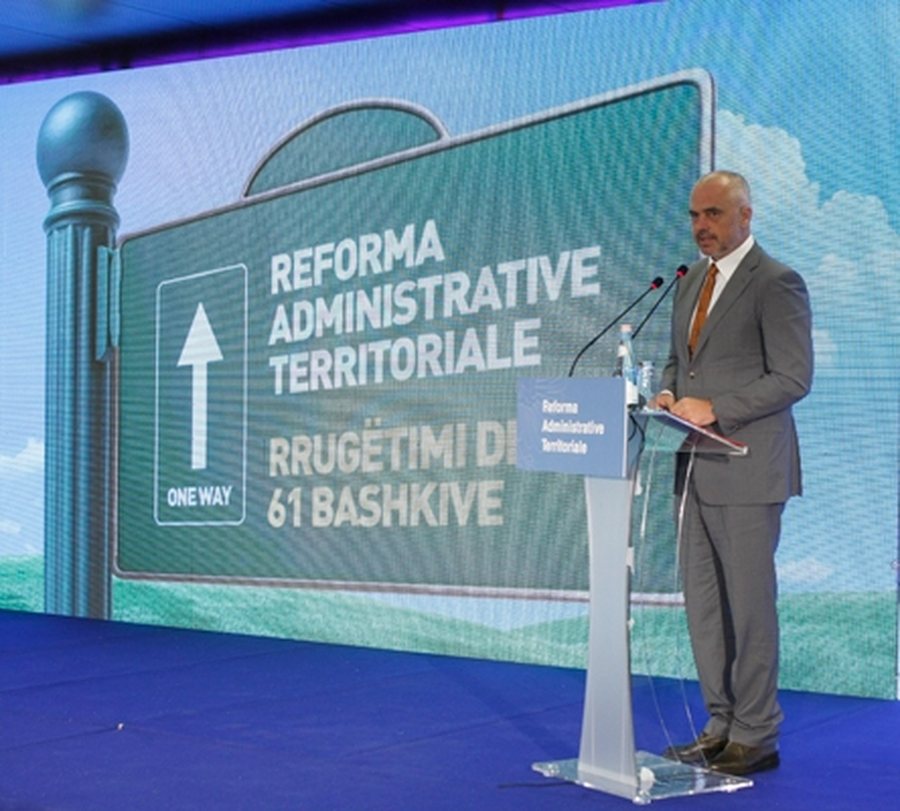
New territorial reform: Albania towards division into 4-5 regions and more municipalities
Although the new Parliament has not yet begun its work, the first contacts between representatives of Edi Rama and Sali Berisha on territorial reform have begun. Preliminary talks describe a new administrative division of the country, which aims to include 4 to 5 large regions and an increase in the number of municipalities compared to the current 61. In this division, some municipalities are expected to merge, others to be divided or to expand their competencies and territory.
One of the biggest innovations is the new status that Tirana is expected to receive. The plan foresees the creation of a metropolitan municipality named "Tirana-Capital", which will have a centralized administration and its own municipal council.
Within this expanded territory, several new municipalities will be created in place of existing administrative units. These small municipalities will have directly elected administrations, but will depend on the main municipality of the capital for investment budgets. Meanwhile, the Tirana Region will cease to exist as a separate unit. The inclusion or not of Kamza within this structure is under discussion. Vora, Kavaja and Rrogozhina will be completely separated from this central unit.
Within Tirana, the division is envisaged into three or four new municipalities: one covering the eastern area from Sauk towards Elbasan; another including the area of Kashar, Astir and Vora; and a third including the territory from Fresk towards Dajti.
Meanwhile, major changes will also occur in other regions.
In Shkodra, it is expected that Velipoja and the Nënshkodra area together with Bushati will become a separate municipality, while Vau i Dejës will be dissolved and its territory will be taken over by the municipalities of Shkodra and Puka. Fushë-Arrëzi will merge with Puka. There will be no changes in Kukës. In Dibër, the merger of Klos with Mati and Bulqiza with Peshkopia is expected, due to the significant decrease in population and income.
In Lezha, the creation of two municipalities is envisaged: one with Zadrima, the city and Shëngjin; and the other with the territory of Kuna up to the border with Kurbin. Kruja will be divided into two municipalities: Kruja and Fushë-Kruja.
In Durrës, the area of Ishmi and Gjiri i Lalzi will pass to the new municipality of Sukthi, while the city will remain a separate unit. Kavaja is expected to expand to include Rrogozhina; Peqin will take some territories from the Peza hills. Elbasan could be divided into two municipalities, including Labinot. Librazhd and Përrenjasi will merge into a single municipality.
In Korça, Voskopoja and Dardha will merge into one municipality, Maliqi will expand with several villages of the Korça plain. Devolli will remain a separate municipality, while Erseka and Leskovik will be divided into two municipalities. In Berat, no changes are expected, the municipalities of Berat, Skrapar, Kuçovë and Dimal will remain. Lushnja and Divjaka will remain as they are. In Fier, the creation of the municipality of Apollonia is envisaged, which will include the coast of Fier.
Vlora, Saranda, Himara and Finiqi will remain in the current structures. Gjirokastra will be freed from several rural units, expanding Libohova. Dropulli will remain a separate municipality. Tepelena and Memaliaj are expected to merge.
The new regions are expected to be four or five: one in the north, two in Central Albania and two in the south, one covering the territory from Lushnja to Saranda and another from Elbasan to Ersekë. The regions will have separate administrations and will take over the water supply and sewage companies, the directorates of agriculture, education and health. The municipalities will lose the powers for the construction and maintenance of schools, nurseries and kindergartens, a responsibility that will be transferred to the regions.
An open debate remains over how regional leaders will be elected: by direct vote like mayors, or through regional councils elected by parties. Fears that this could produce new political figures have led many actors to prefer the model of representation through party lists.
This new territorial reform, which is being discussed behind the scenes by both political camps, aims to be finalized well before the 2027 local elections, to create a new structure of administration and control over the territory, reformatting the political and institutional map of the country./ Pamphlet



Lini një Përgjigje