


 Shkruar nga voxeurop.eu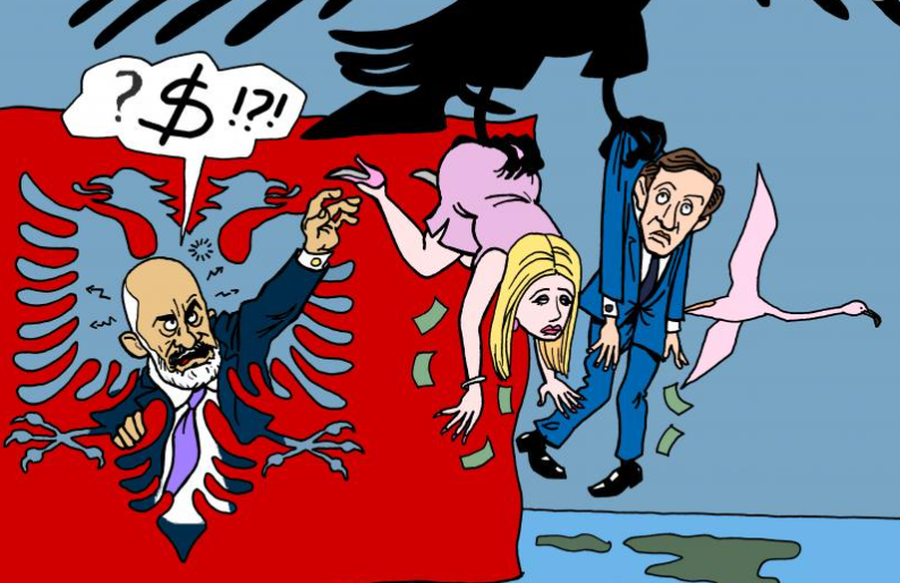
When plans to develop a protected island in Albania, backed by Jared Kushner, Donald Trump's son-in-law, sparked mass protests, something unexpected happened: a generation that was preparing to leave the country decided to stay and fight.
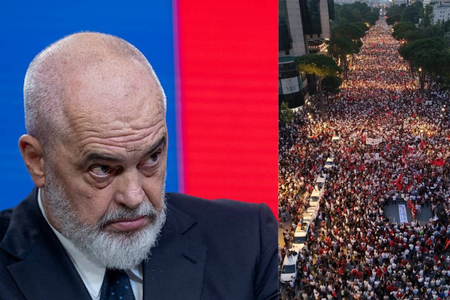
On May 30, protests erupted in Albania that quickly became known as the "Flamingo Revolution," transforming into a much broader movement than a simple civic reaction.
The first spark came from plans for large-scale development and construction on the uninhabited island of Sazan, as well as from intentions to encroach on the coastline of Narta and Zvërnec. These projects were mainly supported by American investor Jared Kushner, son-in-law of US President Donald Trump.
Without party involvement and led mainly by young people born after the fall of the communist regime, the movement united people of different political persuasions, both at home and abroad, around a single idea: development cannot be accompanied by mass emigration, political nepotism, and decision-making closed to the public.
The case of the investment in Sazan summarizes the main contradictions of today's Albania.
On the one hand, the country is promoted as the “new Adriatic Riviera.” On the other, society faces a massive exodus of young people, a housing crisis in big cities, and deep regional inequalities.
Official Tirana moves between two pressures: to protect the environment, guarantee public hearings and fight corruption, but at the same time to attract foreign investment without obstacles.
This clash between proclaimed European values and an aggressive development model with Balkan features is seen as one of the main factors in the political crisis taking shape in the country.
Government collapse?
Ervin Goci, activist and lecturer at the Department of Communication and Journalism at the University of Tirana, says that the protests began as a reaction to the loss of hundreds of hectares of land protected by urban plans, but today have expanded into a larger political demand: the resignation of the government.
Speaking about the European integration process, Goci adds that Albania is at a crossroads of uncertainty, but emphasizes that this does not stem from the citizens, who according to him clearly know what they want.
The problem, according to him, lies in certain political, economic and criminal interests that do not really want EU integration, or support it only superficially.
He also criticizes an approach that, according to him, treats integration as a “political bargain”, where membership is sought without accountability for the rule of law. According to Goci, the protest would not have reached this scale without a profound social change: the transition from apathy to civic organization and solidarity, which took place outside institutional control.
"Flamingo represents a new internationalized Albania, but with an alternative and modern identity, in contrast to the official tourist image of the country. Through this movement we are showing that we are not spectators of corruption and organized crime, but masters of our wealth."
"We don't use the national flag because it divides us. Meanwhile, the flamingo has universal symbolism and builds bridges across borders. It is the symbol of the 21st century Albanian in a global world," he says.
People of the protest
Besiana Guri, founder of the environmental organization “Lumi,” has been part of the movement since day one. She says the “Flamingo Revolution” was born from the citizens themselves and that the flamingo symbol was chosen because it represents a species threatened by development projects in coastal areas.
According to her, the movement has united people with different concerns, including those seeking a profound change in the political system and a break from the long post-communist transition.
Guri explains that the main demands of the protesters are related to a new way of governance: more transparency, participation in decision-making and real listening to the voice of citizens. She emphasizes that most of the protesters are young people who until yesterday were planning to emigrate, while now they see an opportunity to stay.
According to her, new political forces could also emerge from this movement, as there is a widespread rejection of discredited elites. "We don't need a leader or a party to lead us; the protest stems from society itself and will produce its own results," she says.
Corruption, black money and tax evasion
A study by the Global Initiative Against Transnational Organized Crime shows that about 59 percent of companies that received construction permits for towers in Albania during 2017-2019 were financed by undeclared or illegal capital.
For the same period, it is estimated that around 1.6 billion euros were laundered in the real estate sector. While a report by the Friedrich Ebert Foundation estimates that between 2015-2024 corruption and tax evasion generated over 8 billion euros in undeclared funds, mainly in construction.
The Special Prosecution Office (SPAK) has launched investigations into property transactions in the Zvërnec area, while banks have frozen suspected funds related to these purchases.
But the "Flamingos" did not remain only in Tirana. Within a few weeks, the symbol of protest spread to the diaspora.
In various cities across Europe - from Athens and Berlin to Vienna, The Hague, Oslo and Bologna - Albanians took to the streets, shouting in unison: "Albania is not for sale!"



Lini një Përgjigje