


 Shkruar nga Pamfleti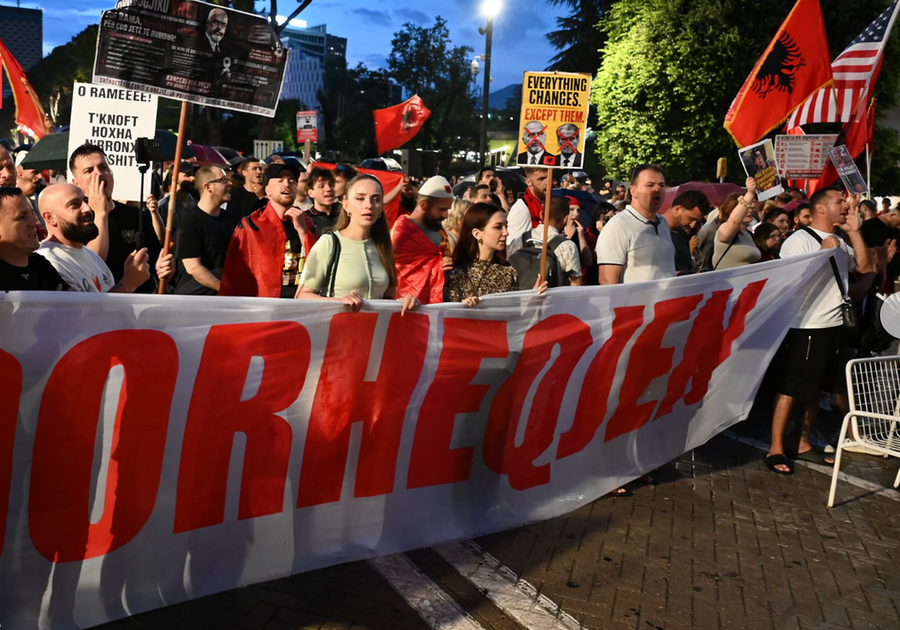
The 25 days that are shaking the old political order...
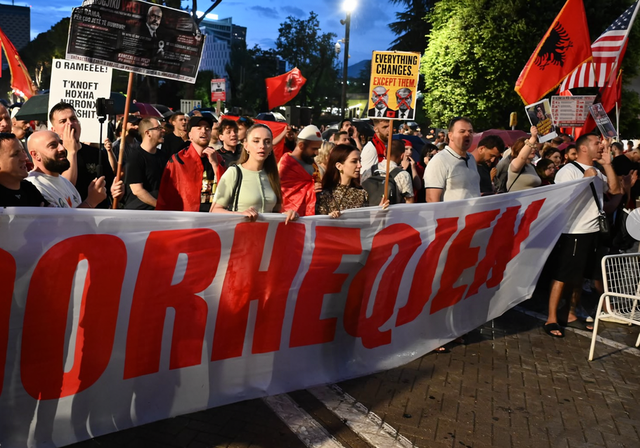
For 25 days, every evening, citizens have been taking to the streets. It started as a revolt against a controversial project in Zvërnec, but it quickly turned into something bigger: a direct clash between citizens and a political system that has lost public trust for years.
For 25 days in a row, despite attacks, labels, pressures and attempts to relativize the protest, citizens have continued to take to the streets. They have marched in the streets of Tirana, raising their voices against corruption, against the arrogance of power and against a political class that, according to them, no longer represents them.
Edi Rama declares that he has no intention of resigning. But the facts show something else. A protest that lasts 25 consecutive days is not ignored. A protest that dominates social networks is not ignored. A protest that has forced the prime minister to gather MPs, ministers and political leaders to order them to jump into the "algorithm war" is not a protest that leaves the government alone.
It is precisely for this reason that the entire political and propaganda machinery has been set in motion. Attacks on protest figures, attempts to shift the debate from demands to individuals, labeling them as "agents," "manipulated," or "incited by others," show that the government has chosen to deal with the messengers because it cannot respond to the news.
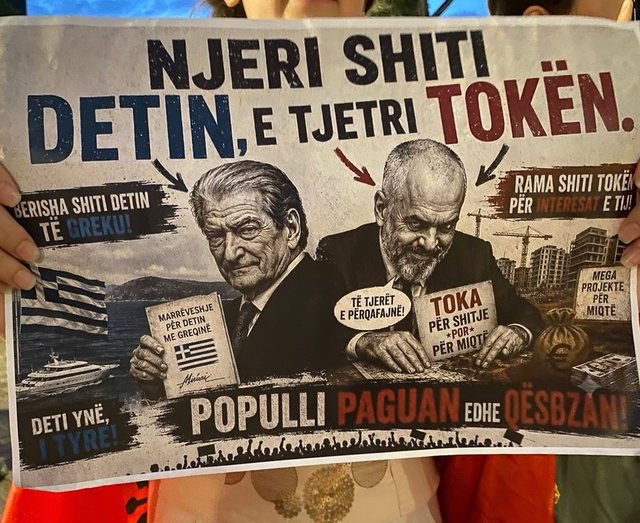
On the other hand, the opposition has also understood the potential of this movement. Sali Berisha has directed his structures to be closer to the protest and has recently expressed support for the protesters' demands.
But so far, citizens have shown that they do not want to become anyone's property. They have not come out to hand power to another party. They have come out with clear demands: the removal of Edi Rama, the creation of a transitional technical government, reform of the political system, and limitation of the prime minister's terms.
This is perhaps the most interesting element of this revolt. For the first time in many years, citizens are refusing to fit into the classic boxes of Albanian politics. They are not cheering for party leaders. They are not demanding rotation among the same names. They are demanding a change in the rules of the game.
Even today, when Tirana was engulfed by heavy rain, thunder and lightning, the protest did not stop. The speeches were interrupted for a while, but the citizens remained in the square. Then the march continued again on the streets of the capital. This is a detail that may seem small, but in fact it says a lot. A protest that is not stopped even by rain, can hardly be stopped by Facebook statuses or political attacks.
Albania has seen major protests in its history, but rarely has a movement that was born outside of parties managed to maintain the same pace for so many days in a row. This is why the government seems worried and the opposition interested.
After 13 years of governance, after dozens of affairs, scandals, accusations of corruption, ties to the oligarchy, the capture of institutions, and the massive departure of Albanians from the country, the dissatisfaction accumulated over years seems to have finally found a form of expression.
No one knows how this clash will end. No one can guarantee that the protesters' demands will be met. But one thing is certain: for the first time in a long time, citizens have stepped out of the role of spectators and entered the field. And this, regardless of the result, is already a victory for democracy. Because the hope of a country is born precisely when citizens refuse to give up. / Pamphlet



Zemra mal, mir shohim kete energji shprese qe buron nga dashuria e shqiptarve per vendin.