


 Shkruar nga Pamfleti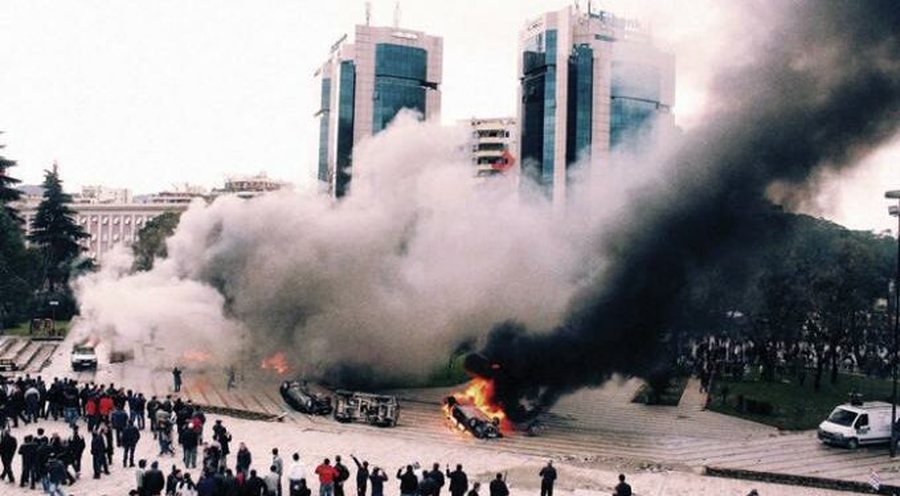
On Tuesday, Strasbourg will come out with a decision on the murder of Alex Nika, the only one who was shot dead in the protest and no one was held responsible for him...
Albanian justice is expected to receive another blow from the European Court of Human Rights regarding the investigations into the massacre of January 21, 2011.
Until today, Strasbourg has made several decisions for the families of the victims, where the government has been forced to compensate them, while it has been requested that they be guaranteed a fair legal process. But despite the decisions, this did not happen.
The last hope is tomorrow. On Tuesday, Strasbourg will come out with a decision on the murder of Alex Nika, the only one who was shot dead in the protest and no one was held responsible for him. The relatives of the deceased, after a lawsuit in 2016, directed you two years ago for the second time to Strasbourg. They consider the investigation into Nika's murder incomplete and therefore filed a lawsuit for the re-opening of the investigation.
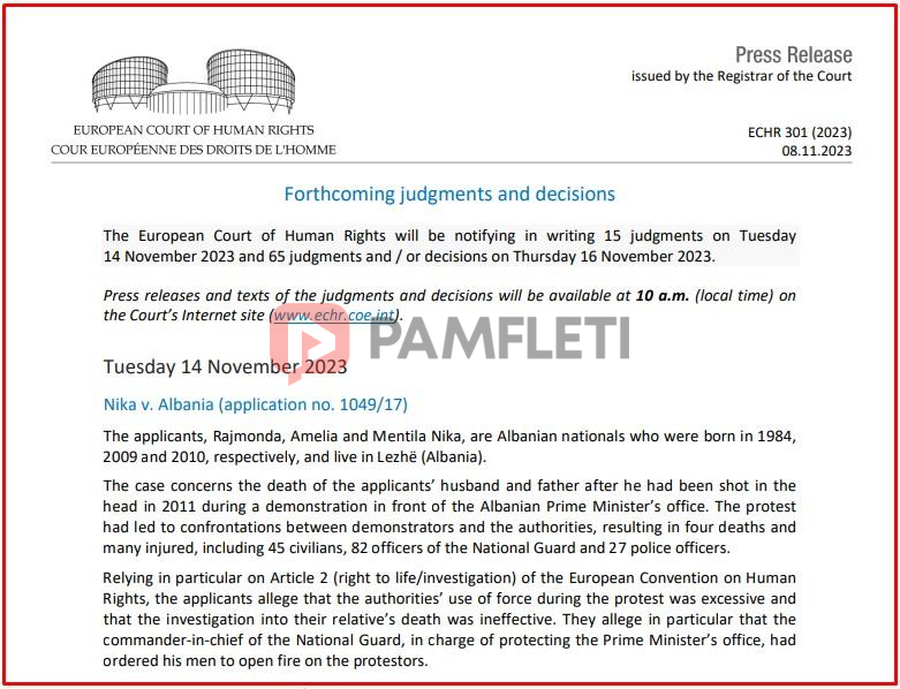
The applicants , Rajmonda, Amelia and Mentila Nika, are Albanian citizens born in 1984, 2009 and 2010, respectively, and live in Lezhë (Albania).
The case concerns the death of the petitioners' husband and father after he was shot in 2011 during a demonstration in front of the Albanian Prime Minister's office. The protest has led to confrontations between demonstrators and the authorities, resulting in four deaths and many injuries, including 45 civilians, 82 National Guard officers and 27 police officers.
Relying in particular on Article 2 (right to life/investigation) of the European Convention on Human Rights, the applicants claim that the use of force by the authorities during the protest was excessive and that the investigation into the death of their relative was ineffective. They claim in particular that the commander-in-chief of the National Guard, in charge of protecting the Prime Minister's office, ordered his men to open fire on the protesters ," the court announced, announcing the release of the decision tomorrow.
Some time ago, Strasbourg asked the Albanian authorities where they are with the investigations and any procedures followed, in order to clarify the incident. The Albanian state has also been asked for information on whether the family members of the deceased had access to the investigative phase of the process, and whether they requested to be included in the process.
The decision comes at a time when the prosecution has blocked investigations. Initially, it was the police that reactivated the file, asking for new expertise and the questioning of witnesses, but the Tirana Prosecutor's Office failed with the investigations. Then it was the journalist Artan Hoxha who released a wiretap where the Guard was ordered to fire on the crowd. The family members filed a lawsuit at the SPAK, but the specials passed it on to the Prosecutor's Office of Tirana, where the investigations continue to be blocked.
From the examples given earlier, Strasbourg is expected to request the reopening of the file. In the case of Ziver Veiz, the same thing was requested.
The young man from Lezha, who was seriously injured on January 21 at around 14:45, died two weeks later in a hospital in Turkey, where he was sent for treatment.
There, the doctors removed the bullet from the body and the projectile was handed over to the Albanian authorities for examination.
The verification of the Scientific Police would make a comparison of the bullet with 75 pieces of automatic weapons and about 60 pistol weapons, all 9 mm, seized from the Guard of the Republic after the events of January 21, but its damage made identification impossible.
The shell was damaged in the shell, the only distinguishing element that serves for the expertise. Based on the marks (traces) left on the projectile from the inside of the barrel of the gun at the time of firing, the identification of the machine gun or pistol that fired is also made.
Regarding the shell damage, the investigators have two versions, but none of them have been confirmed yet.
The first variant is a ricochet of the bullet in the environment, before it hit the victim, and the second version is the bullet damage to the bones of the 36-year-old from Lezha, as the examinations show that the projectile had hit part of his skull. But the investigations have failed to uncover the truth. / Pamphlet


Lini një Përgjigje