


 Shkruar nga Marzia Baldari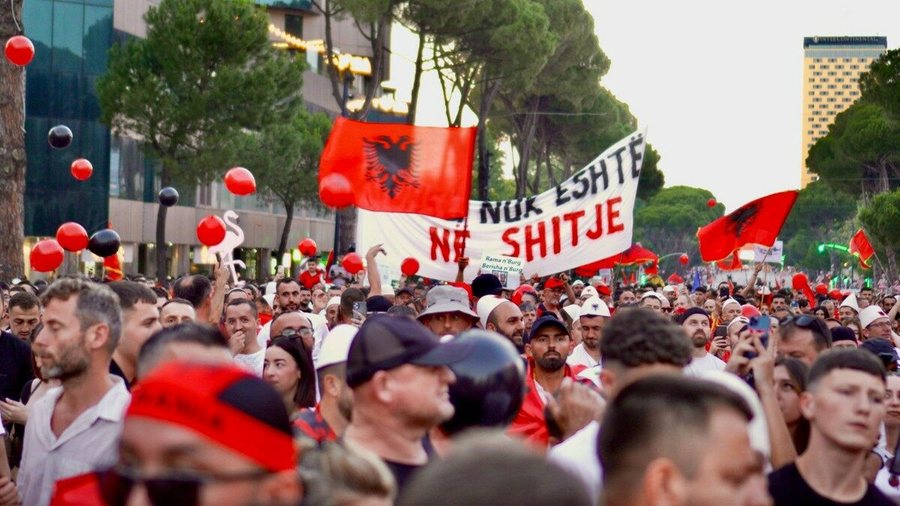
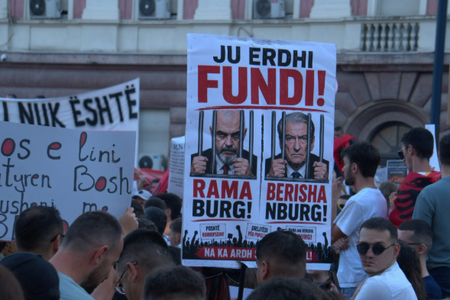
Arrests and clashes are not stopping the largest popular mobilization that Albania has seen in recent decades. In these five weeks, both its ability to spread through social networks and the efforts to delegitimize it have been striking...
“The most important achievement of the protest is what the organizers call the killing of fear. Albanians no longer perceive the power of Prime Minister Edi Rama as untouchable. This psychological change may be the most important consequence of this movement.”
For investigative journalist Jessica Tollia, who has been closely following the “Flamingo Revolution” protests for the investigative portal Shteg for more than a month, this is the turning point of the largest popular mobilization that Albania has experienced in recent decades. According to her, more than political demands, what has changed is the relationship between citizens and the government. Endrin Hysa, 37, of Albanian origin and Italian citizen, shares the same opinion.
He has lived in Italy for years, but when the protests broke out, he decided to join the diaspora and return to Albania to participate in the demonstrations. "Silence has always been one of the greatest evils of this people. For decades, Albanians remained isolated from the world during communism. After its fall, many of them ended up passively accepting a deeply corrupt politics," says the 37-year-old.
Then he recalls some episodes from his childhood: "When I was a child, I lived in Durrës and we all knew that that multi-story building was built by the mafia, and that bar or that other one next to it. For us, the presence of organized crime was something normal," says Endrini.
He adds: “That’s exactly why I always thought that Albania wouldn’t be able to change as long as this collective silence continued. When I saw on Instagram thousands of people taking to the streets, I realized that something extraordinary was happening. For the first time, I saw Albanians freed from fear. And I had to be here!”
His story also demonstrates another distinctive element of the Flamingo Revolution: its ability to spread more through social networks than through traditional media.
"This is a non-traditional protest," explains journalist Tollia. "It relies heavily on social media and uses communication methods typical of younger generations. Anyone with a smartphone and an internet connection can publish a video that can go viral within hours," she emphasizes.
For this very reason, according to Tollias, the movement has never been dependent on coverage by traditional, national or international media. “The protest has spread through social media algorithms. And for this very reason, Prime Minister Rama has repeatedly called the algorithm the main ‘culprit’ of the situation that has arisen.”
According to the Albanian journalist, the prime minister has tried to control the narrative from the beginning:
“At first he tried to minimize the protests. Then, when it became clear that they represented a political reality that could no longer be ignored, he began to look for elements to delegitimize them.”
At first, the Albanian prime minister spoke of a “hybrid war.” He claimed that the movement was influenced by Russian or Iranian interests. When these explanations failed to find support in public opinion, he began singling out individual protesters, publishing their names and photos on his social media channels.
Meanwhile, the climate in the squares is tense. In recent days, there have been clashes and several arrests by the police. However, one of the most repeated calls continues to be: "The police are with us!".
"The use of force cannot be justified by saying that some protesters threw flour or eggs at the vehicles of the deputies," says Tollia. According to her, so far there has been no institutional reaction to the violence denounced by some of the arrested.
"We have seen people who were already neutralized and lying on the ground being hit with rubber batons. These episodes of violence have been immediately incorporated into the government's narrative.
"It was predictable that these incidents would be used to strengthen the government's version. And that is exactly what is happening. Some communication experts believe that the Socialist Party is pursuing a coordinated strategy of disciplining the message," says Tollia.
However, according to the journalist, the clashes have not damaged support for the protest.
"The national protest of July 4, which brought thousands of people to the streets, showed that this movement continues to mobilize citizens just as it did on the first day. The images of parents bringing their children to the protests, sitting them on the asphalt to draw, are the clearest evidence that the majority of participants do not call for violence. They continue to support the movement with the same enthusiasm as at the beginning," the journalist says.
The demands of the thousands of protesters remain the same: a profound political change and the resignation of Edi Rama, who currently has no intention of leaving office. “I cannot say whether Rama will resign or not,” Tollia concludes. “He himself has repeated several times that this possibility is not in his plans. But what I can say is that this protest will have a considerable political cost.”/ Pamphlet from “Il Fatto Quotidiano”



Protesta tregon se regjimi iRamës qenka demokratik…s’ka perkufizim tjetër.