


 Shkruar nga Pamfleti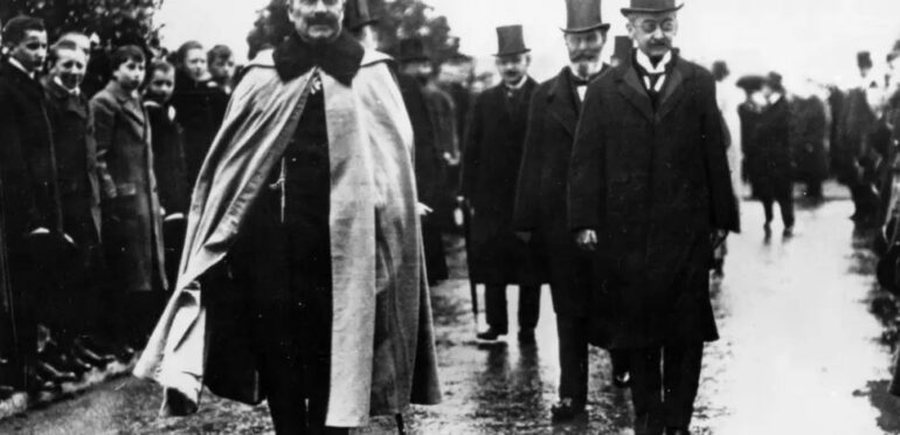
It was a Monday afternoon in December 1912 when the ambassadors of Austria-Hungary, Germany, Russia, France and Italy gathered for tea in the study of the British Foreign Secretary Edward Grey. One of the main topics of the meeting, which in the following months would be repeated and go down in history under the name of the London Conference, was Albania. It was known that the Balkan country, whose people had declared independence almost three weeks ago, would be appropriated. But the question was, what would be the form of this state, its borders and who would lead this nation with a Muslim majority? The German historian Hanns Christian Loehr, in his book entitled "Die Gründung Albaniens - Wilhelm zu Wied und die Balkandiplomatie der Grossmaechte 1912-1914" (Foundation of Albania - Wilhelm Wied and the diplomacy of the great powers towards the Balkans 1912-1914), ed. of 2010, has taken under the microscope the conversations of that time.
The border between Serbia was unnatural
In his book of over 250 pages, Loehr analyzes the diplomacy of the great powers on the eve of the First World War, taking the creation of the Albanian state as an example. By the Albanian state, he does not mean what the majority of Albanians mean, the declaration of independence on November 28, 1912, but the creation that emerged as a result of the London compromise in 1913: So an independent principality under the leadership of the German prince Wilehlm zu Wied and protected by the six great powers.
The negotiations of that time for the creation of the Albanian state, according to Loehr, take on a special importance in European and even world history. Because there the disagreements between the powers were reflected: An example is the reaching of the compromise on the borders of Albania, as a result of which 750 thousand Albanians were left outside the territory: "The border with Serbia, for example, was a very unnatural and unfair border for the people Albanian, but since it was the result of a compromise, it ensured that European peace was preserved for at least two more years and that there was no war between Austria-Hungary and Russia", Loehr said at the time in an interview for DW Albanian.
Austria Hungary in favor of the Albanian state
Austria-Hungary was in favor of a powerful Albanian state that would include all the lands inhabited by Albanians. In this way, Vienna wanted to prevent the exit of Serbia (as well as Russia) to the Adriatic Sea. Austria-Hungary was supported by Germany and Italy, while Russia and France protected the interests of other Balkan states: Serbia, Montenegro, Bulgaria and Greece, which would have preferred to divide the Albanian space between them. That this solution resulting from this bargaining of interests would fail was seen, for example, in the way the construction of the institutions of the new state was planned. "It was also defined in detail how the positions of directors of the Bank of Albania would be divided between the six powers. Such determinations down to the details would become a cause for occasional quarrels" - said Loehr.
German Emperor Wilhelm II against the creation of Albania
The fact that the prince chosen to lead the Albanians was German was definitely not a sign of Germany's special interest in Albania. Wilhelm zu Wied, the prince who was appointed to head the new principality, was elected to the post because he was Protestant and German, so he was thought to be impartial. But he had absolutely no experience with Albania, thus becoming the personification of this weak compromise. The fact that he was German was positive, because Germany had no direct interests in the Balkans. And this is best highlighted by the attitude of the emperor at that time: "Wilhelm II did not even want Wied to go to Albania, nor to have an Albanian state. But it was the diplomats who maneuvered him in this direction. referring to the obligation arising from the alliance with Vienna".
And here is the reason why Loehr, who as a historian has mainly dealt with the kidnapping of works of art during the Nazi era, takes the trouble to do a study on Albania: "Looking at Germany's foreign policy, in the example of Albania, you see that the German Emperor had no power at all. Thus asking the question, who bears the responsibility for the outbreak of the First World War, the answer is that a major part of the responsibility does not bear the Emperor, but the chancellor of the Empire (Bethmann Hollweg)". he says in the interview.
Skandabeg instead of Skanderbeg
So Loehr has proven what he wanted. The question that remains for those who are really interested in learning something new about the history of Albania, is what they can discover in this book. Michael Schmidt-Neke is one of the German historians, who is mostly concerned with the history of Albania of that period. He has read Loehr's book and reviewed it in the scientific journal Suedosteuropa-Mitteilungen (News from Southeast Europe).
In an interview for Deutsche Welle's Albanian program, Schmidt-Neke criticizes the fact that the author only refers to German and Austrian sources. "The book lacks sources from other powers. The scientific literature of the Balkan countries is also completely ignored, not to mention Albanian literature," says Schmidt-Neke.
Schmidt-Neke also regrettably notes that Wied is only discussed in the last seventy pages, so it is not a literal book about the history of Albania in Wied's period, as the title promises. That the author has almost no knowledge of Albania, this is proven not only by the fact that he did not use sources from Albanian literature, but also by the fact that many names of Albanian personalities are written incorrectly, such as: Skandabeg, not Skanderbeg, as Skënderbeu is called from the Germans. But according to Schmidt-Nekes, Loehr is naive when he reproduces the legend that a certain German named Otto Witte, who in 1913 was allegedly proclaimed king of Albania by the Ottomans. "The only source for this tale is the book that Witte himself wrote," says Schmidt-Neke.
Although Hanns Christian Loehr's book has so many shortcomings, for historians it contains many interesting details Diplomatic history and memories of Germany from an Albanian diplomat that can help to complete the panorama of that time. One such is, for example, the fact that there were many Germans who were willing to defend Prince Wied, and one of them was the well-known poet Georg Trackl./DW


Lini një Përgjigje