


 Shkruar nga Pamfleti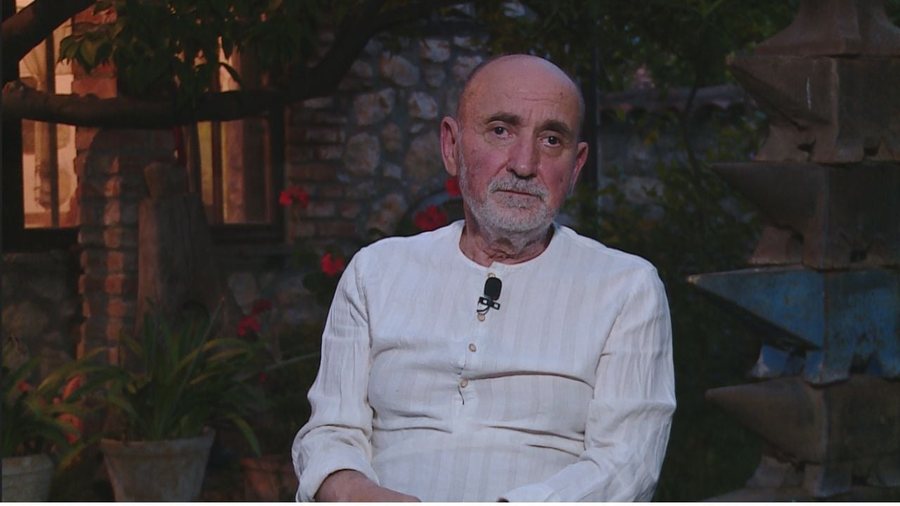
Writer Fatos Lubonja is against the conservation and restoration project of the former Spaç Prison, which began implementation a few days ago under the supervision of the Institute of Cultural Heritage.
As a former political prisoner who served his sentence in the Spaç prison camp, Lubonja states that the restoration of the cultural monument should be carried out according to an archaeological approach, preserving the current structure of the buildings. In an interview with Top Channel journalist Sara Hila, the writer recalled the “Spaç Prison Management Plan”, approved in 2024, which emphasizes that the ruins and existing structures should remain in their current state.
"I have been dealing with the issue of Spaç for a long time, with how Spaç can be preserved. And the idea that I have come across from specialists, not only mine, is the idea that the Santagata Foundation has given in the Management Project, brought by MEKI, where they clearly define the vision of how it should be preserved. They exclude the idea of returning to 1991, it is an archaeological approach. So, the ruins must be preserved, but it must be made accessible, strengthened so that it does not collapse further. Meanwhile, the whole of Spaç will not become a museum. It will be a new building, where the entire history of Spaç will be. Because Spaç was not what it is now, neither in '91, nor in '73. It was originally with barracks. And all this history must be evidenced with testimonies of prisoners, with photos, etc. This is the museum part. The Minister himself approved this vision of the Santagata Foundation, it has been approved as a management plan and now through the Institute of The Cultural Heritage is making a project that opposes this vision and says we must return it to how it was. Only one cell, one room, can be returned to how it was, but not all of it. While those ruins hold history, this is the approach that the Italians also say: archaeological. This is the work of qualified specialists, it is not the work they do. Those buildings, even as they are, speak more than if they were painted with plaster. They have a history. In fact, these 30 years are also part of history, even that inability of Albanians to deal with the past. Because if we had greater sensitivity, we would preserve it as in '91. Massacres took place there. All this massacre is part of history, therefore its preservation has great value, as I said, a brick from that time that has fallen down speaks better than a brick covered with mortar from 2025.
The writer also commented on the plan of director Namik Ajazi and writer Visar Zhiti, who intend to shoot a film after the completion of the first phase of the restoration project by the Institute of Cultural Heritage.
"The city that is there speaks more than the idea they have, which in the end is the idea of making a film, of using it. They want to make the terrace as it was in 73 when the revolt took place, but this cannot be done for a film. It is the same as making a film about the time of the Roman Empire and making the Colosseum as it was. You have to preserve it, not destroy it. I am not against the film, but the film can be made with props, it can be made in another place altogether and released in Spaç. You can build the terrace with boards, with effects, you cannot destroy it there. Imagine that a place where families used to shelter, instead of preserving the material, they have put a plaster on it, they have made a square on the outside. You have to preserve the material above all. The Italians preserve even the stones of the houses when they collapse. In this respect, it has authenticity as it is. Those ruins hold history. Even, even when "I've seen those sketches for those snails, they're not like they used to be. But they also need barbed wire there. They made the snail as if it came out of a Hollywood movie. You can make it identical to how it was, but you've erased all the history. It's an open topic, but the approach that I think is needed, in my opinion, is the archaeological one."
For artist Fatos Lubonja, it is impossible to fade memories of the prison, where political prisoners were forced to perform hard labor and left in poor conditions, including lack of food or physical and psychological violence.
"It is with me every day in my memory and in the processing that I do of it. Every day that I write it, I remember it. Writing is a reliving of life, but in a different form, that you transmit to others. I have the Spaçi that I lived in most vividly in my mind, I see it with barbed wire, with a snail shell, with prisoners... that's how I imagine it. It would be good to preserve it as I said, but destruction is also part of history."
Spaçi was one of the most notorious prisons of the dictatorship in Albania, located in a deep mountainous area in the north of the country, where prisoners were forced to work in copper and pyrite mines in extreme conditions./ TCH





Lini një Përgjigje