


 Shkruar nga Pamfleti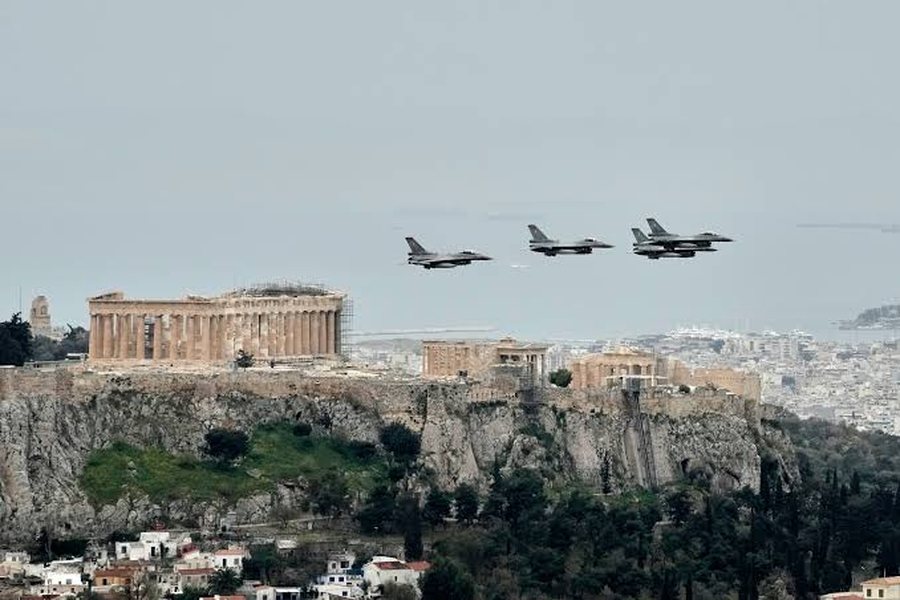
Over the past three decades, Greece has invested enormous sums in the defense sector, spending an estimated 170-200 billion euros on its armed forces.
However, despite these investments, Greek officials continue to argue that the country needs more resources to face security challenges.
This has raised the question of whether the problem is related to the level of spending or to the strategic model that Athens has followed for decades.
Much of Greece's defense policy is built on the perception of Turkey as the main security challenge. Disputes over maritime borders, airspace, Cyprus, and the Eastern Mediterranean have directly influenced the continued increase in military spending.
In 2025, Greece spent about $8.4 billion on defense, or approximately 3 percent of Gross Domestic Product, ranking among the NATO countries with the highest level of spending relative to its economy.
However, critics argue that the problem lies not only in the amount of money spent, but in the way it is used. For decades, Athens has invested mainly in purchasing ready-made systems from abroad.
Rafale fighter jets, Belharra frigates, Exocet missiles, F-16 modernization programs, and other advanced systems have been provided primarily by France, the United States, and Israel.
These purchases have increased the country's military capabilities, but have created a continued dependence on foreign suppliers for technology, maintenance, and modernization.
As modern warfare increasingly gravitates toward drones, artificial intelligence, and cyber systems, this dependence could become even more costly in the future.
The debate becomes more important when seen in the economic context. During the financial crisis that hit Greece after 2008, the economy shrank by more than 25 percent, unemployment reached record levels, and hundreds of thousands of educated young people left the country.
Despite these difficulties, defense spending remained largely shielded from cuts. Even during the COVID-19 pandemic, when the Greek economy suffered a significant contraction, the military budget increased significantly.
This has led many analysts to talk about "lost opportunity costs," arguing that part of these funds could have been invested in industry, technology, scientific research, education, and infrastructure.
According to this approach, if even a fraction of the billions spent on arms imports had been directed towards developing domestic industry, Greece could have built a stronger technological and manufacturing base.
Investments in national drone programs, advanced manufacturing, renewable energy, and partnerships between universities and industry would have created high-value jobs and helped curb brain drain.
The example of Turkey is often cited. In the early 2000s, the Turkish defense industry covered only a small part of the country's needs. Today, the majority of military systems are produced domestically, and the sector has become an important engine of exports, innovation, and employment.
For many observers, this shows that investment in defense can serve not only security, but also economic and technological development. Against this backdrop, Athens has announced a new 12-year modernization program worth 25-28 billion euros.
Unlike previous projects, the new plan pays more attention to strengthening the domestic defense industry. This shows that even the Greek authorities themselves are recognizing that long-term security cannot rely solely on arms imports.
Meanwhile, changes in the international environment make this debate even more important. The European Union is increasingly focused on the war in Ukraine and security against Russia, while the United States is focusing strategic attention on China and the Indo-Pacific region.
In these circumstances, reliance on allies may become more costly and less certain than in the past. In the end, the main question remains open: what does Greece intend to achieve with the hundreds of billions spent on weapons? If the objective is only to purchase new military systems, then foreign dependence will continue.
But if these investments are transformed into a strategy for the development of technology, industry, and human capital, then they can contribute not only to national security, but also to the long-term prosperity of the country.






Lini një Përgjigje