


 Shkruar nga Pamfleti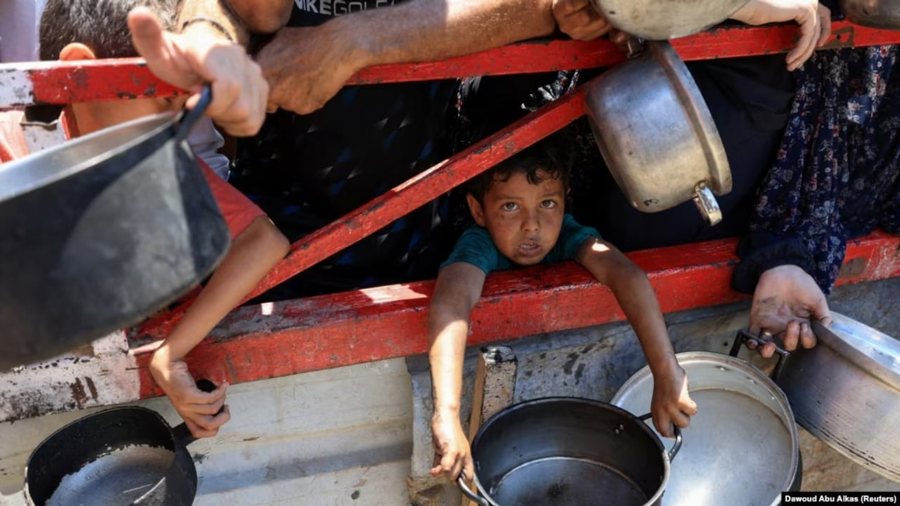
The world's leading authority on food crises announced on Friday that the largest city in the Gaza Strip has been hit by famine and that it is likely to spread to all of Gaza unless a ceasefire agreement is reached and restrictions on humanitarian aid are lifted.
The Integrated Food Security Phase Classification, or IPC, said famine is occurring in Gaza City, where hundreds of thousands of Palestinians live, and that it could spread south to Deir al-Balah and Khan Yunis by the end of next month.
This IPC designation comes after months of humanitarian organizations warning that Israel's restrictions on food and other aid to Gaza, as well as the Israeli military's war, were causing high levels of hunger among Palestinian civilians, especially children.
Israel rejected the IPC's position. Israeli Prime Minister Benjamin Netanyahu called it a "blatant lie."
This is the first time the IPC has officially confirmed a famine in the Middle East.
The IPC report is expected to increase international pressure on Israel, which has been in a bloody war with Hamas since the attack that the Palestinian group, designated a terrorist organization by the US and EU, carried out in Israel on October 7, 2023.
Israel says it aims to escalate the war by retaking Gaza City and other Hamas strongholds, despite experts warning that this would further worsen the hunger crisis.
The IPC stressed that the famine has been caused by fighting and aid blockades, and has been exacerbated by massive displacement and the failure of food production in Gaza, pushing hunger to life-threatening levels for residents across the country after 22 months of war.
More than half a million people in Gaza, about a quarter of the population, are facing catastrophic levels of hunger and many of them are at risk of dying from malnutrition-related causes, the IPC report said.
Last month, the IPC warned that a "worst-case scenario of famine" was unfolding in Gaza, but had not made an official determination.
Netanyahu denies there is a famine in Gaza, calling reports of famine "lies" promoted by Hamas.
"The IPC report is a blatant lie. Israel does not have a hunger policy. Israel has a policy to prevent hunger," his office said in a post on X.
Israel's Foreign Ministry also rejected the findings, saying that over 100,000 aid trucks have entered Gaza since the start of the war, including a large increase in recent weeks.
But experts point out that Gaza is still recovering from the tightening of the blockade from early March to mid-May, when Israel banned the entry of food, medicine and other goods.
"An ever-increasing number of people, especially young children, are dying from hunger and preventable diseases because Israel has made starvation an essential part of the campaign to control the Strip," said Chris Newton, an analyst at the International Crisis Group.
He added that Israel's plan to escalate the war in Gaza City just weeks after warning of the start of the famine shows that "the famine is intentional and that Israel is using it as a weapon."
Netanyahu says more military pressure is needed to achieve Israel's goals: the release of hostages held by Hamas and the ultimate annihilation of the militant group.
How is famine defined?
The IPC said the report published on Friday only includes people living in the Gaza Strip, Deir al-Balah and Khan Yunis districts. It was unable to classify the northern Gaza Strip due to lack of access and data, while the remaining population in Rafah was excluded, as it is largely uninhabited.
The UN has complained about obstacles to the distribution of aid to Gaza, blaming Israel and the insecure situation.
On the other hand, Israel has criticized the UN-led operation and accuses Hamas of stealing aid, which the latter denies.
This is the fifth time in the last 14 years that the IPC has officially declared a famine – an initiative involving 21 aid organizations, UN agencies and regional organizations, funded by the European Union, Germany, Britain and Canada.
The war in Gaza began on October 7, 2023, when Hamas killed 1,200 people in southern Israel and took about 250 hostages, according to Israeli figures.
Since then, more than 62,122 Palestinians have been killed during Israel's war, according to the Gaza Health Ministry, which is part of the Hamas-ruled government and made up of medical professionals.
In addition to this toll, 154 adults have died from malnutrition-related causes since the end of June, when the Ministry began counting these cases, and 112 children have died from malnutrition since the beginning of the war.
The United States, Qatar and Egypt are trying to mediate to end the conflict./REL








Lini një Përgjigje