


 Shkruar nga Andrea Muratore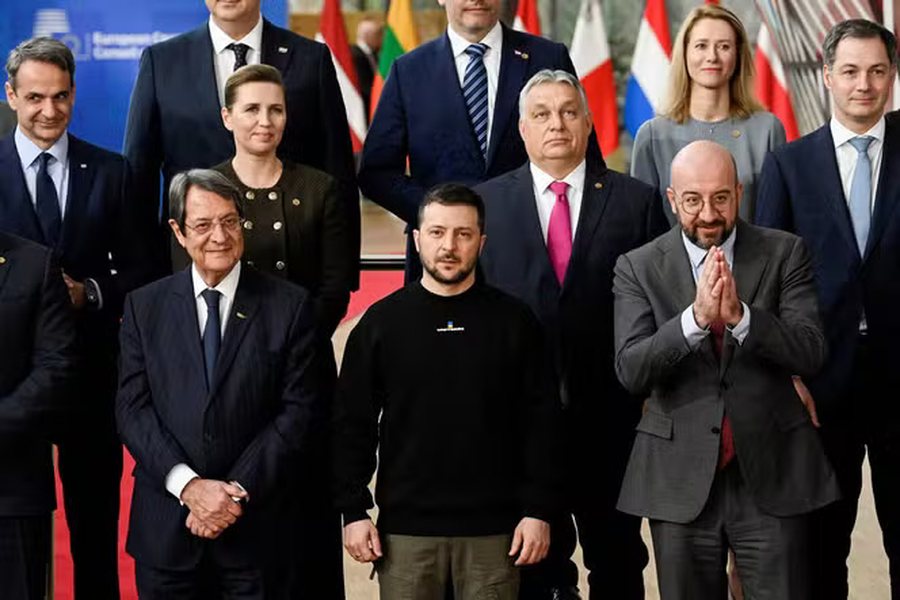
One might think that despite judgments on methods, Trump's America has reached a substantial agreement with Kiev that is less ambiguous than a partnership!
The achievement of a cooperation agreement on the extraction of underground resources between the United States and Ukraine after the third attempt, as its possibility seemed to have faded at the last moment in February and April, has highlighted a big loser: Europe.
In fact, from whatever perspective you look at it, the partnership between Kiev and Washington distances the main countries of the Old Continent from the possibility of a strategic cooperation of the European Union and its member states with a state that has a very important role for economic and geopolitical reasons, and whose evolution after the end of the war with Russia will be, above all, a concern of the bloc.
Kiev has achieved at least three important results, compared to the initial provisions of the agreement. First, the direct link between US assistance to the Ukrainian resistance on the ground and the exploitation of Kiev's mineral resources by the US economy has been broken.
Second, the possibility of American capital investment is considered necessary to expand domestic Ukrainian production. This paves the way for public-private cooperation, which could potentially increase competition and reduce the power of the oligarchs against whom President Volodymyr Zelensky has launched a strong, albeit contradictory, battle.
Third, Washington gains a foothold with which it can influence international markets, especially European ones, for the most important resources of the Ukrainian subsoil.
Moreover, in times of trade wars, it is vital that the United States opens a supply channel of strategic assets for its civilian and military industry, which the trade tariff war with China risks disrupting.
And in a context where America needed this agreement more than in February, when Donald Trump and Zelensky clashed verbally in the White House, this is a quick victory over a Europe that had already signed a declaration of intent with Ukraine to jointly develop the mining sector of the country occupied by Russia for 4 years, but which has never politically encouraged this.
And as the Center for Strategic and International Studies (CSIS) notes, “Ukraine will contribute 50 percent of revenues from the exploitation of new mining, oil, and gas projects,” with one important difference that “current projects, such as those of the country’s largest oil and gas producers, Naftogaz and Ukrnafta, will be excluded from contributing to this fund.”
CSIS emphasizes that “this means that the fund’s profitability will depend on the success of new investments in Ukrainian resources”, with the US investing an increasingly large portion of resources to promote the fund’s investments, which “aim to further stimulate private sector interest in investing in Ukrainian resources and attract the capital needed to rebuild and develop the country’s resources”.
One might think that despite judgments about methods, Trump's America has reached a substantive agreement with Kiev that is less ambiguous than a partnership, which Europe has had 4 years to prove.
In these conditions, it is necessary to ask why countries like Italy, France, Great Britain and Germany have not engaged their large mining and energy companies to forcefully enter such an important sector and to build convergent value chains, strong and capable of uniting Europe and Ukraine in a strategic and economic way.
Now, America will be ready to use this agreement as a geopolitical lever against Kiev, and as an instrument of economic pressure on its European partners, who will have to go through Washington to also benefit from Ukraine's most important underground resources, essential for industry and production.
Another argument against an EU, which due to its own shortcomings, often finds itself out of touch with the rest of the world in terms of diplomacy and foreign policy./ Adapted from "Pamphlet" by "Inside Over"






Lini një Përgjigje