


 Shkruar nga Pamfleti
The cost of a geostationary satellite is $300 million to $400 million.
Elon Musk and rival nations like China and Russia will dominate space if European countries don't act together, the head of NATO's Military Committee told POLITICO.
"There can be no European sovereignty without efforts in space. Today, a great awakening is necessary, even urgent, for Europeans to begin," said the Supreme Allied Commander Transformation of NATO, Admiral Pierre Vandier.
"Americans themselves are calling for a form of emancipation, for Europeans to grow up and be better on a number of topics - and that includes space. This is a huge opportunity," he added.
Russia's war against Ukraine has shown the importance of space assets for battlefield communications and intelligence gathering. It has also highlighted Europe's dependence on a very limited number of American companies - mainly Musk's SpaceX - as the EU's rival IRIS² system is not expected to be operational before 2030.
In parallel, space is increasingly becoming a potential war zone in its own right.
Earlier, the US Space Command described space as "a highly contested strategic environment", specifically referring to China and Russia, while adding that the help of allies will be key to achieving superiority. NATO Secretary General Mark Rutte also expressed concern that Moscow is seeking to place nuclear weapons in space.
"Today, we are seeing a number of players introducing space weapons," Vandier said, citing orbital weapons - bombs placed in orbit that can be dropped on command and evade detection by early warning systems - as well as weaponry aimed at jamming, piercing or knocking satellites out of orbit.
"This means we need to observe much more closely what others are doing and be resistant to their efforts to destabilize us," he added.
New architecture, new business model
"The rapid militarization of space is changing the architecture of the domain - and this requires Europeans to redefine the business model of their companies ," said Vandier.
In space, the military relies on commercial infrastructure, and most satellites and constellations are dual-use, meaning they can serve both civilian and military purposes. To be resilient, he explained, nations can no longer rely solely on large satellites in geostationary orbit and now need backup constellations in low Earth orbit.
Low-orbit satellites are cheaper, between $100,000 and $150,000 each, compared to $300 million to $400 million for a single geostationary satellite. They can also be launched more frequently and at a lower cost.
While Europeans are competitive when it comes to geostationary satellites thanks to companies like ArianeGroup, the so-called New Space market of relatively new space companies is largely dominated by SpaceX, which has driven down launch costs thanks to its reusable rockets.
"The economic model chosen by the Europeans is based on geostationary satellites. Today, the question is: Aren't the Europeans at a point where they need to change their model? From an economic point of view, if they don't do this, I think they will be excluded," said Vandier.
"Today, Europeans are very far from the center of the market. This is a major obstacle because when it comes to European sovereignty, it is overwhelmingly the American offer - whether military or commercial - that provides the services we need," added Admiral Pierre Vandier.
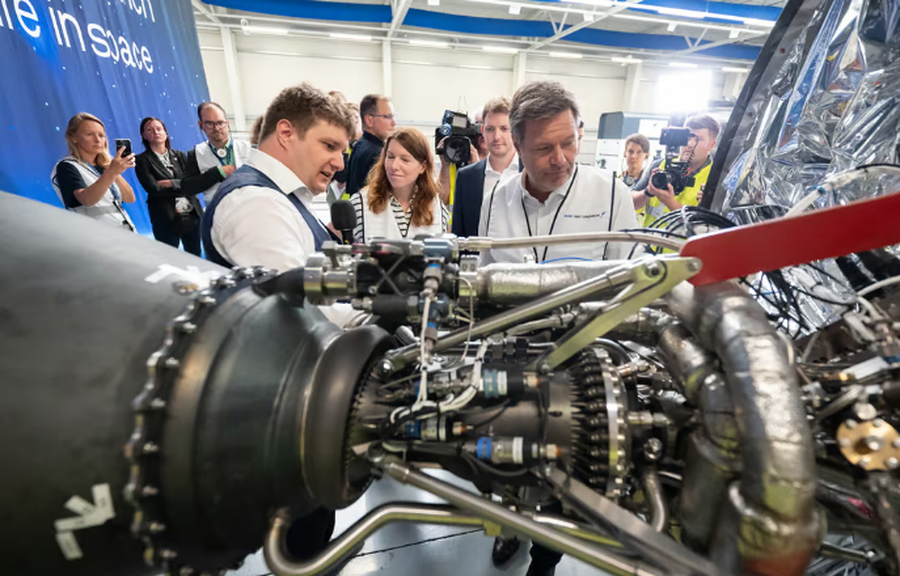
Several European startups are trying to break into New Space, but with limited success. The first launch of the Spectrum rocket by German startup Isar Aerospace exploded less than a minute after liftoff on March 30 from Norway’s Andøya spaceport. Last month, Norwegian defense company Kongsberg launched its first satellite, but via SpaceX.
Vandier knows how Europeans can try to stay in the game. NATO's commander, proposed a European Defence Act to the European Commission. The legislation would create the conditions for the emergence of new defence technology by setting financial, regulatory and tax conditions that encourage new entrepreneurs to develop dual-use technologies for Europe.
He also supports the US call for Europeans to create a space market on their own model, which would allow US Space Command to benefit from commercial technology for space domain awareness and battlefield intelligence.
"The Americans have asked us to work on creating a space market like their Joint Commercial Operations, where you can buy services through speed dating. That's interesting ," Vandier said.
NATO's active role
According to Vandier, NATO is playing an increasingly active role in space, but there is still work ahead to properly divide tasks among allies.
"We are equipping ourselves with the tools we need to understand and maneuver strategically, particularly through space domain awareness. We will be able to see, understand and coordinate actions and say to 32 allies: 'This is what is happening, this is what happened. This is what we call attribution,'" he explained.
NATO, as an alliance, may then decide to take countermeasures.
"This will give us strength: It wouldn't have the same scope or political importance if only France or the United States reacted ," Vandier said.
Besides the United States and France, NATO's main space powers are the United Kingdom, Italy, Norway, Canada and Germany, according to the French admiral.
NATO countries recognized space as a relevant operational domain in 2019. However, this year’s updated capability objectives do not take space into account as much as other domains, such as land, air and sea. NATO must first properly understand what nations can do and what is needed before assigning objectives.
"Countries will either share what is missing, or ask NATO to buy it in the form of services. These remain discussions that will be very interesting in the coming years as part of the next round of NATO's Defence Planning Process. We could also move towards more shared models, such as joint ownership of military constellations of television satellites," he said.
However, in the short term, the admiral does not expect the NATO leaders' summit in June in The Hague to have a major impact on the space issue.
"The big theme will be the 5 percent. It would be nice to have a space declaration, but I don't think we're there yet," he said, referring to US President Donald Trump's demand that allies spend 5 percent of their GDP on defense. / Adapted from "Pamphlet" by "Politico"




Lini një Përgjigje