


 Shkruar nga Pamfleti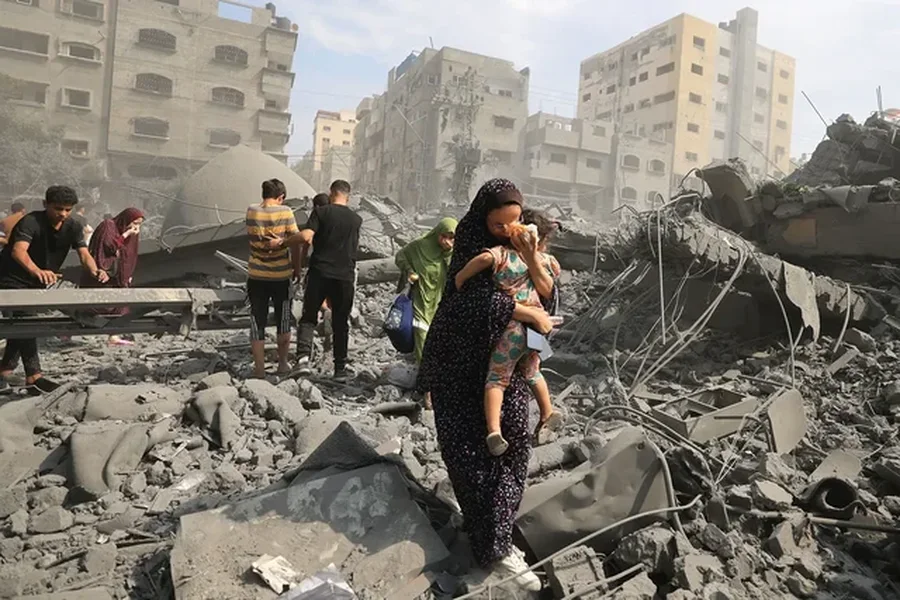
The last three months for Muhammad Ali were a true odyssey in search of security, which does not exist in Gaza. Together with his family, Muhammad Ali had to look several times for a shelter to put his head. His house in Gaza City was destroyed by Israeli attacks, Muhammad writes. "We initially sought protection in the nearby hospital, Al-Quds. When we were told that we had to leave there too, we came to Nuseirat, (in the center of the Gaza Strip). But currently we are in Rafah," he writes. in a message.
Three months after Israel declared war on the extremist Hamas, an organization categorized as a terrorist organization by the US, the EU, and Germany, the 35-year-old engineer fears not only for his daily survival, but also what the future will be like. Not only this, because recently, Israeli politicians, among them ministers of the ultra-right government of Prime Minister Benjamin Netanyahu, question whether the population of Gaza should return there again. "We hope that there will be no forced evictions, that the war will end and that people will return to their homes. Enough with what happened, there must be an end," Muhammad Ali told DW.
Officially, neither the Israeli cabinet nor the expanded security cabinet are in agreement on what will happen to Gaza and its 2.2 million inhabitants after the war. Political discourse in the country is focused on the "elimination" of Hamas, which is responsible for the terrorist attacks on October 7, in which around 1,200 people were killed. And for the release of about 130 hostages still being held in the Gaza Strip.
"Voluntary departure" of Palestinians from Gaza
Far-right politicians, such as Finance Minister Bezalel Smotrich and Itamar Ben Gvir, Minister for National Security, do not hide at all that they envision a future for Gaza without Palestinians and filled with new Israeli settlements. "What needs to be done with Gaza is to encourage withdrawal," Smotrich said recently in an interview with Israeli army radio. "If there are 100,000 or 200,000 Arabs in Gaza and not 2 million, the whole discussion the next day will be completely different." Ben Gvir called for the "voluntary departure" of Palestinians from the Gaza Strip. Other parliamentarians and members of the cabinet have expressed themselves more or less like this. The Israeli media has reported on negotiations with third countries that would be willing to accept the Palestinians, such as the Democratic Republic of the Congo, Rwanda or Chad. But all three of these countries have dismissed these reports as untrue.
Netanyahu: There is no intention to occupy Gaza long-term
Israeli Defense Minister Yoav Gallant has rejected plans for entrenchments by right-wing coalition partners. There will be no "[Israeli] civilian presence in Gaza," says a plan for Gaza's future unveiled in early January. According to him, Gaza should be governed by the Palestinians, the plan says, at a time when Israel is in control of security. Even Prime Minister Netanyahu has made it clear that Israel "does not intend to keep Gaza occupied in the long term or expel the civilian population". Israel withdrew its encroachments on the Gaza Strip in 2005. It has had control over sea and land borders as well as airspace since the militant Hamas violently came to power in Gaza.
The small, ultra-conservative coalition partners are important to keeping Netanyahu's coalition government in power. Their influence on strategic decisions is sometimes controversial. "Israel is more dependent on the US than ever before. This affects both diplomatic relations in the UN Security Council and Israel's national security," says Udi Sommer, professor of political science at Tel Aviv University and researcher invited to John Jay College of the City University of New York. "If you're going to have a forecast for a realistic post-war scenario in Gaza, I'd listen to what the US Secretary of State has to say, not the reckless statements of extremist elements in Netanyahu's government."
There is criticism that public debate in Israel has very little room for the fate of the civilian population in Gaza. An open letter by some former MPs and academics criticizes inflammatory statements against Palestinians by politicians, journalists and parliamentarians. The consternated statements of politicians and ministers have been taken by South Africa as evidence for the charge of genocide that South Africa brought against Israel at the International Court of Justice in The Hague. Hearings were held there recently.
The US and other countries, including Germany, have criticized the far-right's statements as "irresponsible and inflammatory". Antony Blinken in the last visit announced a United Nations mission in Gaza, which should determine under what circumstances the Palestinians can return.
1.9 million people from Gaza are on the run
A potential forced displacement of Palestinians from Gaza is also unacceptable to Arab states. The President of Egypt, Abdel Fatah al-Sisi, has stated that his country has no plans to settle Palestinians in the neighboring Sinai.
According to UN data, currently 1.9 million Palestinians are on the run since the beginning of the war. Hundreds of thousands of people are seeking refuge in Rafah, the southernmost point of the Gaza Strip, on the border with Egypt. The Palestinian activist for human rights, Mustafa Ibrahim, told DW that the quick return of Palestinians after such great destruction in Gaza is uncertain. Ibrahim said that "Smotrich's latest statement that was condemned by Europe and the US sounds like a concept for deportation".
The topic of expulsion and leaving the homeland is not new for Palestinians, says Ibrahim. Many Palestinians still remember the "Nakba" disaster, where hundreds of thousands of people were expelled from their homeland during the Arab-Israeli war in 1948. Among this group of refugees is Amer Abdel Muti, originally from Jabaliya, who had to left, first to Khan Yunis then to Rafah. "If the Western countries during the war open their doors to us, and allow a short-term trip, which allows us to return after a cease-fire, I would leave, because I fear for my life," the 30-year-old wrote in a phone message. "But if I have to leave forever, then I would not want to leave. Then I would like to stay in my hometown." /DW








Lini një Përgjigje