


 Shkruar nga Pamfleti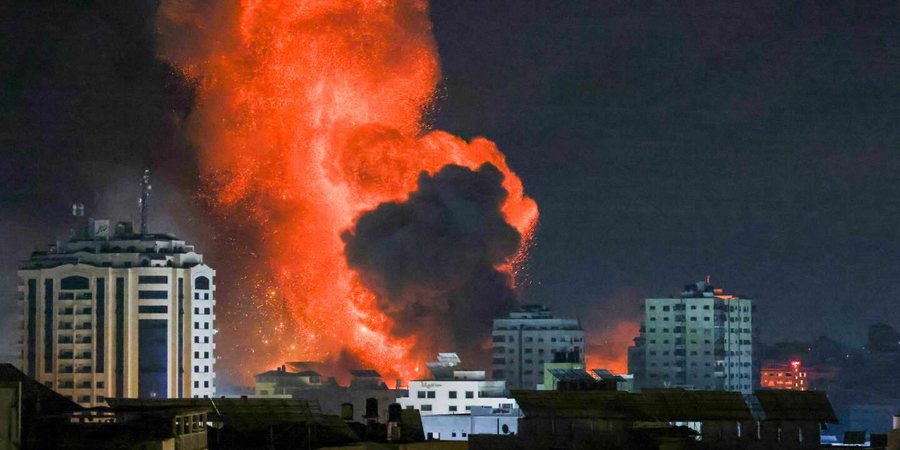
How and when the conflict might end remains unclear as leaders face the risk of the conflict turning into a war on more than one front.
Israel says its goal is to "smash and destroy" Hamas, but what comes next remains unclear. Even the White House fears that Israel does not have an endgame plan, US sources say.
How and when the conflict ends will depend on a number of variables, not the least of which is what Israeli forces find when they enter Gaza. They must also face the risk of the conflict turning into a two- or even three-front war. Here we look at six possible scenarios for the Israel-Hamas war.
1- The destruction of Hamas
Israel may aim for a time-limited incursion in which almost all Hamas members are killed, followed by the withdrawal of Israeli forces relatively quickly. A victory over Hamas in military terms would mean the death or capture of all 30,000-40,000 of the group's members and the destruction of its military infrastructure, such as rocket launch sites. It would also require the elimination of the elite Nukhba commando unit and the death or capture of the group's entire political leadership – although Hamas's overall political leadership is based in Qatar.
If Israel's attack is to succeed militarily, Gaza would need new leadership, something the Israelis would firmly control. One option could be the Palestinian Authority (PA), which is led by the Fatah movement and governs the West Bank, extending its control to the Gaza Strip. That would reverse the outcome of a 2007 civil war in Gaza, in which Fatah was forced out of the territory after an election defeat by Hamas.
It is unclear whether Mahmoud Abbas, the PA president, has any appetite for this. The deeply unpopular Palestinian Authority closely cooperates on security with Israel — so closely that it has faced accusations from Palestinians that it is a de facto arm of the Israeli military occupation, a charge it denies.
2- Gaza is divided into two
Israel may choose to extend its decades-long military occupation of the West Bank into Gaza, a massive undertaking that will require large numbers of troops to remain in the Strip for the foreseeable future.
Such an occupation would take years or potentially decades, rather than months, the latter of which could involve dividing the Gaza Strip into non-contiguous pieces of land; The apparent attempt to split Gaza into a militant north and a civilian south suggests this is already underway.
Isaac Herzog, the president of Israel, seems to have already ruled out this scenario. Joe Biden, the US president, has also urged Israel against this course of action, calling it a "big mistake". Abbas is also said to strongly oppose a long-term occupation of the Gaza Strip.
3-The complete cleansing of Gaza
Since Monday, about half of Gaza's population of two million has been ordered by Israel to leave from north to south. This moves them inside the country to an area that shares a border checkpoint with Egypt – the Rafah crossing – which they would be able to escape if opened by Egyptian authorities.
But some reports suggest that many Palestinians may refuse to leave the Strip. They fear a second Nakba - Arabic for "catastrophe" - echoing May 14, 1948, the day Israel declared independence and 750,000 Palestinians subsequently fled or were driven from their homes.
A major concern is that, even if Palestinians flee temporarily to Egypt's neighboring Sinai region, they may never be allowed to return. However, Egypt has so far been extremely reluctant to open Rafah, a move that would involve hosting hundreds of thousands of Palestinian refugees.
This would be ethnic cleansing, which according to the United Nations is not only classified as a crime against humanity, but a possible violation of the Genocide Convention.
The settler movement, which still holds sway over Israeli leaders, remains deeply bitter about the 2005 disengagement from Gaza, when 21 settlements were evacuated.
4- The Israeli offensive fails
Any battle with Hamas would be long, difficult and costly for Israel. The Islamic group has at least 30,000 well-armed and trained fighters, who will have the advantage of defending territory they know extremely well.
The "colossal" security failure that allowed hundreds of Hamas terrorists to infiltrate southern Israel has raised serious questions about the competence of Israel's intelligence and military chiefs. Survivors of these massacres complained of long delays in Israeli troops reaching their countries as they pushed Hamas across the Gaza border. In other words, Israel has never faced a military test like this before.
If an offensive falters and large numbers of Israeli troops begin returning to their families in body bags, Mr. Netanyahu may be forced to bow to pressure to limit the scope of a ground offensive, or call it off, then fully commit to hostage negotiations. But a more ambitious deal would involve swapping all 200 Israelis held in Gaza for about 5,000 Palestinian security prisoners held in Israel. Some Hamas officials claim that this was the ultimate goal of the October 7 massacre.
5- The outbreak of a regional conflict
Iran and its main group Hezbollah have threatened to join the war if a ground invasion takes place. Only the regime leaders in Tehran and Hassan Nasrallah, the leader of Hezbollah, will know for sure if this is a bluff.
Hezbollah also has a presence in Syria, while some pro-Iranian proxies in Iraq have also made threats to attack Israel this year. The Houthi rebel faction in Yemen, which is believed to possess medium-range missiles that can reach Israel, is also considered a proxy for Iran.
This creates the risk of what the Israelis call a "multi-front war," an event they have warned about for years: incoming missiles from Iraq, Syria, Lebanon and possibly Yemen at the same time.
This may well explain the apparent delay in Israel launching a ground invasion. A war with Iran and its proxies would be even more costly than a war against Hamas, especially since Hezbollah in particular possesses much more powerful weaponry. But the real wild card will be Iran and whether it moves to fully activate Hezbollah to open a northern front against Israel. Despite the cross-border escalation, we are not yet at that point, and the US, Israel and regional partners will try to prevent that movement.
6-The outbreak of a global war
This is the most extreme scenario and one that no sane leader would want to bring upon himself. If Hezbollah and Iran join the war, the United States will face overwhelming pressure to launch direct attacks on both entities. Washington has already deployed F-15 bombers to Jordan and sent two aircraft carriers to the region. Britain, which has sent Royal Navy ships to the Mediterranean, would be in the same situation.
This in turn creates the risk of an outright US-Iran war. Iran's nuclear program would most likely be destroyed by joint Israeli and American strikes, severing its most powerful tool to pressure the West. Iran's leaders will have taken this into account when discussing the prospect of joining the war.
Russia, a key ally of Iran, may choose to get involved as well. In recent months, Iran has become a major supplier of drones and missiles to Moscow as part of a growing military alliance. At that point, all bets would be off and the risk of a global conflict could not be ruled out, although this remains the most dire and far-fetched scenario. / Adapted "Pamphlet" from 'The Telegraph'





Lini një Përgjigje