


 Shkruar nga Pamfleti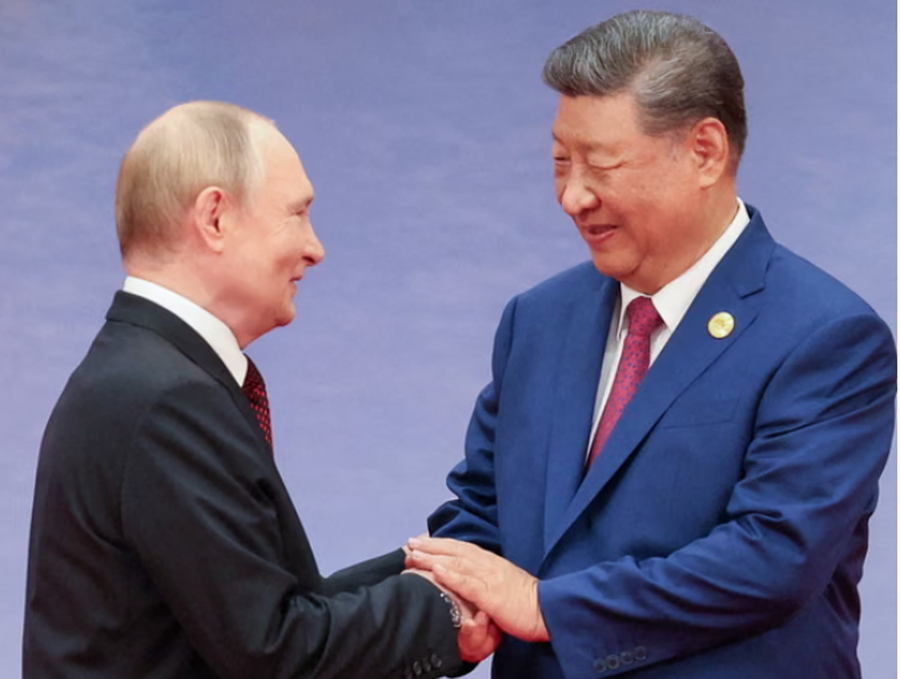
The meeting in Beijing will be attended by the leaders of Russia and North Korea, along with the Iranian president, a grouping called the axis of unrest...
Leaders from countries aligned with the West will gather in Beijing this week in support of President Xi Jinping as China holds a military parade to mark the 80th anniversary of the end of World War II. The parade is designed to showcase China's military might and geopolitical clout.
Described by Western analysts as the "axis of unrest," military, economic and political cooperation between Russia, China, Iran and North Korea has appeared on the battlefield in Ukraine and the Middle East this year.
But on Wednesday it will be Beijing that will take center stage as the world's second-largest economy and rising superpower, presenting itself as an alternative to a Western-led global order.
The well-choreographed military parade in Beijing's Tiananmen Square to commemorate the 80th anniversary of Japan's defeat in World War II, known in China as the Resistance Against Japanese Aggression, will feature 26 heads of state. In addition to Russia, North Korea and Iran, leaders from Myanmar, Mongolia, Indonesia, Zimbabwe and Central Asian countries will witness China's unveiling of a range of war-ready weapons. The only Western leaders on the guest list released by China's Foreign Ministry are from Serbia and Slovakia.
“Xi Jinping is trying to present his ambition for the global order,” said Yu Jie, a senior research fellow at Chatham House. In Xi’s view, “the world should be multipolar, led by China and united by many non-Western countries,” Yu said.
Vladimir Putin, the Russian president, is already in China, having attended the Shanghai Cooperation Organization summit in Tianjin over the weekend. Indian President Narendra Modi also attended the annual meeting of Eurasian leaders, a sign of the thaw in China-India relations at a time when India has been hit with 50% tariffs by the US in retaliation for purchases of Russian oil.
Besides demonstrating Beijing's power to rally non-Western leaders, this parade, two months after the US military parade held on Donald Trump's 79th birthday in mid-June, offers a direct comparison of American and Chinese military strength with which Beijing will feel comfortable.
In recent months, China has emphasized the importance of its narrative about Japan's defeat in World War II, which downplays the role of the West. In May, when Xi visited Moscow for Russia's Victory Day parade, he wrote an article calling for a "correct historical perspective" on the war.
Xi said that China and the Soviet Union were the main theaters of war in Asia and Europe, and that the two countries "served as the main pillar of resistance against Japanese militarism and German Nazism, making important contributions to the victory of the world anti-fascist war."
Xi's article did not mention any US or European contributions against the Axis powers in the war.
Analysts will be watching Wednesday's parade closely for signs of China's military upgrade, especially anything that could be of particular relevance to an attack on Taiwan.

“Taiwan is the big unspoken part of the parade,” said Charles Parton, a senior fellow at the Royal United Services Institute. By projecting military power, he said, Beijing is “sending a message to the Taiwanese that resistance is futile.”
In May, Chinese weapons appeared to prove themselves in a conflict between India and Pakistan, when Pakistan used Chinese J10-C fighter jets to shoot down several Indian fighter jets. The role of Chinese equipment in that conflict, while never officially acknowledged by Beijing, was nevertheless highlighted in Chinese media as a success story for China's military capabilities.
Even more advanced aircraft could be on display at this week's parade. Wezeman expects to see so-called "fifth-generation" fighter jets, such as the J-20, a more advanced and stealthy version of the J-10C jets used by Pakistan in May.
The key issue is that Chinese fighter jets are increasingly being produced with Chinese engines rather than Russian ones, part of China’s military modernization plan, which emphasizes the importance of self-reliance. “The whole goal for China is to be completely independent of anyone else, including the Russians,” Wezeman said.
This desire for military self-sufficiency comes at a time when China's main ally on the world stage, Russia, has been propped up by Chinese economic support and North Korean troops during its war in Ukraine. Many analysts believe Beijing is drawing lessons from that conflict to inform its thinking about a potential conflict with Taiwan, a self-governing island that China claims as part of its territory.
While it's difficult to show China's naval advances in a parade through the concrete streets of Beijing, there may be certain technologies, such as supersonic drones and large underwater drones, that could demonstrate China's ability to "deter anyone who comes to Taiwan's aid via the sea," Wezeman said.
Who will go to the Victory Day parade in China?
Russian President Vladimir Putin and North Korea's Kim Jong-un will attend the Victory Day parade on September 3, marking the end of World War II after Japan's formal surrender. It will be the first time the two leaders have appeared in public together with Xi.
Myanmar's junta chief Min Aung Hlaing, who rarely travels abroad, will also attend, the Chinese foreign ministry said on Thursday.
Most Western leaders are expected to shun the parade, making it a grand show of diplomatic solidarity between China, Russia and the global south.
The only Western heads of state or government attending the events in Beijing are Robert Fico, the prime minister of Slovakia, an EU member state, and Aleksandar Vučić, the president of Serbia.
Fico has been an opponent of sanctions on Russia over its war in Ukraine and has soured relations with the EU by visiting Moscow. Vucic also visited Moscow in May and wants good relations with Russia and China, but says Serbia remains committed to joining the EU.
The United Nations will be represented by Under-Secretary-General Li Junhua, who previously served in various positions in the Chinese Foreign Ministry, including time as Chinese ambassador to Italy, San Marino and Myanmar.
What do the experts say?
Political analysts say the parade is designed to demonstrate Xi's influence over nations aiming to reshape the Western-led global order.
"Xi Jinping is trying to show that he is very strong, that he is still powerful and welcome in China," said Alfred Wu, associate professor at the Lee Kuan Yew School of Public Policy at the National University of Singapore.
Lim Chuan-Tiong, a researcher at the Institute for Advanced Asian Studies at the University of Tokyo, said the main purpose of the "temporary spectacle" was to reinforce Xi's power and the strength of the CCP.
"Commemorating the 80th anniversary does not necessarily require a military parade," he said, noting that China began marking this date only 10 years ago and at a cost far below budget.
“Most of the leaders who are attending, those who are invited, are not there to support China’s commemoration of the 80th anniversary of the victory in World War II,” Lim said. “They are there to give face to China, to give face to Chinese leaders and to avoid damaging bilateral relations. Very simple.” / Adapted from The Guardian /


Lini një Përgjigje