


 Shkruar nga Mark Gongloff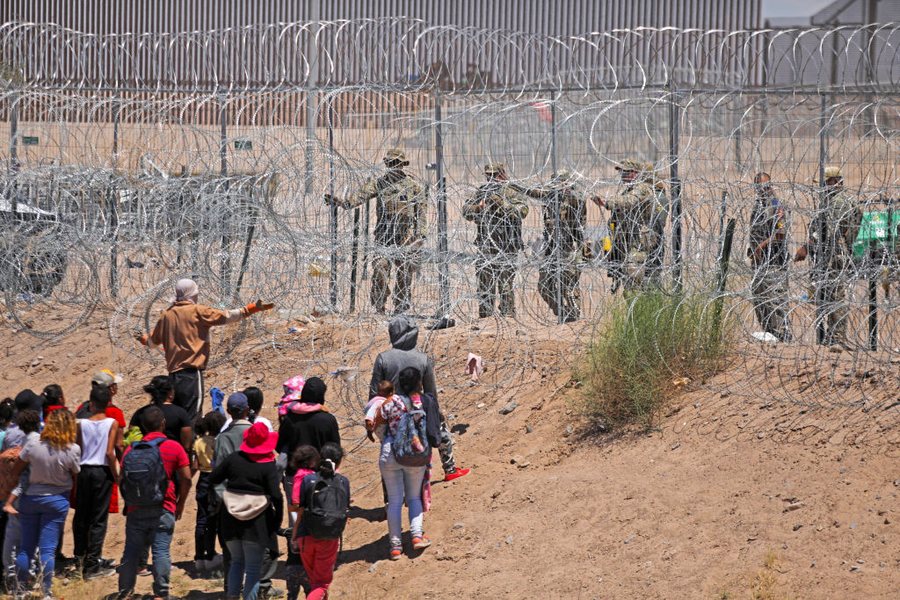
Gardi Sugdub is a small island off the coast of the Caribbean and opposite Panama. It has as an emergency the shelter of about 1300 members of the indigenous Guna people. The island is sinking as a result of rising sea levels, while the planet continues to warm. Under these conditions, Panama has implemented a project for their settlement in the interior of the continental part.
The indigenous residents will move into their new homes within this month. If only all climate change migration were that simple! US President Joe Biden signed an executive order last week that will make it harder for people to seek asylum at the US-Mexico border.
This is the latest step in a bitter political battle over immigration that has torn the country apart for decades. But, as with many effects of a changing climate, one day we may look back on the era that gave us panic over the caravan of immigrants in an election year and Donald Trump's great wall and weep for the "good old days of past".
As temperatures rise around the globe, so will extreme heat waves, droughts, floods, pandemics and other natural disasters, along with food and water shortages and conflicts over resources.
According to the logic of the climate change nightmare, the countries least responsible for pumping greenhouse gases into the atmosphere and warming the planet will bear the brunt of these impacts. And such countries tend to have less wealth, infrastructure and social fabric to protect their citizens.
In fact, after just 1.3 degrees Celsius of global warming above the pre-industrial average, countries with the most refugees, asylum seekers and other people already uprooted tend to suffer the greatest damage from climate change.
And they are concentrated mainly in sub-Saharan Africa, southern Asia and South America, along an equatorial belt that has experienced more extreme heat caused by climate change than the rest of the planet in recent decades. To be sure, most migrants will not say they are fleeing climate change.
They are fleeing war, economic insecurity, social instability, etc. But climate change multiplies these threats. It is perhaps no coincidence that according to the UN High Commission for Refugees, 95 percent of refugees fleeing conflicts in 2020 came from the most problematic areas of global warming.
With so many different factors influencing why people move, it can be difficult to single out climate. However, there are some concrete data. A recent review of the scientific literature by researchers at the University of Vermont in the US and the University of Otago in New Zealand found that high temperatures and weather-related disasters consistently trigger migration around the globe.
And a 2021 study by researchers at the National Autonomous University of Mexico found that the movement of low-income farmers from Mexico to the U.S. not only tripled during periods of drought, but accounted for perhaps 1/3 of all cross-border migration.
Given all the complexities and the lack of data, it is even more difficult to model the future migration trend driven by climate change. Various algorithms have produced global data that speak of a number from 50 million to 1.2 billion. The World Bank estimates that by 2050, there could be 216 million people displaced within national borders. And internal migration—say, from rural to urban—is usually the first step in cross-border migration.
According to a 2010 Princeton University study, as many as 6.7 million people could leave Latin America for the US due to climate change by 2080. But trying to accurately measure such numbers is of little use. .
It is enough to know that they will probably be very high, especially considering the extreme reaction that even the relatively small volume of cross-border migration has already caused in recent decades. We in the US talk about the "crisis at the border" all the time, but as my Bloomberg Opinion colleague Justin Fox has pointed out, illegal southern border crossings are no worse now than they were in, say, the 1980s and 1990s.
Confrontations between immigrants and border officials are at an all-time high, but those officials have become much more adept at catching illegal immigrants in recent years. The result is a real problem, but not necessarily a bigger one. Or at least not yet.
It is easy to imagine the political reaction in this country when the number of arrests doubles or triples. But adding higher walls and more barbed wire cannot be the only answer to this phenomenon. First, this is immoral.
Because the US and other developed countries are responsible for most of the greenhouse gases that have warmed the Earth's atmosphere, and damaged the lives of millions of people around the world. So they are the ones who bear a great responsibility for cleaning up the mess they have caused.
Expecting to fight the immigration problem when it appears at the border is an impractical and dangerous approach. Stranding hundreds of millions of people in unlivable conditions will only create tremendous pressures, which will fuel even more chaos and conflict.
It will cost very little in dollars and lives if these people are supported before they leave their homes. Especially if they help their countries to mitigate and adapt to climate change. The policies to do this are really hard now, but they won't get any easier in the future.
Of course, at stake is an amount of about 70 billion dollars a year. This is the annual debt service cost of developing countries, which can be canceled or repaid through debt-for-kind swaps to ease the burden of the most vulnerable countries.
Also, developed countries should continue to fulfill their long-delayed pledge to spend $100 billion a year on climate change relief, without using gimmicks such as providing most of the "aid" in the form of more many debts, or demanding that the revenues return one day to the donor countries.
Climate-driven migrants deserve full protection under international law, along with the recognition that leaving for 'greener pastures' is not a crime, but a survival and adaptation tool that people have used since from the beginning of humanity. While the number of climate safe havens is dwindling, this fact helps us remember that the rest of us may one day be climate refugees./ Adapted Pamphlet from "Bloomberg"






Lini një Përgjigje