


 Shkruar nga Jasmin Mujanoviç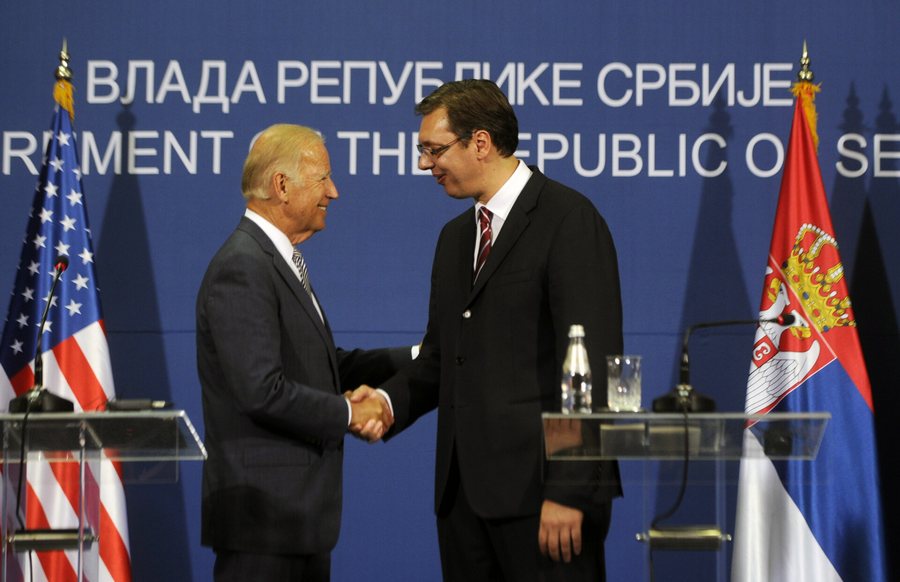
However, the concern has been greater in the Western Balkans, because the US has exerted a very wide influence here since the bloody disintegration of the former Yugoslavia.
Democratic Vice President Kamal Harris' campaign has often raised the issue of her foreign policy priorities.
Given the primacy of the US in the international system, this is a concern for the entire global community.
However, the concern has been greater in the Western Balkans, because the US has exerted a very wide influence here since the bloody disintegration of the former Yugoslavia. But also because since 2014, the region has been perceived as the hottest geopolitical hotbed in Europe, after Ukraine.
Moreover, this is a region where Russia and China have made the most of the EU's declining capacity by making major strategic strides. Meanwhile, the restoration of authoritarian-nationalist rule in Serbia has fueled growing fears of a new conflict, especially after the discovery of large lithium deposits.
But it is not easy to understand what attitude Harris has towards the Western Balkans. During her term as a senator (2017-2021), Harris was not as outspoken on foreign policy issues. For example, its concern in relation to Europe was mainly noticed after Russia's interference in the 2016 US presidential election.
Upon assuming the vice presidency in 2021, Harris was assigned to deal primarily with domestic issues, and above all with immigration and the southern border. After Russia's full-scale invasion of Ukraine in February 2022, it became part of the Joe Biden administration's efforts to rally support for Kiev among European allies.
But it's hard to identify a single foreign policy issue that bears her stamp, and that she pushed forward. And there is no public record that Harris was ever interested in the Western Balkans. This is not to say that she was insignificant in her role.
But the most significant aspect of her legacy as vice president, at least in relation to the Western Balkans, may be its inexorable connection to Biden's approach to the region. In a May 2023 article for Foreign Policy magazine titled "How Biden Lost the Balkans," I wrote that the Biden administration had "greatly deepened its relationship with Serbia's quasi-autocratic president, while also reorienting its overall approach to the region to put Belgrade and its foreign policy priorities at the center".
This has had negative effects on the security and stability of Bosnia-Herzegovina, Kosovo and Montenegro. Biden's ambassador to Belgrade, Christopher Hill, appeared frequently in public as a part-time spokesman for Vucic's government.
After Serb militants in northern Kosovo attacked NATO peacekeepers, the US and EU imposed sanctions on the Kosovo government, absurdly accusing Pristina of instigating the unrest. Will Harris continue her predecessor's approach to the region if elected president?
We don't know, and we have little data to interpret. On the one hand, the Harris camp has signaled that as president, it will replace Secretary of State Antony Blinken, but also national security adviser Jake Sullivan. Such a move would bring about other personnel changes within the US foreign policy and defense apparatus.
If these changes will show the new president's desire to break away from the policies of the democratic establishment on foreign policy, then they will potentially be an opportunity for the Western Balkans. So if Harris takes a critical view of this period, and wants to follow her new course, the Western Balkans will quickly feel the effects (and benefits) of such a decision.
On the other hand, Philip Gordon, Harris's national security adviser, and the man expected to play a key role in shaping her foreign policy should she become president, previously served in the Clinton and Obama administrations. American media have portrayed Gordon as a Europhile.
In the absence of more detailed information about Harris' possible inclination towards the region, it may be safer to assume that she would continue the policy of her predecessors to view the Western Balkans as a peripheral part of American foreign policy.
In practice, this meant that those who would direct Washington's policy in the region would continue to be career diplomats in the State Department, a mix of political appointees and even a handful of influential ambassadors like Hill, who have dominated regional politics until now.
But given the corrosive nature of the US status quo in the region, this is not an optimistic scenario. However, none of this means that a second Trump presidency would be preferable for the Western Balkans, also because of the Trump family's close ties to Vucic, related to multibillion-dollar real estate ventures in Serbia (and Albania) by the former president's son-in-law, Jared Kushner, and his daughter Ivanka Trump.
Even Trump's close associate, Richard Grenell, the former head of US National Intelligence, has direct ties to the Vucic regime. Grenell frequents Belgrade and is a staunch supporter of Vucic on social media. In 2023, the Serbian leader awarded him the Order of the Serbian Flag, one of the highest state honors.
There is much speculation about the Grenell-Vucic report, including a plan for the secession of Serbs from Bosnia and Herzegovina. Grenell was accused by Kosovo Prime Minister Albin Kurti of orchestrating a coup against his first government, but the 2020 Washington Accord, backed by the United States, secured Israel's recognition of Kosovo.
While during the Biden presidency, during the paramilitary attack in Banjska in 2023, militants associated with the Belgrade regime committed the most serious incident against Kosovo since the war of 1998-1999. Republicans are unlikely to secure the vote of Bosnian-Americans or Albanian-Americans, but Harris' fate in states like Georgia and Michigan may well depend on their turnout.
So Harris' team would do well to speak directly to these communities, softening the effect of Biden's perceived betrayal over the past 4 years, and offer them a compelling reason to vote on November 5, especially about their core issue: American policy toward the Western Balkans and Kamala Harris's hitherto unarticulated view on it.
The most urgent priority for the Harris administration's foreign policy in the Western Balkans would be a comprehensive reset of Washington's stance toward Serbia. The Harris administration must admit that the policies of the time of Trump and Biden, which were based on trying to remove Belgrade from the orbit of Moscow, have failed.
In fact, they have only helped the most radical elements in Serbia in their increasing claims against the neighboring states, above all towards Kosovo and Bosnia-Herzegovina. Therefore, the US must urgently change its policy towards the Balkans, shifting its focus away from Serbia and refocusing its efforts on strengthening the security and democratic integrity of states and governments that have proven to have a pro-Western orientation./ Taken from " New Lines Magazine", adapted "Pamphlet"




Lini një Përgjigje