


 Shkruar nga Marie Cronqvist
 As the war in Ukraine continues, the sabotage of underwater infrastructure in the Baltic Sea and increasingly aggressive nuclear rhetoric from Russia, many countries in the region are giving their citizens advice on how to prepare for a crisis, emergency or war.
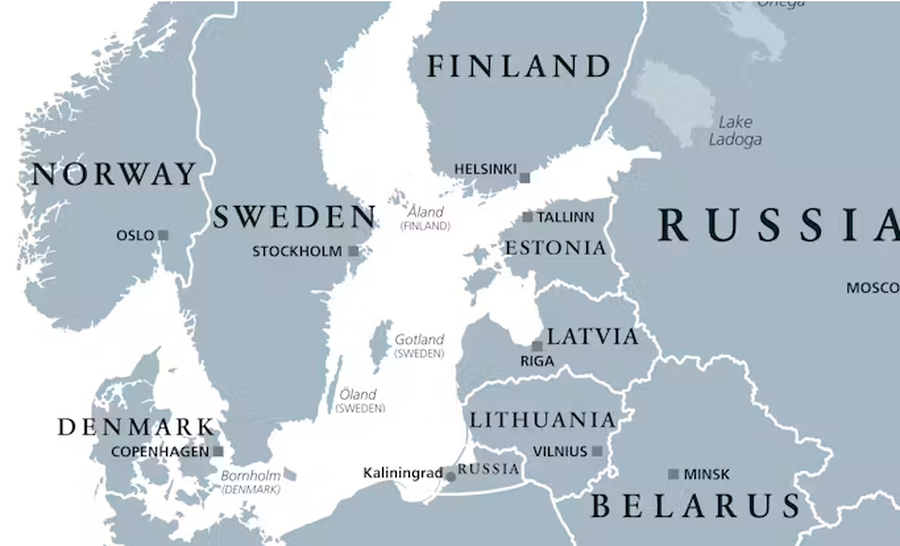
The Baltic states - Estonia, Latvia and Lithuania, which border Russia - have regularly updated public information over the past decade. This stems in part from the historical experiences of the Soviet occupation, as well as the fear that something similar will happen again.
On the other side of the Baltic Sea, emergency preparedness advice has also been updated in Denmark and Norway. In Denmark, the information campaign is not directly related to the war, but mentions other possible crises such as extreme weather and cyber attacks.
The tips focus on how citizens can prepare to live without electricity for 3 days, including water supply and having a stock of canned food. Meanwhile, the Norwegian authorities also give advice on how to survive for 3 days without electricity.
They suggest stockpiling 9 liters of water per person, as well as food, matches, candles and iodine tablets in the event of a nuclear attack. Finland and Sweden, which recently joined NATO, launched major crisis preparedness campaigns this month. Both countries are calling on citizens and residents to be better prepared to face unexpected events. The advice leaflet in Sweden is available digitally, but has also been mailed in paper format to 5.2 million households. The yellow cover shows two armed soldiers, a warship and fighter jet.
Inside, readers can learn about everything from warning systems, shelters and emergency evacuation, to digital security and home preparedness. She begins the words: "We are living in uncertain times. Armed conflicts are currently taking place in our corner of the world!".
The leaflet also provides practical advice on food storage in conditions of electricity shortages, access to health care and water. If due to the crisis, there can be no supply of stores, then the shelves can be emptied in a few days.
It is advisable to keep cash dry, as digital forms of money may not work. "Start preparing gradually from now on, buying an extra item or two every time you go to the store," the leaflet states. It also includes a description of the Swedish concept of "psychological protection", which has the relevant government agency since 2022. Psychological protection, says the agency's homepage, is "the shared ability of society to detect and resist the influence malicious information directed to Sweden by hostile foreign powers". The Finnish guide takes a different approach. The cover image is more metaphorical. "Prepared people cope better" - it says, while two women are shown in the rain, where only one of them is holding an umbrella.
Meanwhile, the online guide has a variety of topics to click through, including military conflict, terrorism, water pollution and power outages. The differences in their approach can be explained, at least in part, by the different histories of these two neighboring countries and their respective relations with Russia.
Sweden remained neutral in World War II, and was never invaded like Denmark and Norway. But countless parallels have been drawn between today's Ukrainian soldiers, and the staunch resistance of Finns to the brutal Soviet occupation during the Winter War of 1939-1940.
After the 1940 Treaty of Moscow, Finland ceded 11 percent of its territory to the Soviet Union. Finland's president, Alexander Stubb, says NATO membership was a must after Russia's full-scale invasion of Ukraine began in 2022.
Remembering their history, the Finns thought that Russia might advance towards them as well. Sweden has a long history of nationwide information campaigns and ambitious civil defense planning, compared to most other countries. As early as 1943, the government issued the first leaflet to every Swedish family entitled "If War Comes: Instructions for Swedish Citizens".
It contained information on everything from sirens, shelters and blackouts, to spies and rumours, and how to maintain the "will to defend". Several updated editions were published during the Cold War, focusing on what to do in the event of a nuclear attack, such as in 1952, 1961, but also in the 1980s.
For decades, key information was included in all Swedish phone books. Between 1996-2004, Sweden dismantled its civil defense along with most of its military defenses. But in the 2010s, he realized that this was not such a good idea.
In 2017, it reintroduced compulsory military service. Meanwhile in 2018, after decades of silence on the issue of civil defense and preparedness, the Swedish authorities revised their Cold War approach. Six years later, a new guide has emerged.
Meanwhile, Finns maintained a defensive stance in the 1990s and early 2000s, unhappy with the advent of peace and prosperity and the dissolution of the Soviet Union. But today they are clearer about the prospect of war than Swedish politicians.
Because unlike the Swedes, the Finns do not need to be reminded that war can become a reality or where the threat comes from. Finland's long border with the Soviet Union has long forced it to manage Russia's behavior in a different way than its Nordic neighbors.
A diplomatic balancing act of a non-aligned country against an imperialist neighbor. Under the background of different historical experiences of the 20th century, but also different traditions of how to treat their populations, the Nordic and Baltic governments today aim to strengthen the daily readiness of citizens in their own ways. However, they share a common perception of where the threat comes from: Russia./ Pamphlet adapted from "The Conversation"






Lini një Përgjigje