


 Shkruar nga Gabriele Segre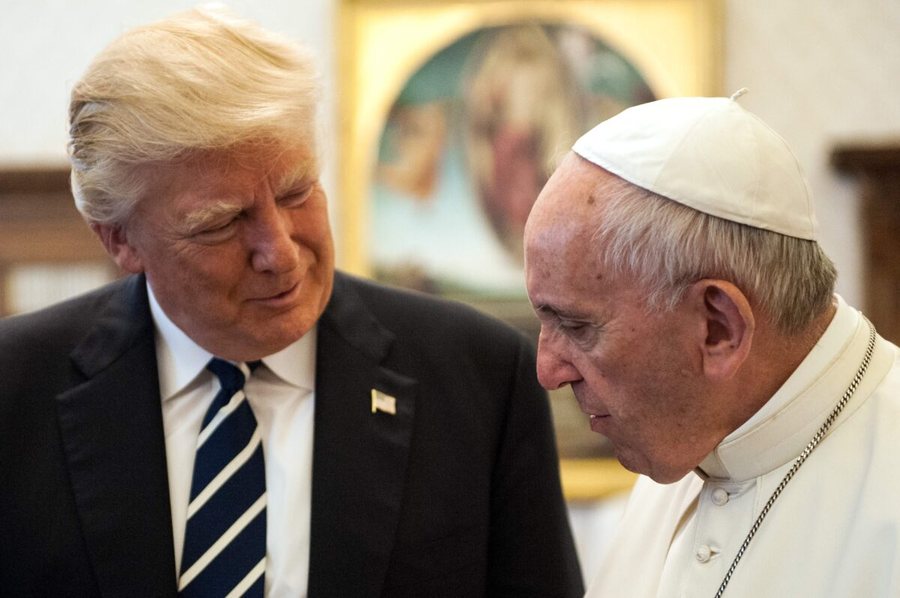
"One Pope dies, you make another one"
After the death of Pope Francis and the return of Trump to power, fears of the collapse of civilization are high. But Italian political analyst Gabriele Segre argues that apocalyptic narratives risk becoming self-fulfilling prophecies.
Few events prompt us to reflect on the meaning of an era quite like the death of a Pope. And perhaps all the commentary about Pope Francis' legacy will end up overshadowing a more prosaic but equally urgent consideration: the first 100 days of Donald Trump's second term.
Some might even see this coincidence as a sign of the times we live in. Neither the man who made peace his life's mission nor the one who promised it within 24 hours of taking office seems to have achieved it. And so we ask ourselves: if neither faith nor a superpower can save us, what can?
It is a grim thought, revealing a curious paradox: we constantly condemn the unpredictability and relentless pace of our era, and yet whenever change comes, it seems to us as threatening and final.
We see this in the sweeping judgments given at the current moment: “American democracy is lost,” “globalization is over,” “conflict with China is inevitable.”
Self-destructive guilt
Even European Commission President Ursula von der Leyen has said: "The West no longer exists." Francis' death has been met with similar sentiments. We have heard that "with his death, the Pope of hope has died," as if no one who comes after him can carry on that message of hope.
This mindset is so widespread that it might deserve a new word: definitiveism. And it's worth noting how, rather than evoking the usual apocalyptic "we're all doomed," it feeds a kind of self-destructive guilt: just look at how often the word "suicide" appears these days in headlines and speeches: the suicide of the United States, of democracy, of the West.
If we look closely, this kind of thinking is not unique to our time. Societies in every era have suffered from what we now call "presentism," the belief that only the here and now matters and that it is constantly under threat. Even the ancient Egyptians, who had a 3,500-year run, believed they were at the end of an era every time a pharaoh died.
All of this shows us that, for better or worse, every age is shaped by the way it tells its story. We might never have reached the moon if Ludovico Ariosto or Jules Verne had not first dared to imagine it. Today, some even suspect that the wave of war films serves to normalize the return of war to the global stage, even after we once swore it off for good.
Conspiracy theories aside, one thing is clear: fiction and reality shape each other. The problem begins when we start to believe too much in the stories we tell ourselves - when we mistake narrative for fact.
History is full of self-fulfilling prophecies, things that happen precisely because we imagined them so vividly and repeated them so often that they felt not only possible but inevitable.
The idea that our era is coming to an end does not arise spontaneously, nor is it dictated solely by events. Rather, it is the product of a narrative that, day after day, turns uncertainty into conviction, speculation into dogma, until we no longer see a transition, but an imminent collapse.
By constantly calling for the end of our world, we turn a perfectly understandable anxiety into a foregone conclusion.
A little patience
It is here that history, in the sense of a critical investigation of the past, should serve as our guide. It teaches us that nothing is ever truly inevitable. Even what now seems clear and linear is, in reality, the result of histories that sought to impose order on chaotic events, creating logic where only confusion reigned.
This would not be the first time we have fallen into such simplification. After the victory of the liberal democracies, we convinced ourselves that we had reached the “end of history” – the dawn of an era of uninterrupted peace and prosperity.
Today we risk the opposite: imagining that what awaits us must be a long, painful descent into a darker fate. But both of these conclusions stem from the same impulse to freeze the course of events in a story that must have an ending, whether happy or grim.
In doing so, we forget that history more often changes shape than it ends directly. It rarely offers the clean breaks we like to think we are living in today. Having a little patience, a little perspective, can often be enough to see it through.
This is the mindset we need if we are to free ourselves from our endless present and begin to imagine a different future: one that is not surrendered to fear or fate. We can take a turn at an old papal proverb that carries a kind of world-weary hope: “whenever one era ends, another begins. Always.”/ Adapted from “Pamphlet” by “WorldCrunch”
* Note : Translation matters a lot, to better explain the meaning of the above expression, the Italian author Gabriele Segre, closes the piece with an elegant paraphrase of an old Roman saying: “Morto un Papa, se ne fa un altro”, which literally translates to: “A Pope dies, you make another one”. Figuratively, it is used to express the idea that, despite obstacles, life goes on. It is often said with a touch of pragmatism or even indifference, but it can also have a hopeful or reassuring meaning, depending on the tone and context: a gentle reminder that new beginnings are always possible. In this case, the author applies the same idea to world political cycles. It works very well in Italian, but it was impossible to keep up with the English word play and maintain the rhythm of the closer, so I simply made a reference to the proverb related to popes .


Lini një Përgjigje