


 Shkruar nga Vudi Xhymshiti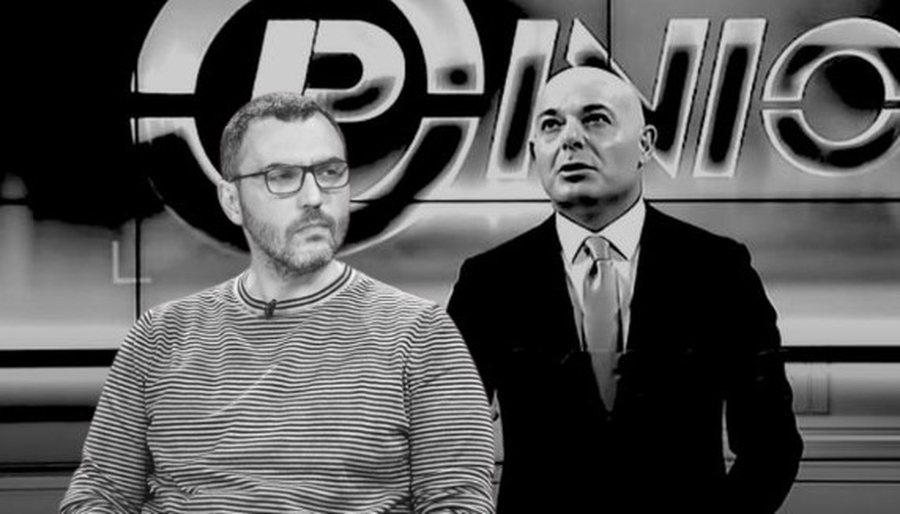
As long as figures like Fevziu choose to close their eyes to injustices and silence critical voices, Albania will remain in the hands of those who see the state as a tool for personal enrichment and not as a public service...
In a television studio where Albanian political debates take the form of a controlled spectacle, a clash between journalist Blendi Fevziu and the chairman of Lévizje Bashke, Arlind Qori, exposed more than just personal tensions.
It was an episode that shed light on the profound failures of the Albanian media to fulfill their role as watchdogs of power. Fevzi's response to Qori's accusations that he is not under anyone's influence when deciding who to invite to his show was an empty defense that avoided the core problem: a journalist who has chosen to play the role of a silent supporter of a system rotten with corruption and ties to organized crime.
Fevziu, as one of the most popular figures of Albanian journalism, has a special responsibility. He is not just an ordinary journalist; he is a shaper of narratives that reach every corner of the country. His claim to editorial independence, while figures like Arlind Qori, who challenge the status quo remain outside his studio for more than a year, is not only an irony, but a silent indictment of a system that favors silence of critics.
In Fevzi's case, his show is more of a mechanism for maintaining power narratives than a space for exposing injustices.
Arlind Qori, who represents a political grouping that resists oligarchy and state capture, raised a direct accusation: the censorship that media such as Fevziu's silently implement. For a country like Albania, where corruption has metastasized in every aspect of society, such an accusation is more than political rhetoric; it is a painful reflection of the failure of one of the most important institutions of a democratic society, the media. However, Fevzi's reaction was a clear attempt to shift attention. He did not challenge the substance of the accusation, but turned to superficial statistics to show that even senior government officials were not often invited. This is a maneuver that does not aim to solve the problem, but to relativize it.
But what makes this debate more than a personal clash? It is a symptom of a larger crisis that has engulfed Albanian journalism. In the last decade, Albania has experienced a dramatic transformation in the relationship between media and power. Instead of being a guardian of democracy, many media have become amplifiers of the interests of political and economic elites. This is not a unique situation for Albania.
Carl Bernstein, another well-known journalist honored with the 'Pulitzer' prize, has pointed out in the global context where he says that "Journalists should illuminate the darkness, not be part of it." But in the Albanian case, "darkness" has become the norm and journalists like Fevziu, instead of illuminating it, often feed it.
Fevziu claims that he is not under influence, that his choices are independent and that censorship does not exist in his show. But in an environment where oligarchy and organized crime have gripped the state, such a lack of commitment to challenge power is itself a tacit act of support. It's what many call "soft censorship" — a phenomenon where the silencing of critical voices is more powerful than any outright ban.
In this context, Albania is not just a small country in the Balkans struggling to integrate into the European Union. It's a case study in what happens when the media fails to protect the public. Edi Rama, the prime minister who has led the country for more than a decade, has managed to build a regime that, according to Der Spiegel and The Washington Post, is practically a mafia state. These accusations, documented with concrete evidence, show a government that not only tolerates, but integrates organized crime at every level. For a country that aspires to become part of the European family, this is a catastrophic situation. But even more disturbing is the fact that these accusations receive almost no space in the country's media discourse. Fevziu, for example, did not even have the courage to browse these reports on his television program, much less debate them to help the public understand that the state is captured by the mafia.
If we follow the opinion of the journalist Walter Lippmann, another journalist honored with the Pulitzer Prize where he says "The function of the press is to serve as a checking body on power, not to become part of it." This basic principle of journalism has failed in Albania. The media, instead of being a bastion of truth, has become an extension of power. What is even more disturbing is the role of the international community, which often turns a blind eye to these phenomena. The continued support for Rama by institutions like the EU and the US is not only a moral failure; it is a tacit cooperation in maintaining the status quo.
To finish this thought, I want to say that the debate between Fevzi and Qori is not just a TV episode. He is a reflection of a bigger crisis that is destroying the foundations of Albanian democracy. The media, which should be a counterweight to power, has turned into one of its most powerful allies. As long as figures like Fevziu choose to close their eyes to injustices and silence critical voices, Albania will remain in the hands of those who see the state as a tool for personal enrichment and not as a public service. And history will not forgive those who, knowingly or not, were complicit in this process. /SpotLight-Pamphlet



Lini një Përgjigje