


 Shkruar nga Skënder Asani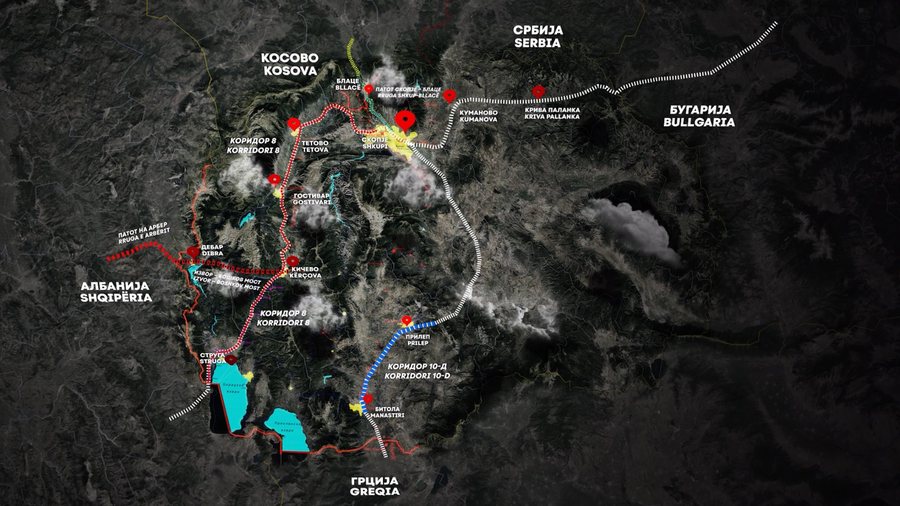
The history of the Balkans is full of scenarios where geography has been used to change orientations: yesterday with language and religion, today with infrastructure and economic dependence. The assimilation of the past came with new flags; the new assimilation moves on railway tracks and concession contracts. In this panorama, the rapprochement between Skopje and Athens is taking on a narrow bilateral dimension; the dialogue with Sofia remains frozen; and with Tirana a common strategic axis is still missing.
In the Balkans, history does not move forward, it turns. New roads are never new; they are old tracks covered with fresh asphalt. Every corridor paved over this land is not just an engineering project, but an invisible thread that connects today's calculations with the long-ago plans of great powers. Here, where borders are drawn more often than school maps, nothing is built without a deeper motive than what is written in contracts.
North Macedonia's "Corridor 10", presented as a development artery, is transforming into a strategic chain that follows the trajectory known from past centuries: a path that once connected Mediterranean ports with the heart of Central Europe, and today crosses Thessaloniki, Macedonia, Serbia and Hungary, creating an architecture of connections that extends to the sponsorships of Beijing and Moscow as a counterweight to the Euro-Atlantic "Corridor 8".
After 2022, when the war in Ukraine accelerated the wheel of history, a ring of NATO states was built around Belgrade, with the aim of removing it from the orbit of the East. But Serbia, as in the 19th and 20th centuries, turned the pressure into a springboard: first by consolidating positions in Montenegro and then in Skopje, where last year's elections brought a political configuration that, rather than opening doors, chose to open corridors. Thus, a new corridor was opened that starts from the Chinese-dominated port of Thessaloniki, climbs through Macedonia and Serbia, and ends in Hungary, a route that on public maps is marked as economic, but on diplomatic maps is read as strategic positioning.
But while Corridor 10 is advancing at an accelerated pace, Corridor 8, the most important project for the east-west connection and for the integration of North Macedonia into the Euro-Atlantic axis, has suffered open sabotage. For 15 years, only 15 kilometers of the Kichevo-Struga route have been put into service, completed only last month. This slow pace is not simply technical incompetence; it reflects a deliberate strategy that favors the north-south axis and weakens ties with Bulgaria and Albania.
Instead of accelerating the development of Corridor 8, the government led by Prime Minister Hristijan Mickoski has embraced a political course closely linked to the interests of the “Serbian world”, allowing its penetration into the country’s economy and strategic infrastructure. Taking on a billion-dollar debt from Hungary, the opening of Serbian banks, dubious investments in the state-owned Telecom, as well as the postponement of work on Corridor 8 in the face of visible progress on Corridor 10 and the north-south railway, clearly indicate a coordinated political orientation.
These developments are not isolated, but part of a dangerous trinity under Russian-Chinese influence, where Vučić, Mickoski and Orbán are creating a new axis of influence in the Balkans. Under the pretext of development, the country is moving away from Western standards and alliances towards a geopolitical gray area, where the strategic interests of Moscow and Beijing have free space to operate.
The history of the Balkans is full of scenarios where geography has been used to change orientations: yesterday with language and religion, today with infrastructure and economic dependence. The assimilation of the past came with new flags; the new assimilation moves on railway tracks and concession contracts. In this panorama, the rapprochement between Skopje and Athens is taking on a narrow bilateral dimension; the dialogue with Sofia remains frozen; and with Tirana a common strategic axis is still missing. These gaps, as history has shown, are always exploited by those who read the map faster than others.
In this context, the signals circulating about a sponsorship of Greece as a driver of Macedonia's unblocking Eurointegration process are judged as an attempt to introduce BRICS into Europe through the "small door", weakening the Albanian and Bulgarian position in the Balkans and favoring the Russian-Chinese corridor of the strategic line of Corridor 10.
For Albania and Kosovo, this is not an issue that can be followed from a distance. The corridors that are drawn today will determine the geopolitical orientation of the Albanian space tomorrow. If a common strategic approach is not built, the risk is not only isolation from the Euro-Atlantic axes, but also integration into networks of influence that see the Balkans as a bridge to other interests, not always friendly to us.
The public sees the asphalt; the diplomat sees the direction. The public sees development; the diplomat sees orientation. And when the next chapter is written, it will not only be about the kilometers paved, but also about who those kilometers served. If the Balkans do not choose their own itinerary, others will draw it, and rarely do those roads take the people where they want to go.
The lobbyists hired by Serbia to promote the concept of the “Serbian world” are the same ones that Hristijan Mickoski is silently but deliberately using to fuel his pre-election and now governing narrative of “restoring the state,” a political formula that, seemingly domestic, is essentially linked to clear regional trends. In the complex landscape of diplomatic moves, Christopher Hill’s return to the stage is not just a rotation in the calendar of posts, but a well-thought-out move at the tables where influence is built over years. Hill, who served as ambassador in Skopje in the late 1990s and until a few months ago held the post of ambassador in Belgrade, was appointed a few days ago by the Serbian lobby as a lobbyist for its interests in the United States of America. On the website of the non-profit organization Pupin’s Initiative from Washington, it was announced that former US ambassador to Serbia Christopher R. Hill has joined this organization as an advisor. This organization represents just one of several lobbying forums for the creation of affirmative US policies towards Serbia through the political, economic, security, and cultural spheres.
In this picture, the ties between Belgrade and Skopje do not appear through declarations, but through the synchronization of influence mechanisms operating below the surface. For those who read politics as the art of managing invisible balances, this is a signal for increased vigilance and smart mobilization of the Albanian diaspora in the US, not being satisfied with delayed reactions, but by building sustainable lobbying networks that can balance a new alliance, which is being projected under the shadow of “corridor ten” and goals that transcend formal state borders.
The strategic orientation of the region is being shaped today by the way infrastructure projects are developed and prioritized. Corridor 10 is advancing at a rapid pace, strengthening a north-south axis under increased Russian-Chinese influence, while Corridor 8, the natural east-west connection and the strongest bridge to the Euro-Atlantic axis, is remaining in the shadows.
For Albania, Kosovo and the Albanians in North Macedonia, this situation requires a unified vision that combines active diplomacy with coordinated economic and infrastructural actions. The completion of Corridor 8, deepening cooperation with neighboring Euro-Atlantic countries and avoiding dependencies on projects with alternative geopolitical trends are essential steps to preserve the stability and western orientation of the Albanian space. The decisions taken today will determine the direction of the coming decades.
Skopje, 11 August 2025





Lini një Përgjigje