


 Shkruar nga Pamfleti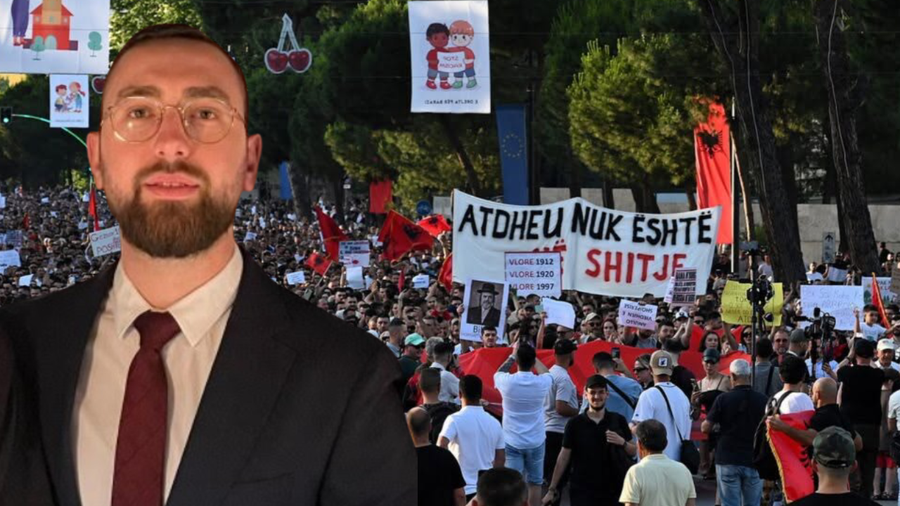
After more than three decades, the transition in Albania has not ended but has turned into a self-reproducing hybrid system, where power remains stronger than the law. The current protests are not only against specific projects, but against the very idea of an endless transition that justifies the failure to build independent institutions and the rule of law.
Written by: Agred Tafaj, lawyer in London (former student protester of the 2018 student protest)
For more than three decades, almost every problem in Albania has been justified with the same
phrase: we are still in transition. In theory, transition was intended as a transitional period,
a necessary stage to pull the country out of the old system and towards a
functioning democracy. But, after more than thirty years, the question that naturally arises
is: are we still in transition, or has transition become the system itself?
A transition is not measured by the passage of years, but by the achievement of its objectives. It ends
when the state is built on the law and not on individuals, when institutions function regardless of
who governs, and when the citizen feels protected by the system, not dependent on it. From the expression of
the protesters' dissatisfaction today, it seems that many of the objectives still remain
unrealized.
Today, we live in a hybrid system, where economically we claim the free market, politically
we claim democracy, but practically we continue to face institutions dependent on
political leaders, contested justice, and a political culture where power has shown itself to have more
power than the law. The form has changed, but the control mechanisms have remained the same.
In communism, control was exercised openly through the party, censorship and a
centralized economy. In democracy, power should be limited by law, independent institutions and
free competition. Albania today remains a hybrid system: we hold elections and have
a market economy, but political influence over the administration, public employment, the distribution of
funds and pressure on dependent and independent institutions show that power continues to
have more strength than the rules that should limit it. If violence was once ideological,
today it appears in more sophisticated forms, such as psychological and economic.
In essence, the Albanian transition has not been just a process of transformation. It has become a
mechanism that constantly reproduces itself. Every political crisis, every wave of emigration, every
protest or civic disillusionment brings back the same question: why have we not yet reached where we should
have arrived long ago? Perhaps because a completed transition would mean
institutions stronger than individuals, law stronger than power, and citizens freer from
political dependencies. And here lies the paradox: the longer the transition lasts, the more
those who manage it benefit.
Therefore, our challenge today is not to reform the transition, but to close it. The 6th day of
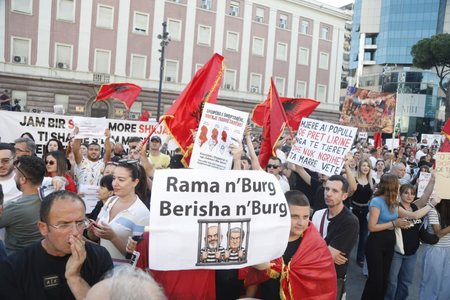
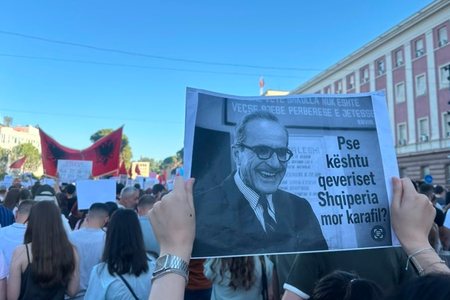
the protest is showing that we are not protesting only for the Zvërnec Project or the
Rrioll Constructions, or the mountains package. We are protesting for everything that has not changed for years. We are protesting
because after more than three decades of transition, many of us still feel defenseless in the face of the state, unrepresented by politics and disappointed by institutions. The protest is
the voice of a dissatisfaction that has been accumulating over the years. It is the reaction of those who believe that
the transition, which was supposed to bring functional democracy and the rule of law, has turned into a
permanent state where promises are repeated, but the problems remain the same.
And as we raise our voices against this state of affairs, are we ready to demand not just an end to an
injustice, but an end to the very transition that produced it? For no society can build a future by living endlessly in a state of transition. A nation cannot
move forward when each generation grows up with the promise that real change will come tomorrow.
And if after more than thirty years we still continue to live in transition, isn't
it time to ask whether it has failed to be completed, or has it been deliberately kept
unfinished?



Lini një Përgjigje