


 Shkruar nga Lilia Yapparova
"It is likely that the elite will put pressure on Putin and even tell him: You must resign. We must have a new leader at the helm!"
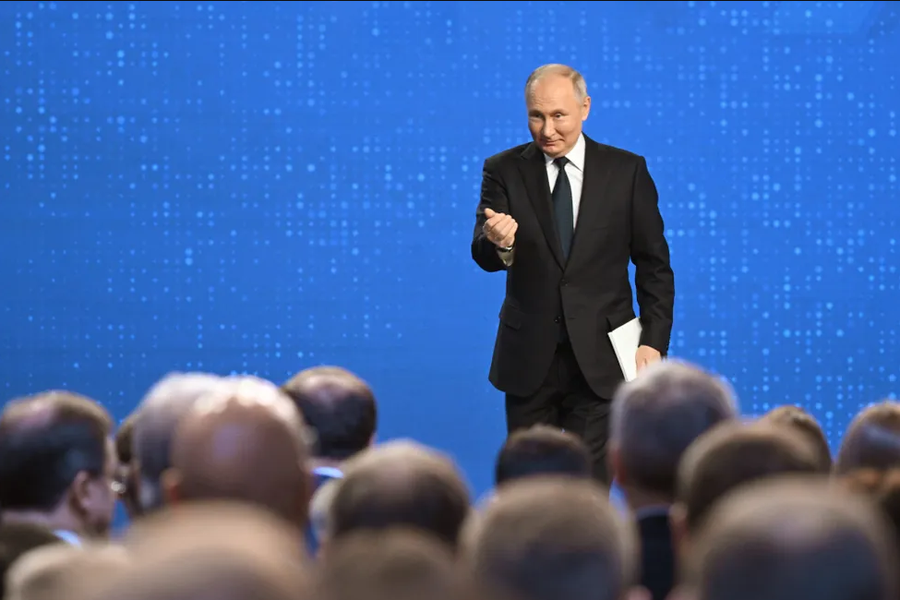
American historian Amy Knight has been studying Russian elites for decades. She worked for 18 years at the US Library of Congress as an expert on Russian and Soviet affairs and has written many books on the Cold War, the KGB, its post-Soviet ideological successors, and the Kremlin.
Some of her more recent books focus on the culture of political assassinations under the rule of Vladimir Putin. "Meduza" spoke with Knight about the trials, tribulations and changing behavior of Russian elites since the start of the full-scale invasion of Ukraine.
The costly invasion of Ukraine, and the muted response from many of Moscow's wealthiest and most influential people, make it tempting to ignore them entirely.
But this behavior would be wrong, says historian Amy Knight.
She thinks that Putin is forced to share power with these people, whether he likes it or not. "He depends on the entire Russian elite," says Knight, adding that Russian elites in the so-called "ministries of power" and elsewhere communicate with each other, leading to talk about this group of people as a kind of special class.
War weariness
Knight admits that predicting the behavior of Russian elites is difficult. But he adds that the fighting in Ukraine is tiring everyone. Knight cited oligarch Oleg Deripaska's willingness to publicly criticize the invasion as evidence that "he is aware that there is a lot of resentment" (even though he is not actually a government official).
"This approach prompts me to wonder if there aren't some other reasons to speculate that Putin is not completely sure," says the expert. Western sanctions have "set the stage for a gradual and real disaffection with Putin", although "nothing has happened yet", says Knight.
She emphasizes that the war in Ukraine has limited the prospects of future generations of Russian elites, making their children, grandchildren "captives of the current shell where the country is isolated". "She is removing any kind of hope for the future of the new generation, that is, the new generation of these government officials and law enforcement officers," the American historian underlines.
Knight has doubts about the Kremlin's capacity to buy the support of Russian elites or a new middle class. Asked whether the increase in defense spending has won the loyalty and self-interest of a new generation of Russians, she declares that the Russian government's bloated military budget is not yet enough "to produce massive support for Putin." "I think what he's doing now shows how desperate he is," she added, arguing that Russia's higher defense spending is unsustainable.
Loyalty only from serviles
What will Vladimir Putin do without broad support? Knight says he bases his rule on personal loyalty. "There is no doubt that Putin values loyalty over effectiveness," says Knight, adding that the Russian president's need for loyal allies also explains his reluctance to replace officials like former Defense Minister Sergey Shoigu, despite failures in their work and rampant corruption.
At the same time, Putin fired Shoigu, and now prosecutors are punishing many of the generals who got rich during the invasion of Ukraine. These anti-corruption trials, Knight says, are one of the president's main tools for maintaining the loyalty of his subordinates.
Ultimately, "he can't get very far by killing, pushing through windows or poisoning key members of his elite," she adds. Putin keeps the Russian elites under control by "changing the rules of the game" at different times. Despite Putin's favoritism to proven loyalists, Russian elites' ties to the regime are fundamentally based on self-interest.
"One can never talk about loyalty to ideals, as these people can change at a moment's notice, if their political survival is at stake... It's all about money."
This is true, despite the Kremlin's apparent commitment to patriotic ideology. And in an environment dictated by "money, political survival and security," the elites abhor anything else that might bring "real chaos within the Kremlin."
The "red lines" of the elites
While she doesn't foresee any imminent uprising against Vladimir Putin, the American professor thinks there are likely to be "many sympathizers of Prigozhin's rebellion among those who are really unhappy with the way the Russian military is waging the war in Ukraine."
In addition, she told Meduza that "it is not inconceivable that some members of the elite will form a coalition, go to Putin and pressure him to make concessions to end the war in Ukraine" ( assuming they can recruit people who have "some control over Russian mechanisms of force and coercion").
"It is likely that the elite will put pressure on Putin and even tell him: You must resign. We must have a new leader in charge!". But according to her, this scenario becomes plausible only if the war in Ukraine goes badly for Russia in many respects.
Also, much depends on continued (and expanded) military support from the West, which Knight strongly supports. Also, she believes that Russia's elites are likely to intervene to prevent another major escalation by Putin, i.e. the use of tactical nuclear weapons.
"I personally think that this is an empty threat. Like the threat to invade a NATO member country. The Russians do not have the right troops or equipment. Therefore, such a decision would definitely encounter great opposition" - points out Amy Knight. / Adapted Pamphlet from "Meduza"


Lini një Përgjigje