


 Shkruar nga Preç Zogaj
The US itself has demonstrated its leadership and protagonism in close cooperation with NATO allies and democratic countries around the world.
With his sensational return to the White House, President Trump is shaking up the international status quo of friendships, enmities, alliances, blocs, exchanges, and borders. To make an analogy in terms of the consequences of this storm, many European media outlets have recently quoted a phrase attributed to Lenin, which says: "There are centuries in which nothing happens, and there are weeks in which centuries happen."
Sensational in relation to what America has taught the world, at least for a century, the President's acts and actions have been announced in his electoral campaign. Although they have never been so explicit, such as the idea of relocating the Palestinian people from Gaza to other countries, thus approaching with a so-called real estate philosophy a long history of drama, blood and efforts of the Palestinian people for independence and national rights.
Or the reversal of the narrative of Russian military aggression against Ukraine, which relativizes the responsibilities of the aggressor and does not hesitate to blame the victim. As in the tale of the wolf and the lamb. Something that shocks the knowledge of the facts and goes beyond the natural verbal concessions in order to sit down for talks with Russia for a peace agreement.
As a superpower, the US deserves the leading role. Not only does it deserve it, but it is demanded of it by its friends and allies. No European country has ever questioned this. The US itself has demonstrated its leadership and leading role in close cooperation with NATO allies and democratic countries around the world. The broad alliance of these countries in support of Ukraine against unprovoked Russian aggression was achieved under the leadership of President Biden. This support and heroic Ukrainian resistance have not allowed Putin to create another Belarus, a satellite of Moscow.
Nobody loves war. Least of all, the country that is hit day and night with all kinds of weapons from the Russian arsenal and counts the victims every morning: children, the elderly, men, women. Peace has long been sought and served. Before Trump came to power. A peace founded on the right of Ukraine to exist as an independent, secure state, in the regime that the Ukrainian citizens choose with their own will.
Trump raised hopes by declaring the cessation of the war in Ukraine a priority of his presidency. He has enough advantages to reach a peace agreement with Russia. Above all, good relations with Putin. There is no one in his right mind who does not appreciate his effort. But due to poor coordination, the questions that unilateralism raises in such major undertakings, or who the hell knows, his movements have created concerns and doubts. Whether in Kiev as the attacked party, or in EU countries as parties involved in the strong support of Ukraine.
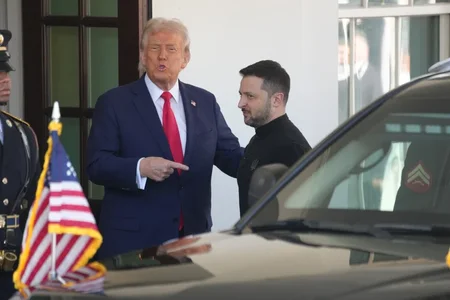
The synthesis of these concerns was yesterday's appearance in the Oval Office where hosts Trump and Valls engaged with their guest Zelensky in a nervous exchange of jokes that has never been seen before.
How will US-Ukraine relations continue? Will the US continue to support Ukraine? Will options and the presence of official Kiev be considered in the supposed peace talks with Russia, if these talks are still on the agenda?
Further: What will be the US's relations with Europe, about which Trump has not hesitated to speak badly, as if the EU is a structure that was born to impose its will on the US, and others?
Could it be that a Trumpist America will gravitate towards strategic alliances with autocratic or one-party powers like Russia and China in the phantom vision of a new Yalta, or a tripolar world, to which vassal zones of interest around the world would be subordinated?
What will be the fate of democracy in the illiberal order and realpolitik promoted by Trumpism?
Could it be that, while there was no need to invest in making Russia a democratic country, the US itself becomes an autocracy of billionaires?
There are a multitude of questions of this nature, unimaginable until a year ago. The answers are taking shape in the efforts of European countries to definitely maintain close strategic relations with the US. And to strengthen cohesion between them in order to strengthen defense capacities and grow as a major development pole with a population larger than that of the US and Russia combined.
Despite the apocalyptic prophecies, it can be said: first, there can be no second Yalta. There is no analogy to the real Yalta of February 1945 between Roosevelt, Stalin and Churchill, as leaders of the victorious powers of World War II. There is no context and no one in Washington or Moscow thinks so, I don't think.
Secondly, unlike Russia, which emerged from a centuries-old history of slavery, as the great Russian writer Vasily Grossman says, the USA was founded as a democratic country and became the world's superpower primarily thanks to democracy. As such, it cannot escape its fate. Illiberalism as a trend of a period can be grafted onto democracy with its innovations, but it cannot alienate it. In the USA, there are elections, there is independent justice, there is freedom of the press. Trump himself and his government promote freedom of the press, and this was even the main theme of Vice President Vance's speech at the Munich Conference a few days ago.
Third, US relations with Europe are unlikely to enter an irreversible crisis. The US and Europe are like arms of one body. Europe is strong with the US and the US is strong with Europe. Both would lose a lot without each other. Europe has admitted that it is ready to talk about balancing the tariffs that Trump advertises as unfair. Europe has officially committed to buying more energy, in particular liquefied gas and weapons from the US.
European leaders, French President Macron, British Prime Minister Starmer, Polish President Duda, and others, have not hesitated to go to the office and beg President Trump to maintain close friendship with the old continent. On the other hand, emphasizing that "the best thing would be for America to continue to consider Europeans as partners," the future Chancellor of Germany, Merz, a staunch Europeanist, has warned that "very negative scenarios for us may occur." But we must wait until he takes office and commits to the Chancellor's dress for a stronger Germany and Europe.
Trump's threats, in truth, have shaken Europe, which was poorly accustomed to favorable exchanges for itself and had lulled its mind into thinking that the US guarantees our protection. Beyond the words, scenes, and scenographies that are known as the President's talent, the only "new order" we see taking shape in this period is Europe taking responsibility for its own destiny.
To continue with the analogies, these days the Japanese Kabuki theater is being evoked, where the actors wear masks of cruel people, but real blood does not flow, it is all staging, scenography. "Therefore, we must begin to decipher the rituals of this gentleman, Donald Trump," suggests the newspaper "Corriere della Sera" with optimism.
In our small, from Albania, which is big for us, we want it to be like this: a staging, a scenography to force Europe to spend more on defense and buy more in the US. We don't want to see a US-Europe clash, we don't want to be in a dilemma about who to side with.


Lini një Përgjigje