


 Shkruar nga Veton Surroi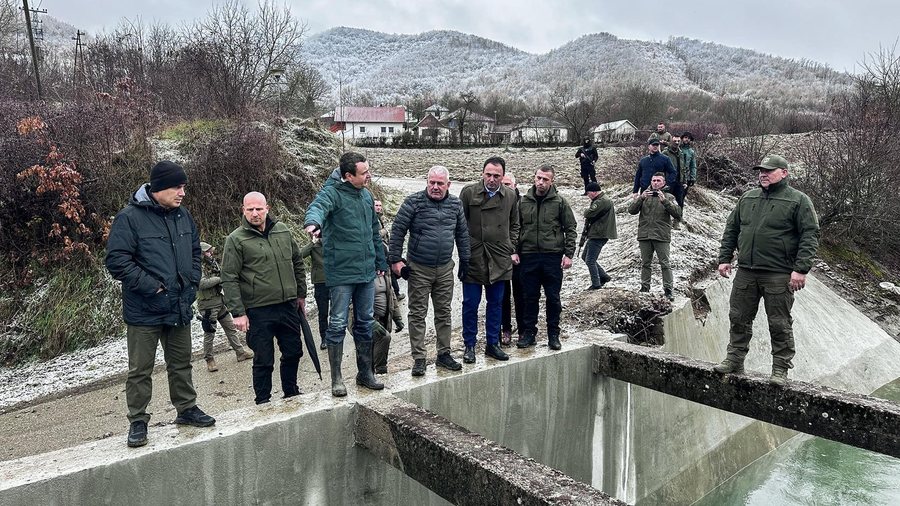
Zubin-Potoku was not a war zone and whoever planted the explosives does not belong to sabotage units, but to a terrorist operation.
Two days before the explosion occurred in the Ibër-Lepenci canal near Zubin-Potok, I was at a security conference for the Western Balkans at the Greek Army Officers' Club in Athens. To the room full of interested military men, diplomats and academics, whom I have known for the past thirty years, I did not have much new to explain in the details of the day, but I thought it was worth assessing the historic moment in that the region is going through with a statement made in the 17th century by the Dutch philosopher Baruch Spinoza.
It's been a long time since the pronunciation and there have even been appropriations (in the 20th century by Martin Luther King and in the 21st century by Barack Obama) - but the saying in the original and extracted from an extended sentence simply says that " Peace is not the absence of war", or it is more comfortably pronounced: "The absence of war does not make peace".
So, as Spinoza would describe it at the time, the fact that there is no armed war in a country or region does not mean that country or region lives in peace. And the Western Balkans would probably be the best example: next year marks thirty years since the Dayton Armistice Agreement and 25 years since Resolution 1244, which ended the war in Kosovo, but this period is not necessarily called a life in peace.
Peace, in its tangible European definition, is the state of free democratic societies cooperating with each other - with the four freedoms of movement of people, goods, capital and services - in a common space of security. Of course, it is also a culture of peace and reconciliation, it is also a confrontation with the past, and there are many other things. But, above all, peace is an active state in contrast to the passive state of absence of war that we live in the Western Balkans.
A Serbian liberal intellectual concluded at the same conference that there will be no more war in the Western Balkans, and to support this conclusion he made, as they usually did in Athens, valid arguments that there is weariness from wars and destruction, that the whole area is with the presence of NATO (three countries are members, Kosovo and BiH are under the protection of NATO, and Serbia is completely surrounded by NATO) and that the goals of all countries in the region are the EU. integration.
Arguments can find equally valid objections. For example, that in the environment of lack of peace, new generations have grown up who have not experienced war, but have spent day after day in the toxic narrative of war to qualify as soldiers of new wars. Or that NATO's presence has not eliminated, but rather encouraged an organized opposition to Russia in the Western Balkan states to try to prove NATO's inability to maintain peace in the region with a hybrid war . And, finally, it can be doubted that the whole region wants EU membership: Kosovo and Albania constantly show in polls that this is the only option of their societies, countries like Serbia or BiH are deeply divided in strategic affinities between The West and Eurasia.
But even if it were completely so - that the Western Balkans do not experience armed war - this does not remove Spinoza's conclusion that the absence of fighting does not mean peace. And it didn't even take 48 hours from the conference in Athens to prove the nature of insecurity and the dimension of danger that life in the absence of peace entails. In the Ibër-Lepenc canal, which provides a large part of the drinking water for a large part of Kosovo, as well as the critical water supply for cooling the power generation equipment in the Obiliq power plants, a significant amount of explosives, which caused damage that had the dimension of a strategic terrorist attack against Kosovo and at the same time contained the great potential threat to the country in the event that there would be similar explosions with a larger amount of explosives in the future and greater amounts of destruction.
The explosion in Zubin-Potok was similar in content to Russia's military actions against Ukraine's critical infrastructure - energy equipment or water supply - but instead of frontal warfare or aerial bombardment with missiles and drones, in this case, improvised explosive devices were used by persons capable of this.
And, this is where two assessment paths diverge. One that investigated some of the reactions, even of neighboring countries - without going into the motives that may have been contrary - called this an "act of diversion", immersing this act in a subconscious form in an operation guerilla regulars. paramilitary or military. So, sabotage is done by sabotage units, which traditionally operate deeper in the rear (destroying train tracks, knocking down bridges, etc.). But subversive units do this in war, and therefore make it legitimate and protected by the laws of war.
Zubin-Potoku was not a war zone and whoever planted the explosives does not belong to sabotage units, but to a terrorist operation. Herein lies the additional concern: the explosion in Zubin-Potok is the first terrorist escalation of this nature (of an attack against critical infrastructure) that could pave the way for other actions. The governments that gave it the name "sabotage" did not see enough of the devastating potential that the terrorist attack had for the future. In other words, even though they judge the action, placing it in the "diversion" category, they legitimize it as a normal military act.
The second evaluative path is more difficult, even more difficult to accept. And this is the analogy between Russia's actions in Ukraine against critical infrastructure (albeit with military means) and the terrorist action in Zubin-Potok. Immediately after the explosion, the initial debate about guilt began, which stalled with the accusation of the suspected parties behind this action. I don't think it is important to know who ordered such an operation. But I think that more than the accusation (for which perhaps there are still no indisputable facts) two things are clear.
First, the security sector in Serbia is still indebted to the previous question, that of the paramilitary attack in Banjska, led by Radoici. So how much did the security sector (including civilian and military intelligence services) know about this action? If he knew what he had undertaken, if he didn't, is it possible for paramilitary and terrorist organizations to be created in Serbia in violation of the country's laws?
And, since Serbia, through its president, has promised to cooperate in the case of Banjska and Zubin-Potok, can it be known whether or not there is knowledge and support from the security sector of Serbia for the two attacks against Kosovo.
And secondly, that the issue of relations between Kosovo and Serbia is necessarily also (or primarily) an issue of security, and not only regional. As a senior Greek official told the conference, his country had always thought of Europe as a unique security zone. And, as it was natural to answer, the unique European security area must mean the unique security area of the Western Balkans.



Lini një Përgjigje