


 Shkruar nga Pamfleti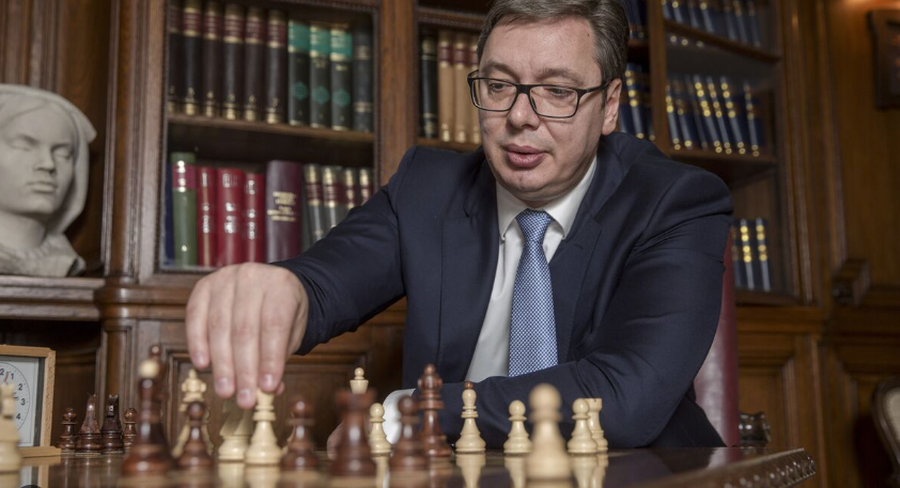
As Serbian media increases support for Russia in the Balkans, the West must counter Belgrade's disinformation...
When Ukrainian First Lady Olena Zelenska arrived in Belgrade on May 12, one media outlet called it "a signal of the Balkan country's departure from Moscow." Another drew a similar conclusion. But most Serbs in the Balkans do not see it that way.
Serbia's increasingly authoritarian president, Aleksandar Vučić, has tried to project an image of neutrality toward Ukraine, saying his country is not "the lackey of either side" while trying to position himself as a Tito-like figure who is in able to maintain friendly relations with the West.
To appease his Western friends, he is said to have sent some "lethal weapons" and humanitarian aid to Ukraine - apparently enough to ensure that there was little reaction to his regime's destabilizing actions in Kosovo in 2023. , where more when 90 NATO peacekeepers were injured, and the terrorist attack in Banjska.
Whatever Vucic says to the West, two years after the start of the war, Serbs across the Balkan region are openly supporting Russia's actions.
An International Republican Institute (IRI) poll in the Western Balkans published on May 14 found that the majority of respondents from Albania, Kosovo, Bosnia and Herzegovina, Montenegro and North Macedonia condemn Russian aggression in Ukraine, while 49% of Serbs they see them as "justified".
A significant number of Serbs also supported Russia's actions in Montenegro (31%) and Bosnia and Herzegovina (27%). About 29% of Montenegrins identified themselves as Serbs in the 2011 census, while in Bosnia and Herzegovina, 31% are Serbs, according to a 2013 estimate.
Their views echo those of Serbian news channels with close ties to the Vucic regime, which often broadcast pro-Kremlin propaganda in countries with significant Serbian populations.
Anti-Western narratives find fertile ground among Serbs, many of whom believe that NATO's military interventions in Bosnia and Herzegovina in 1995 and Kosovo in 1999 were unjustified.
Sometimes, when defending the Kremlin, Vucic compares the Russian invasion of Ukraine to NATO's bombing of Serbian targets during the Kosovo War, although there are differences.
The clear support for either side of the Russian-Ukrainian war is also a reflection of the Western Balkans region. Albanians and Kosovars overwhelmingly support Ukraine, while clear support for Kiev is more muted in Bosnia and Herzegovina, Montenegro and North Macedonia. In Serbia it is minimal (4%).
A significant proportion of Serbs (54%) are explicitly on the side of Russia, reflecting the strong ties between Belgrade and Moscow. In addition, Moscow is supported by a significant minority of Montenegrins (26%), Bosniaks (26%) and Macedonians (19%).
Russia does not have the economic influence of the European Union (EU) and China in the Western Balkans, but Gazprom and Lukoil continue to exert significant control over the energy sector in Serbia, Bosnia and Herzegovina and North Macedonia. Russian elites also own about a third of registered yachts in Montenegro, with its Adriatic coast, and almost 40% of real estate.
The most obvious reason that the Kremlin is in favor of the Serbs is the fact that Balkan elites such as Vučić (Serbia), Milorad Dodik (leader of the Bosnian Serbs) and Andrija Mandić (Speaker of the Parliament of Montenegro) have close relations with the Kremlin. supported by local and Russian media and the Serbian Orthodox Church. These connections serve as conduits for Russian narratives and shape public opinion and political positions in the region.
While Western states ban Moscow's propaganda channels, Serbia has welcomed Russia, allowing it not only to continue its information war from Sputnik Serbia's office in Belgrade, but also by launching RT Balkan, which has expanded its disinformation operations. Russian.
Both channels offer news in Serbian, allowing the Kremlin to reach a wide audience across the Balkans. Sputnik Serbia also works closely with local media, providing them with Kremlin-made propaganda.
While Serbia has offered some help to Ukraine, the regime has refused to impose sanctions against Russia because, Vucic said, "A friend in need is a true friend." He has sold dual-use military technology to Moscow and opened Serbia's doors to a significant number of Russian companies, creating opportunities to circumvent Western sanctions.
If the West wants to combat Russian disinformation in the Balkans, it must confront its epicenter: Belgrade, where many of the Serbian media organizations that parrot Kremlin propaganda are based.
Fighting Kremlin-linked media is also important because Russia is fueling secessionist sentiments among Serbs in Republika Srpska and northern Kosovo, which pose a threat to regional stability. A February report from the US Office of the Director of National Intelligence highlighted the potential for conflict escalation in the region.
Such an escalation would not only affect the Balkans, but would also have serious consequences for Ukraine, as the West has limited capacity to respond to further crises and wars./ CEPA


Lini një Përgjigje