


 Shkruar nga Auron Tare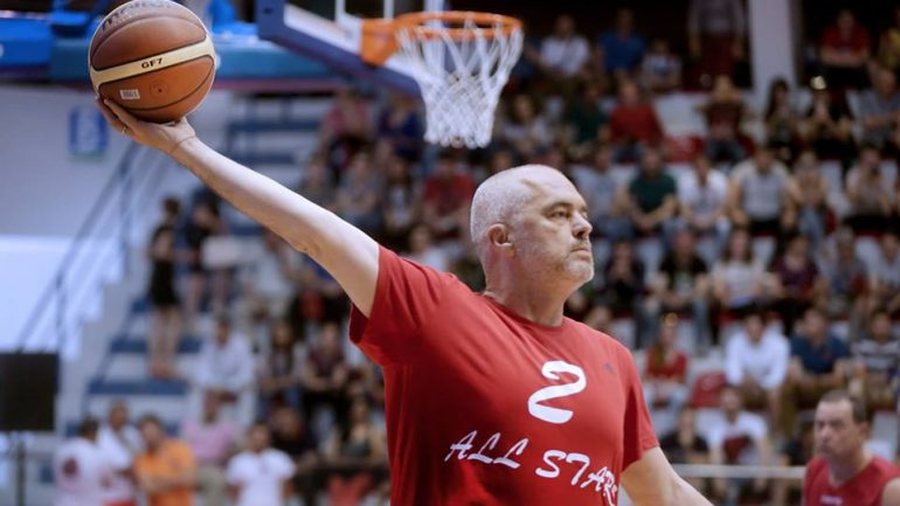
Even though we were separated by two clubs that were built to never love each other, the Army's Partizani and the Ministry of Interior's Dinamo, we in the army often heard stories and jokes that the young basketball player, Edi Rama, made at the expense of the regime.
Once upon a time, when we were young and we played basketball with the famous Partizan and Edi Rama with “Dinamo” always in second place, in the oppressive atmosphere of the time, we were both considered somewhat the rebels of our teams. Rama was much more advanced in his liberalism, but I too, although raised in the military discipline of Partizan, was often the object of criticism for “deviating from the Party line”.
Even though we were separated by two clubs that were built to never love each other, the Partizani of the Army and the Dinamo of the Ministry of the Interior, we in the army often heard stories and jokes that the young basketball player, Edi Rama, made at the expense of the regime. Rama at that time despised servility, patronage and partisanship, that environment of hypocrisy with which we were all forced to coexist.
And so, even though I don't remember the day or the moment when he brought into his circle a character who later reached me, Comrade Bule, I remember well the inspiration I received from her.
Comrade Bule was the typical neighborhood Party secretary. A little short, a little fat, a little clumsy, but always vigilant. She was the eye that observed and the ear that listened. Comrade Bule was everywhere, in the neighborhood, in the factory, in the cooperative, in the faculty. She was the embodiment of the person who lived to control the lives of others.
Rama had his friend Bule on the tip of his tongue. Reciting the famous verses, he would make fun of all the “Bules” of the faculty and the environment where he lived. Through him, this character also reached us at “Partizani”. I was the youngest in the team and I always looked at Rama with admiration for his open anti-conformist courage and of course I took my friend Bule to use in our Club environment.
But my friend Bule brought me another, much more important discovery.
Through her, I met one of the most courageous Albanian anti-conformist poets of that time, Kiço Spiri. A very special character from Zagoria, eccentric, with a language that could not be silent and with a rare talent for constructing verses with double meanings.
His poems circulated secretly in Tirana, only in trusted circles. They were read with avidity, because they were a breath of freedom at a time when even humor was considered a political danger. They hit all the "Bules", the Party secretaries, the doctrinaires, the petty spies and all those who, in the name of the Party line, destroyed people's lives.
***
This beautiful memory from my youth, when both Rama at Dinamo and I at Partizan, admired Kiço Spiri, came to mind these days.
In my public space, where I write my thoughts, I have been attacked by a whole kennel of "Bules". Unfortunately, today they are no longer called neighborhood party secretaries. Today, the Bulets are called patronageists.
But there is a difference.
Yesterday's "bule" were ordinary, uncultured women, dressed in the typical party style with Berati basme, whom people feared for the small power that the system had given them.
Today's "bule" are more elegant. They are young deputies, boys in white linen shirts, with expensive perfume, modern phones and luxury cars. Some even speak a little English, just enough to seem "cool". They also work in the administration, in modern offices and present themselves as the faces of a new generation.
But, essentially, in origin, they remain the same ones that Kiço Spiri described with such mastery and that Edi Rama once recited with such pleasure, a caste of party-minded ignorants, convinced that loyalty to power is the greatest virtue and that free thought is the enemy of this virtue.
Therefore, for all of today's "Bulle" in memory of that time when Kiço Spirit's poetry illuminated our minds and souls, I greet all of today's patronageists with one of his pearls, inspired by a true event and with a title that remains as current as it was then. "Remarks in the biography".
Kicua tells how one day he took his 4 goats to graze on the border. However, Kicua's goats inadvertently entered the Greek land with better grass. The "bullets" of the village, after learning about this event, urgently convened the Village Council and judged Kicua severely, even proposing his exile from the village, which was ashamed by this essentially "class" event.
And Kicua, with his Zagori arrogance, did not give in to "Bule" and wrote the next gem where he carved the portrait of Bule who, with her finger raised, unmasked the poor Kicua in front of the village.
"Remarks on the biography"
K.Th.Spiri of Zagoria,/ What did the goat's wedge do
to you? Your goats are traitors,/ They are whores, that's what!/
They didn't like the goats of the country,/
They wanted a goat of the poor!/
You have blackened both our cheeks,/ You have touched
the honor of the nation!/
Albanian goats were needed/
To ride the Greek goats!..
And so the tragedy and comedy of the Bules continued with Kico from Zagori, who, without spoiling the story at all, greeted "Bules" with another pearl.
"If Kico doesn't surrender, come on, the corn is healthy."





Lini një Përgjigje