


 Shkruar nga Pamfleti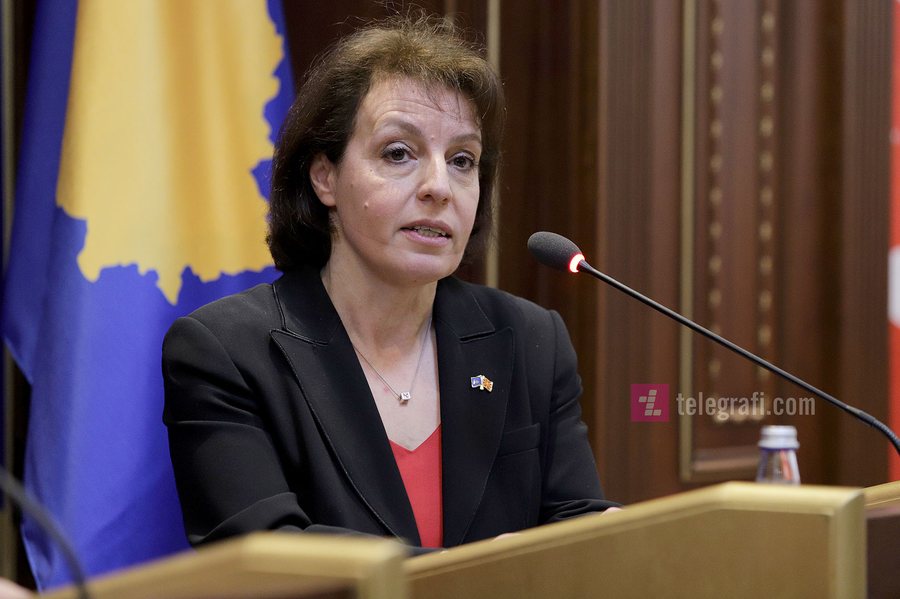
The Minister for Foreign Affairs and Diaspora of Kosovo, Donika Gërvalla, has said that Kosovo will be able to review the draft statute proposed by the West for the creation of the Association of Serb-majority municipalities, only if that document is part of the Basic Agreement for normalization relations, reached between Kosovo and Serbia, a year ago, and if Belgrade respects it.
"There is a logic why it should be part of the package, because the package foresees de facto recognition by Serbia. Such a document is not healthy for our country at the moment when we don't even have de facto recognition, let alone de juro recognition by Serbia".
She made these statements in an interview for the news agency, KosovaPress.
According to Gërvalla, currently the Government of Kosovo cannot proceed with the draft for the Association, since, according to her, the drafts are not sent to the Constitutional Court for review.
"The drafts must go through several stages before being sent to the Constitutional Court. And this draft, as it is, separated from the package we have in Brussels, cannot be processed further by the Government at any step", said Gërvalla.
She said that this draft is part of the Basic Agreement, which Kosovo plans to withdraw.
"What we have said, we have proposed to our partners that if they consider that we cannot achieve success with Serbia in a bilateral way, then we, as a responsible Government, have shown our willingness to sit down with representatives of the Serbs in Kosovo, as well as we draw up a document that respects our constitutional order, our laws, but also meets some demands of the Serbian community in Kosovo. For this proposal, we have not yet encountered the readiness of our partners". The international factor insists that Kosovo should form as soon as possible the Association of municipalities with a Serbian majority.
Failure to take steps in this direction has penalized Kosovo with non-participation in the Council of Europe - the leading organization for human rights - earlier this year. Kosovo and Serbia have reached agreement on the Association in 2013 and then in 2015 on the principles for its establishment. In 2015, the Constitutional Court of Kosovo found that the agreement is not in full harmony with the Constitution.
Serbia demands that Kosovo implement the agreements reached, but the Government of Kosovo has declared against a mono-ethnic association. Last year, European officials compiled a draft statute for the Association, which was accepted in principle.
But, later, the prime minister of Kosovo, Albin Kurti, described this document as "non-paper". In the language of the European institutions, non-paper is an informal document, which is exposed in closed negotiations within the EU institutions, in an attempt to find agreement on any disputed issue.
Kurti said earlier in the week in an interview for A2CNN that the EU emissary for the Kosovo-Serbia dialogue, Miroslav Lajçak, can send the draft for the Association to the Venice Commission.
The European Union has reacted to this statement, saying that the Brussels agreement on the Association does not foresee something like this. Serbia does not recognize Kosovo's independence and is constantly engaged in lobbying campaigns against Kosovo. The two countries have been in dialogue in Brussels, for the normalization of relations, since 2011.
The parties have signed a number of agreements, but not all have been implemented. The European Union has repeated several times that the solution of all problems between the two countries is a very important factor for their European path.
Gërvalla for Osman: We don't always need to agree 100 percent
During the interview for KosovaPress, Minister Gërvalla also spoke about her relationship with the President of Kosovo, Vjosa Osmani. Discussions in this direction have grown each time more and more, since the Presidency of Kosovo has said that the Government has not consulted with it, regarding the steps that Kosovo has taken for membership in the Council of Europe.
"We, with the president of the Republic, have always had good relations and I have no reason to think that there is a change in our relations. I am of the opinion that we do not always need to agree 100 percent on all topics. Of course, as people who carry many responsibilities, in different spheres, sometimes we have different opinions about different processes".
According to her, even when there are differences between high state officials, they find "a way out and a common language".
Kurti said days ago that he does not believe that there are insurmountable differences between him and other heads of state, including President Osmani.
Osmani himself has said that the differences are surmountable when the state and citizen interest is placed above all./REL



Lini një Përgjigje