


 Shkruar nga Pamfleti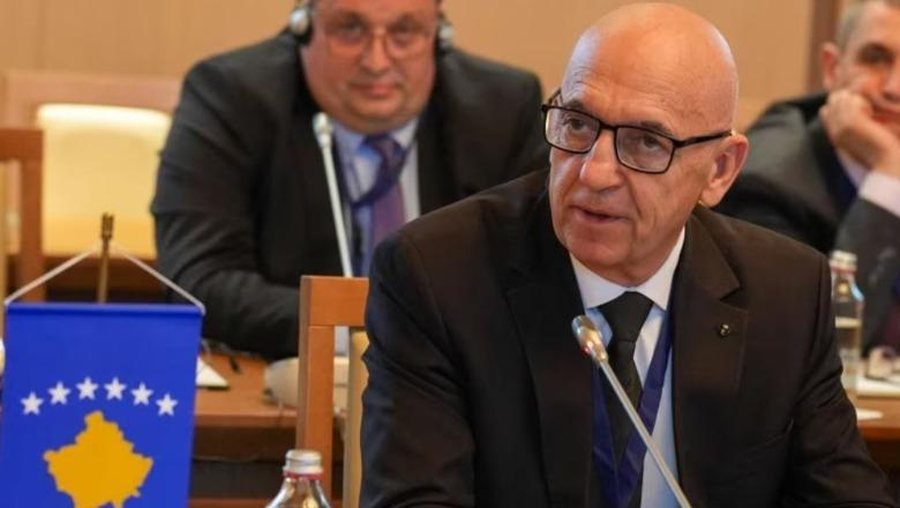
The Kosovo Prosecutorial Council (KPK) dismissed Besim Kelmendi from the position of Acting Chief State Prosecutor on Thursday, reports Betimi për Drejtësi.
According to reports, the dismissal was made by five votes, while Agron Qalaj was appointed as Acting Chief State Prosecutor in his place.
The proposal for Kelmendi's dismissal was made by Council member Jehona Grantolli.
Ardian Hajdaraj, chairman of the Council meeting, said that there was a sufficient quorum for voting at the meeting and Kelmendi's presence was not necessary as he would have had to be excluded from the process, since the discussions were held for him.
Kelmendi left the hall a few minutes before the vote, after discussing with other members of the KPK, he assessed that the proposal for his dismissal was an attempt to destroy the system.
His dismissal comes a day after he held an extraordinary press conference in which he denied reports that he had collaborated with Serbian judge Danica Marinkovic in 1999, who was in charge of the Recak massacre case.
At the time, Marinkovic was working as a judge at the District Court in Pristina, and had described the massacre as a "fictional event."
45 Albanian civilians were killed in that massacre.
Kelmendi confirmed that on Wednesday he appeared as a witness at the Kosovo Special Prosecution Office regarding his work in court at the time the massacre occurred.
According to him, at that time he was employed at the District Court in Pristina as a professional associate, emphasizing that he performed the work of a clerk, therefore he denied the accusations that he was Marinković's assistant.
According to him, Marinkovic was the judge who "disappeared evidence of the Recak massacre."
His statements come after claims by local media in Kosovo, Paparaci, that Kelmendi had been involved in handling the Reçak case in 1999.
Radio Free Europe has not been able to verify reports so far regarding the dismissal.
During the November 19 conference, Kelmendi was also asked why he was invited as a witness to the Special Prosecution Office.
"I was called as a witness because a person who was a prosecutor at the time, named Ismet Shufta, when asked who worked in the Court, mentioned the names of people who came to mind. My name also came to mind because today I am the Acting Chief Prosecutor. I don't know why, because I didn't receive any explanation," said Kelmendi.
He added that he is willing to go to the Prosecutor's Office again about this case.
The claims made at the time by Serbian judge Marinković about the Recak massacre are in line with the current narrative that the Serbian authorities have about this event.
William Walker, who served as head of the Organization for Security and Cooperation in Europe (OSCE) Verification Mission in 1999, documented the crimes committed in this village.
After the Racak massacre in March 1999, NATO attacked military and police targets in the former Yugoslavia.
After 78 days of attacks, the bombings were halted on June 10, 1999, with the adoption of United Nations Security Council Resolution 1244.
NATO's intervention in Kosovo also enabled the return to their homes of more than 800,000 refugees, displaced persons inside and outside Kosovo.
In the war in Kosovo in 1998/99, over 13,000 civilians were killed and thousands more disappeared.
Nearly 1,600 people are still missing – most of them Albanians./REL



MASAKRA E REQAKUT SI DHECTE GJITHA MASAKRAT TJERE QETNIKE FASHISTE TE SERBISE JANE BERE QYSH PREJ KOHES KUR EVROPA UA SHITI TROJET E DARDANISE DHE NGA 1878 KUR VEQ BISMARK E NENSHKROI MARREVESHJEN DHE FINALISHT KJO U MUNDESU NE VITIN 1912 KU I MOREN KETO TROJET TONA.ATA FILLUAN ME MASAKRA MIZORE ME KOHEZGJATJE NE CDO PESE VITE NJE MASAKER TE RE 1912 I NDOQEN DHE MASAKRUAN DHE I DOGJEN PER TE ZHDUKUR GJURMET E KRIMIT PASTAJ EDHE 1913 1924 1944 1945 MASSKRAZE TMERSHME E TIVARIT 1950 1956 1060 1965 1972 1978 DHE MASAKRAT 1981 1988 1989 1990 1998 1999 .