


 Shkruar nga Pamfleti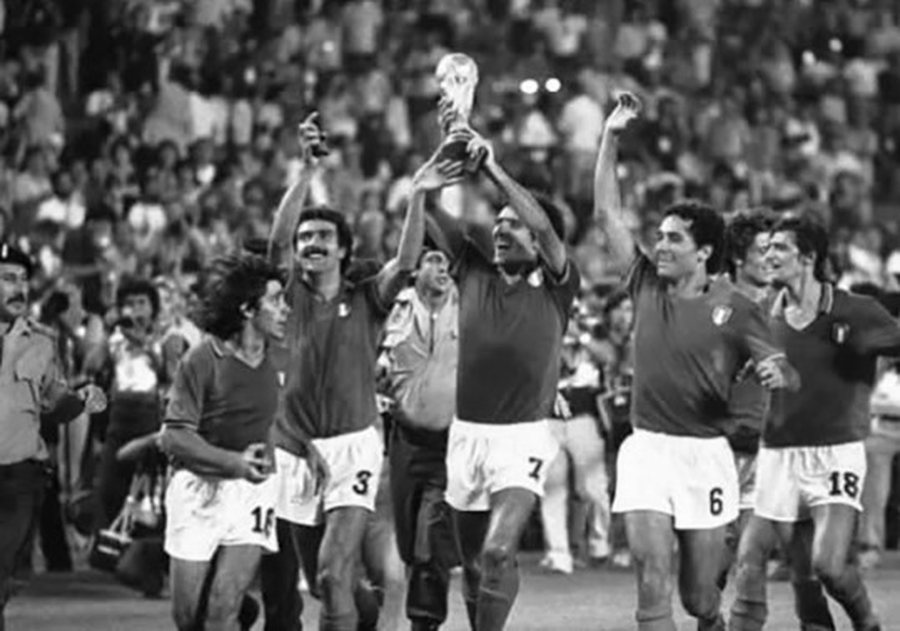
Spain 1982 will remain one of the most special World Cups in football history. Italy was declared world champion after a 44-year wait, while the tournament also marked a historic moment for the World Cup itself, as 24 teams participated for the first time, instead of the 16 that had competed until then.
The Italian success came under the guidance of coach Enzo Bearzo, with Paolo Rossi as the team's most prominent figure. The Italian striker became the symbol of the Azzurri's triumph, leading the team to its third world trophy.
A World Cup in the shadow of the Falklands conflict
The tournament began just two days after the end of the Falkland Islands War between Argentina and Great Britain. Although the British emerged victorious in the conflict, the English team failed to repeat their success on the football field, being eliminated in the semi-finals by West Germany.
Even defending champions Argentina couldn't get far. Along with Brazil, they were stopped by Paolo Rossi's Italy, who scored four of the five goals that sealed the elimination of the two giants of world football.
Europe dominates participation
In the 1982 World Cup, Europe had the largest representation with 13 teams, not counting the host country Spain. South and North America were represented by four teams, while Africa, Asia and Oceania had two teams each.
Among the major absentees was the Netherlands, world runner-up in the previous two editions, who failed to secure qualification. In contrast, England was returning to the world stage after a long absence.
Difficult start for the Italians
The tournament began with surprises. Argentina was defeated by Belgium in the opening match, while West Germany unexpectedly lost to Algeria 2-1.
Italy, on the other hand, did not start convincingly. The Azzurri drew all three of their group games and only advanced to the next round on goal difference. Few could have imagined that this team, struggling to win a single match, would lift the trophy at the end of the tournament.
Meanwhile, West Germany managed to secure a place in the final after a dramatic semi-final against Michel Platini's France, won after extra time and penalty kicks.
Madrid final
On July 11, 1982, at Madrid's Santiago Bernabéu Stadium, Italy and West Germany faced off for the world title.
The Italians found themselves in trouble in the opening minutes, with Francesco Graziani forced off injured. A little later, Antonio Cabrini missed a penalty, adding to the tension in the Italian camp.
However, in the second half everything changed. In the 57th minute, Paolo Rosi opened the scoring. Marco Tardelli then scored the second goal after a beautiful collective action, while Alessandro Altobelli sealed the victory with the third goal.
The Germans only managed to score a consolation goal through Paul Breitner. The match ended 3-1 and Italy was declared world champion for the third time in history.
Paolo Rossi, hero of Spain 1982
Paolo Rosi was undoubtedly the main figure of this World Cup. Born in Prato in 1956, he began his career in the youth ranks of Juventus, but broke through to Vicenza, where his talent was noticed by all of Italian football.
In 1981 he returned to Juventus and a year later made history at the World Cup. With six goals, he was named the tournament's top scorer and the competition's most outstanding player.
Rossi scored three goals against Brazil in the second group stage, two against Poland in the semi-finals and one in the final against West Germany. These performances made him a symbol of Italian success and one of the biggest names in world football history.
After the World Cup, he continued to excel with Juventus, winning important trophies, and later played with Milan and Verona, where he ended his football career at the age of 31.



Lini një Përgjigje