


 Shkruar nga Pamfleti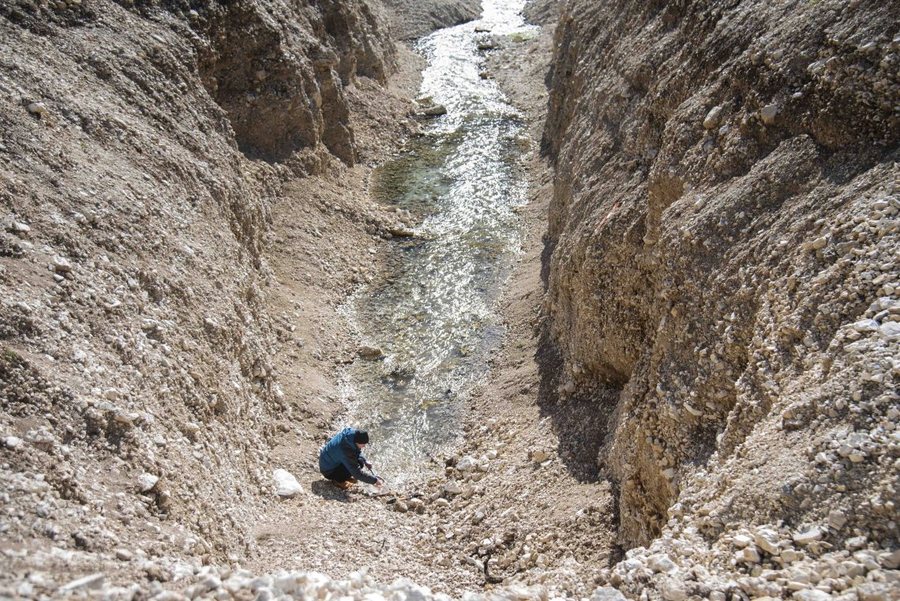
In the center of the village of Kuç, which lies in a valley winding between the mountains of Labëria, a handful of men and environmental activists gathered on Tuesday to express their opposition to the construction of the new Himara aqueduct that diverts the river's water. of Shushica, branch of Vjosa.
They are part of a group of 54 residents of Brataj, Kotë and Kuç administrative units who together with the Center for the Protection of Natural Ecosystems in Albania "Eco Albania" filed a lawsuit in the Administrative Court of Tirana demanding the cancellation of the construction permit, the cancellation of the decision on the preliminary assessment of the impact on the environment, as well as the cancellation of the permit for underground water use.
One of the residents who signed the lawsuit, Mit'hat Balilaj, 70 years old, from the village of Kuç, told BIRN that the diversion of water would bring disaster to the community.
It is a sin to blacken everything here for a drop of water", said Mit'hati, while emphasizing that water was their greatest asset. "It is the extermination of the community," he warned.
"My son came back from Germany to build a complex, but now with the news of the water supply, he canceled the plans," added the 70-year-old, while stressing that "without water we can't do anything."
Along the valley of Shushica lie around 30 villages of the municipality of Himare and the municipality of Selenica that are affected by the project of diverting the river of Shushica to supply water to the coastal area of Himare. Residents of these communities claim that they were not present in any of the consultative meetings for the implementation of the project.
The new Himara aqueduct is being built by the Albanian Development Fund as part of the Rural Aqueduct Rehabilitation Program IV. The fund did not respond to a request for comment from BIRN on the valley residents' allegations by the time of this writing.
This project envisages the diversion of water from Lëpusha - the main source of Shushica, towards the city of Himara and other coastal villages to serve about 80,000 residents and many tourists who rest on the Ionian Riviera during the summer months.
The people of the valley recognize that everyone deserves to have a supply of drinking water, but this should not be done at the expense of other communities.
"These river diversion projects are not new history, they have been discussed several times during the last 50 years, but it has never been realized until now due to the social and environmental consequences", said Astrit Balilaj, the headman of Kuç village.
According to the headman, even in the previous projects, it was found that the water of Shushica barely met the demands of the valley community and could not be diverted to quench the heat of the coast.
"There are 30 villages whose ecosystem is being destroyed," said one of the residents gathered on Tuesday in Kuç, while adding that so far they had organized six protests in defense of the cause. "In July-August here it will be completely dry if they take away our water", he added indignantly.
Experts and scientists who have been dealing for years with the study of the ecosystem and species living in the waters of the Vjosa and its tributaries, affirmed for BIRN that the Environmental Impact Assessment report of this project is wrong and not based on scientific evidence.
"The EIA is wrong and also misleading," said Friedrich Schiemer, a professor from the University of Vienna.
According to the data of the environmental organization Eco Albania, the report of the Environmental Impact Assessment (EIA) carried out in 2020 is a preliminary and erroneous report, which also served for the issuance of the environmental permit by the National Environment Agency.
This report cites that there are no rare endangered species that have been recorded in these waters, but scientists who have been studying the waters of Shushica for years report that there are actually hundreds of endangered species in the source and in the lower river.
The report also falsely claims that the project does not interfere with any protected area, while experts say that this area is already part of the Vjosa National Park.
Olsi Nika, head of the Eco Albania organization, emphasizes that the Vjosa river was declared a national park together with its two branches, one of which is the Shushica river.
"The protection enjoyed by a national park, according to the law on protected areas, excludes any development of an infrastructural construction, such as the water supply construction project," said Nika.
Vladimir Ganaj, forest engineer and resident of the valley, appreciated the source of Shushica as a natural monument.
He said that the government and decision makers were questioning the future of the community.
"Taking the water of Shushica is like removing the queen from the bee hive and letting the flies catch them," Ganaj said regretfully. /BIRN








Lini një Përgjigje