


 Shkruar nga Pamfleti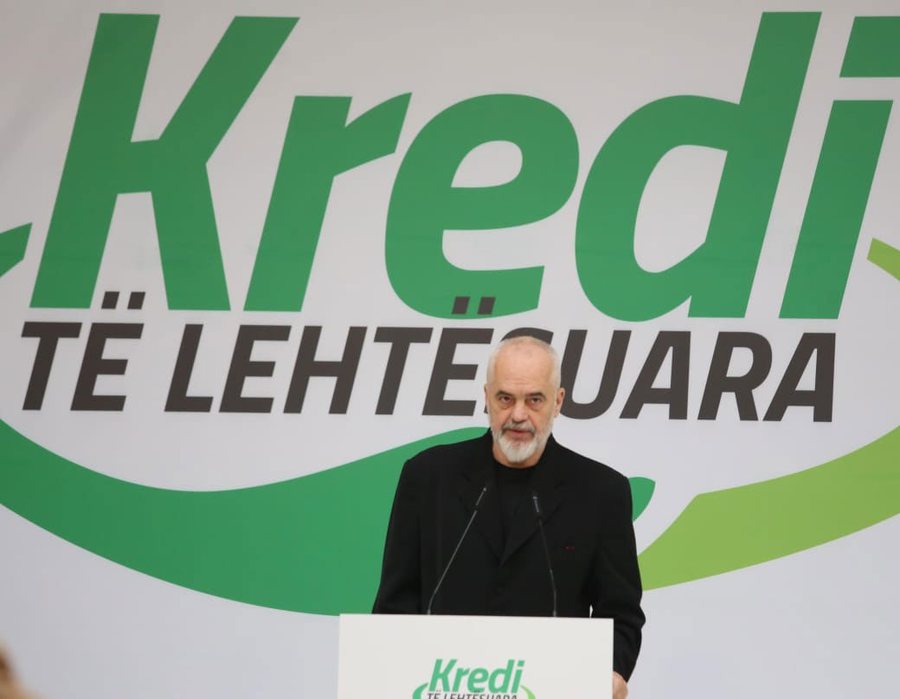
This year, a method for learning German without a teacher became a much sought-after book in the modest book market in Albania, apparently not so much because of the passion discovered by Albanians for learning foreign languages than because of German aspiration.
But what does Germany offer more than Albania? According to Rama, it offers nothing compared to his governing package. He declared as a tempting offer a government program aimed at subsidizing interest on home loans for doctors, soldiers and policemen. According to Rama, this program "is the best and safest way, among other things, it gives you more inner peace than living in a foreign country, 99% of which you can't even touch, you can only see , as you see them in a shop window, because the prices are high." And also, according to Rama, in Germany, you don't have time to drink a coffee and chat in Albanian. [Rama's speech link]
He further argued that in Switzerland, people who receive a salary of 5,000 or 6,000 francs "can't make ends meet".
It is a moment for reflection: what does Germany offer more than Albania?
Man lives for work as well as for pleasure, and historically, while the world has found ways to measure work, to calculate it on the basis of needs, and to make these comparable from country to country, it has hardly found ways to measure the fun, or rather, the pleasure of drinking Turkish coffee. And since we can't figure out how to measure pleasure, we can measure the economy.
The minimum wage in Germany is currently 12 euros per hour [link] while in Albania it is 2.3 euros per hour. [Link] It is absolutely true that in Germany, the prices of goods and services are more expensive than in Albania, so to say that the German worker receives 19 times more salary than the Albanian worker, this is untrue. It's just that the world has learned a style to compare these two figures and, contrary to what the prime minister assumes, the result is obviously that 5 or 6 thousand francs in Switzerland are somewhere more than 40 thousand ALL in Albania. The tool that the world has invented to compare these figures, taking into account the different prices, is called "purchasing power parity". It was actually invented as a tool by the British newspaper The Economist in 1984, before it became the standard of world economics. Its logic is as follows: if a hamburger in Germany costs 6 euros while in Albania it costs 2 euros, then 2 euros earned in Albania is equal to 6 euros earned in Germany.
It is understood that the International Monetary Fund, the World Bank or Eurostat use not only the price of hamburger but a multitude of prices of goods and services to make the economic conditions of Albania and Germany comparable. And Eurostat accounts [link] says that the Albanian economy, with or without the governing foresight of the prime minister, continues to be the poorest economy on the continent, where, taking into account the purchasing power parity, the gross domestic product of the Albanian is as much as 34 per percent of the European average. This means that in Germany, both the simple worker, as well as the average or the high one, earns on average three times more than he can earn in Albania.
It is understood that the comparison of income in itself does not have a high measuring value. Man does not live only for money, although, I believe the Prime Minister agrees with this, when you have a lot of money, it is better than when you have little. Social structure, property structure, quality transportation, environment, climate, heating or air conditioning system, these are comforts that do not depend entirely on the level of income, but also on the type of society that politicians create.
For example, in Germany, the vast majority of the population lives in rented housing and rented housing often eats up a third of income, while in Albania, the majority of the population lives in their own home and rent-free. In Germany, the houses are warm, while in Albania, poverty is such that it often does not allow the citizen to pay for a comfortable environment. At most you can heat a room or half a room.
On the other hand, the worker in Germany expects to receive a pension of 1,500 euros per month, while in Albania, the average pension is 160 euros per month. [Link] If the prime minister prefers popular comparisons, we can say that a German pensioner, after removing a third of the pension for the house rent, has 20 turkeys left to buy, while the Albanian, not taking into account the electricity bill, he still has a little more than three turkeys left.
The Prime Minister spoke in a pseudo-event organized with pomp by him to announce that somewhere around 300 families, from public administration employees, including doctors, will benefit from loans with interest subsidized by the taxpayer. This cannot avoid mentioning the fact that Germany is recruiting foreign doctors to provide free health services to its population, something that in Albania, maybe only Rama does not know that it is not free.
However, such comparisons are only trivial details. The author of these lines is one of those who believe that Albanians are not leaving the country for higher salaries in Germany or elsewhere. Economic inequality cannot explain why in 2023 there are Albanians ready to risk their lives in rafts to cross the English Channel. Albanians are not fleeing to Germany for higher wages.
The three hundred families expected to receive self-subsidized interest loans are expected to benefit, according to a rough estimate, around 35-45% of what they would have spent if they received unsubsidized loans. So, if they get, say, a 100,000 euro loan, they would have to pay 140,000 euro with interest. This is based on the current home loan interest in the Albanian banking market (it is 4% and not 6, as the prime minister said), as well as the assumption that the loan will be taken with a term of 15 or 20 years.
There are two bad news for doctors, policemen or teachers who are hoping to buy a house: first, thanks to the enlightened policies of the Rama government, including a three-year block on building permits when he came to power, the lack of expansion of the main cities of country with regular urban plans or allowing crime money to park drug money in the construction market, housing prices have doubled over the past six years, according to the calculation of the Fischer Index by the Bank of Albania. [Link] In short, the interest subsidy is not even enough to cover the completely illogical increase in house prices. And the second piece of bad news is that, with current public sector salaries, it is unlikely that the vast majority of government workers will be able to afford the monthly installments.
If you get a loan of 100,000 euros, even with zero interest, the monthly installment is 420 euros per month for a 20-year loan and 555 euros per month for a 15-year loan. Banks do not grant loans with an installment higher than one third of the annual income and, if you have a salary of 700 euros per month, which is the average net salary of the public sector at the moment, this loan is a bit difficult.
The increase in the price of real estate over the last few years in Albania does not seem to have come from any sudden increase in costs. At least, if we believe the figures of INSTAT, the cost continues to be more or less 300 euros per month, despite the fact that the prices have gone five times the costs. While subsidizing loan interests may help the Prime Minister deliver another speech to the extras in his theater of the absurd, perhaps it is better for the Government to ask why property prices have soared to such levels relative to costs and what can be done to provide affordable housing for everyone, whether they are state employees or private employees.
Maybe drinking coffee probably tastes better in Albania (which I'm not sure about), but as far as the rest is concerned, the far-sighted policies of the Albanian government clearly make Albania the loser./BIRN





Lini një Përgjigje