


 Shkruar nga Pamfleti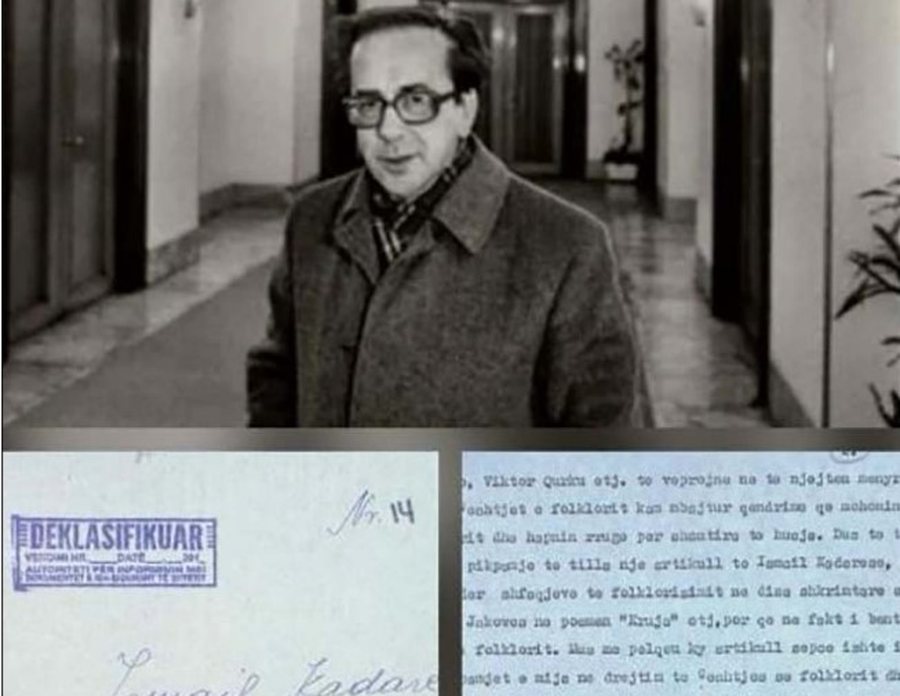
January 28 marks the 90th anniversary of the birth of writer Ismail Kadare, one of the most important figures in Albanian and European literature.
Archival documents of the former State Security show that, although Ismail Kadare was not directly affected by the regime's repression during his lifetime, and was even appreciated by official authorities, he was under surveillance by the dictatorship's structures. One of these documents dates back to 1977, a period when the so-called "enemy and anti-party group" in art and culture, headed by former Minister of Culture Fadil Paçrami, was targeted.
As part of the investigations, the testimonies produced under fear for their lives also include the name of Ismail Kadare, who is mentioned as a writer who, according to the language of the time, had "treated reality with a critical eye", had expressed opinions that "contradicted the official line" and had produced poems and articles considered "problematic for ideology".
The Files Authority (AIDSSh) has declassified the document with the note "For Ismail Kadare: The Party should be notified and the material should be preserved", it is evidence of the mechanism of fear and ideological interpretation of literary creativity and keeping the individual under constant surveillance.
In this sense, the document did not produce punishment, but according to the philosopher Hannan Arendt, such documents keep the individual in a state of permanent uncertainty, which is one of the most effective forms of domination. In the book “The Origins of Totalitarianism”, Arendt explains that totalitarian regimes do not need to strike everyone at once; it is enough for everyone to be potentially strikeable. This is precisely what happens here: the writer is not punished, but is recorded, interpreted, archived and kept under surveillance, a way of transforming creative freedom into self-control.
Transcript of Fadil Paçrami's statements
"I have had views contrary to the Party's line on the issue of handling conflicts in the field of literature, art and culture. I have brought out the conflicts within the people more sharply than necessary, an action that led to unjust solutions, contrary to the Party's line on conflicts within the people. With these views, I have encouraged other creators to handle the issue of conflicts in the same way. I have had such conversations on this issue with Ibrahim Uruçi, Kujtim Spahivogli, Bardhyl Kosoven, Riza Hajrion, Qamil Buxhel and Ismail Kadarena. With these views, I have distorted our reality, treating bureaucracy as a phenomenon that has taken on large proportions in us, our apparatuses and administrations completely bureaucratized and our leaders as bureaucrats.
By acting in this way, I paved the way for other creators such as Qamil Buxheli, Fadil Paçrami, Ismail Kadareja, Fatos Arapi, Sulejman Mato, Viktor Gjika, etc., to act in the same way. Even in matters of folklore, I have held positions that denied the values of folklore and paved the way for foreign performances. I would like to highlight here an article by Ismail Kadare, who spoke out against the performances of folklorization in some writers and poets, such as in Kol Jakova in the poem 'Kruja', etc., but which in fact dealt a blow to folklore itself. I liked this article because it was close to my views on the issue of folklore and the fight against folklorism, but in fact folklore itself was being fought.
Another harmful phenomenon in our poetry has been the creativity that looks at everything with a critical eye in the Albanian reality. This type of poetry actually took on the character of denigrating life itself and our system. Here, creators who had unjust intentions, who opposed our development, benefited. This tendency has been seen in the poems of Fadil Haliti and Ismail Kadare, which I have encouraged and have given the opinion that they are publishable, because these poems, in different forms and ways, have opposed our reality . / Panorama





Lini një Përgjigje