


 Shkruar nga Pamfleti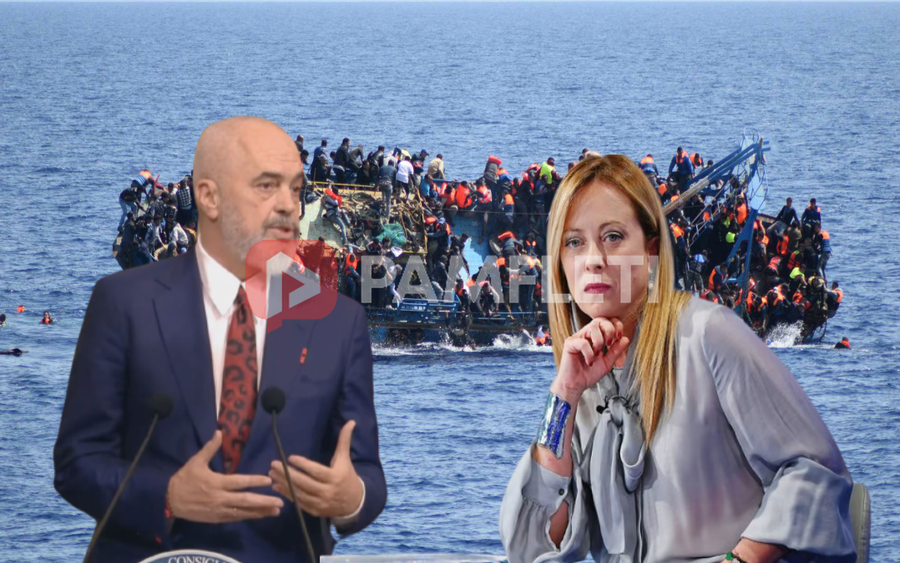
ECRE lists 7 violations of the pact, as it makes it clear that Italy cannot exercise sovereignty in Albania...
The European Council for Refugees and Emigrants (ECRE) has overturned the Rama-Meloni pact. The organization has come out with a statement, where it has analyzed the draft in detail, while also showing the problems that are noticed there.
ECRE lists 7 violations of the pact, as it makes it clear that Italy cannot exercise sovereignty in Albania, no matter how hard it tries and no matter how many concessions Official Tirana can make.
"The agreement contains very few details about what will happen in the centers, what their purpose is and how they will be managed, so it is difficult to comment on the legality of what is planned. Meloni's comments to the media suggest that the plan is to manage a screening process at the centers, however, language in the protocol suggests that asylum border procedures and return procedures will be conducted at the shelter centers," the report noted.
Problems according to ECRE
1- The extra-territorial application of the control process and border procedures of asylum and return is not allowed.
Although the content of the legal instruments is still under discussion, the management of the review process, asylum or return procedures is prohibited by the relevant legislation (Review Regulation, APR, Return Directive). Under current EU law, the asylum process and procedures take place on the territory.
2. Compliance with procedural guarantees will not be possible.
Even if this were not the case, ensuring compliance with the required procedural safeguards would most likely not be possible outside the State's territory, despite the limited references in Article 6 to access to the centres. In addition, primary EU law applies, including the Charter of Fundamental Rights, and the model is likely to breach a number of Charter rights.
3. The automatic use of detention is not legal.
The proposal appears to provide for the automatic use of detention. The protocol refers to the "staying" of people in the centers. It must be assumed that this is detention. The period of stay cannot be longer than that allowed by the legal framework in Italy. When it ends, people are not released in Albania, but leave the Albanian territory (Article 9.1). There is no doubt from the description that the centers are detention centers and will be considered as such according to national and ECJ jurisprudence.
4. Conditions in the centers are likely to be illegal.
Beyond the use of detention, the conditions inside may be in violation of EU law and IHRL, raising questions about access to rights, including rights to health care, dignity, justice, etc.
5. Diversion of Search and Rescue Operations (SAR) towards Albania will often be a violation of the International Law of the Sea (ILOS).
Obligations under ILOS vary depending on where people are rescued (in the territorial sea or on the high seas, or in another state's SAR area) and which state is coordinating the rescue, among other factors. However, some general remarks can be made. According to ILOS, there is a duty to rescue people at sea and rescue includes transporting them and landing them in a safe place. Possible violations include: 1) it is not clear that Albania is a safe country (for example, for victims of trafficking, of which there are many among those rescued in the Mediterranean; 2) it is not clear that the transportation of people rescue to stop them constitute transport to a safe place (of course it violates IHRL); 3) the usual interpretation of ILOS (which Italy accepts) based on the 2004 amendment of the SAR Convention is that people should be transported to the nearest place of safety.
6. Albanian law cannot be bypassed
There may be potential legal challenges in Albania. Despite the claims in the Protocol, Albanian law will continue to apply. According to international law, it is not possible for a state to issue jurisdiction over a part of its territory for the purposes described (it is not similar to a diplomatic mission for example). Albania is also bound by the ECHR and all other international treaties, its signatory. Albania has gradually adopted the EU acquis, including asylum.
The people will be under Italian jurisdiction, but they are not on Italian soil; they also remain under Albanian jurisdiction.
7. Practical obstacles
It is not clear how vulnerable people will be excluded from them. This creates legal and practical problems. / Pamphlet





Lini një Përgjigje