


 Shkruar nga Pamfleti
"Anyone who doubts NATO's military intervention in Serbia should go and visit Poklek ." Lord George Robertson's iconic quote refers precisely to such scenes...
One of the worst massacres of the Kosovo war among the civilian population was carried out in the village of Poklek in Drenas.
The Muqolli and Elshani families, the two most affected, lost 53 members. Among them, 24 minor children, the elderly and women. All innocent. Defenseless in the face of the cruelty of the extermination machinery of the Serbian army that knew no limits in its hatred towards the Albanians of Kosovo.
They attempted to extinguish the continuity of the existence of Albanians in those lands. The documentation of such events should have great importance, as a national and international memory above all.
To this day, 27 years after that genocidal crime, the blood of the innocent still remains fresh in the basements of the Muqolli family's house turned into a museum.
Fadil was at war, as a soldier of the Kosovo Liberation Army, when he learned of the murder of his 4 children, wife, parents, grandchildren, nieces and his closest family circle. The Muqolli family house has been turned into a museum, to the great credit of Fadil who has preserved everything as it was and has tried to leave a strong testimony of the inhumane crimes of the Serbs in Kosovo.
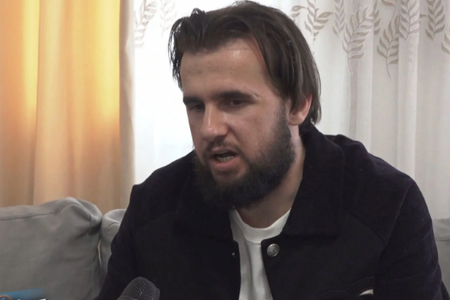
"On April 17, 1999, Serbian forces attacked the village at around 6 am. The family woke up, it was Saturday, a rainy day. The family woke up, unable to leave to flee to the mountains due to the explosions, decided to go to the town of Drenas. They went, because I followed them with my eyes, all the way to Drenas. Serbian forces came out on the road and stopped them from entering Drenas. Baba refused and Serbian forces shot him in the air and threatened that if you don't come back, we will kill you here ," said Fadil Muqolli, a relative of the victims.
Finding themselves in conditions impossible to react, the 59 people who were part of this group were forced to return to their home. The KLA forces failed to stop the Serb attack, while Fadil had no idea that his children had already returned home.
"The Serbian forces came, took them out of the room and counted them, there were 59 people. They brought them inside, after 15 minutes they returned and took the father, Sinan Muqolli and Ymer Elshani out, took them out into the yard and executed them immediately. As soon as they executed them, they returned shooting in the direction of the house to prevent them from going outside...", said Fadil Muqolli, a family member of the victims.
Despite the fact that most of the people were minors, at least 23 people, the Serbian forces did not take this into account. They had a clear intention to eliminate them at all costs.
"As soon as they entered, they opened the door to the room and dropped two hand grenades. After the bombs had been defused, he entered with an automatic rifle and kept shooting until he thought he had killed everyone and left," said Fadil Muqolli, a relative of the victims.
Six people managed to escape the room alive, five of whom continue to be living witnesses to the Poklek massacre, while one of them passed away after the war.
"There were 51 people killed in this room. There were injured, wounded, there were unharmed, unscathed children who remained alive, but their mothers refused to take their children away. The Serbian forces returned after an hour here and searched the room with people inside," said Fadil Muqolli.
It was in the very room where Fadil is telling his story that the most horrific massacre a human being can imagine took place, the burning of bodies. There, even the children who had escaped until that moment were burned alive.
"Brother Qamili realized that night what had happened and came and went inside. He saw the people, they were completely burned, but intact. The next day we came again in the evening and we saw that there were only bones, unlike the night before when they were burned, but the bodies were intact. At 2 a.m. there were only bones, but the bones were intact," said Fadil Muqolli.
Pathological hatred was not enough. The Serbs, having committed a terrible crime, now wanted to eliminate every possible trace. They did not want to leave evidence for any possible investigation of the massacres of civilians. With this timely plan, they continued with their anti-human plan that knew no bounds. They were preparing to finally eliminate the human remains, most of whom were children.
"On the 6th day of the massacre, we came again and the bones were the size of cigarette packs and separated on this side and that side, prepared to be taken. We organized ourselves like soldiers and took a car battery, blankets and nylon bags. We came and turned off the light, took the bones and put them in bags, took them to the mountain, opened a bunker and hid them," said Muqolli.
In the bag were only the remains of the bodies of 51 members of their family. The bodies of Sinan Muqolli and Ymer Elshan were not immediately found, as the place where they were executed was burned. Only Sinan's watch was found there. After much searching, the soldiers found their bodies in the well of the house.
The KLA soldiers managed to extract the bodies of the elderly, who had also been burned and buried in the mountain. Fadil returned home to find out if anyone was left on the upper floors of the apartment.
"There wasn't, but I went and entered the basement, with Nehat Sulejmani. I opened the door when I went inside I stepped on something on the ground, wet. We went inside, closed the door, I touched it and lit a match and we saw that it was blood. The wall was on both sides, on the left and right only blood. Even the ceiling, the tiles above were dripping blood, the middle of the ceiling which is still bleeding today. It was dripping blood..." said Fadil Muqolli./ Inside Story


Lini një Përgjigje