


 Shkruar nga Pamfleti
The agency that aimed to build a modern system of science in Albania believes that Albanian researchers are not prepared to be part of the international scientific community - while they are looking for state budget funds and not international programs.
Changes in the law on Higher Education in 2015 created the National Agency for Scientific Research and Innovation, AKKSHI – an institution aimed at building a modern system of science in Albania as well as strengthening scientific and technological research.
But nine years later, the representatives of this institution say that although funds for scientific research have increased, the quality has remained stagnant.
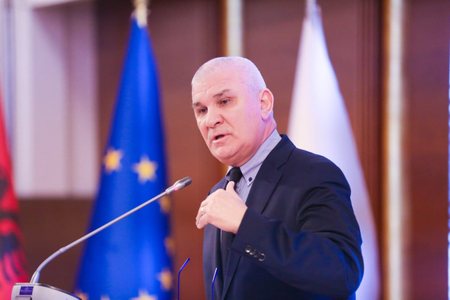
"We don't have good products," Mirela Muça, general director of AKKSHI, told BIRN.
"Unfortunately, we return unused money to the budget, but even for the projects we finance, researchers do not manage to use 100% of it. This gives me an indication that now there is money, but there must be good and quality research," she added.
At a time when science and technology are playing a key role in the economic and social development of countries, Albania continues to rank last in Europe and in the region for the number of scientific publications published, according to a 2023 study by "Science" .
Albania has also shown a notable lack of investment in research and development compared to other countries in the region. In 2024, the budget for science reached the value of 586 million lek - a figure that, although it has tripled compared to 2021, is still below the recommendation of the European Commission for 1% of the Gross Domestic Product.
However, the director of AKKSHI, Mirela Muça, estimates that the low records are more related to the work methodology than to the lack of funds. In an interview for BIRN, she emphasized that only a few of the Albanian researchers manage to finalize a genuine scientific product, as they generally choose to conduct surveys or questionnaires instead of laboratory-based research.
"This is not a good thing. A survey or focus group is a helpful tool, but it is not research itself. They don't use laboratories and don't have a genuine scientific product," Muça said, adding that almost 80% of research from social sciences and Albanianology was based on surveys.
Another weak point is the channeling of funds from applicants to administrative expenses, such as offices and rent for conference rooms, or inflated research teams of up to 15 people.
"We have to open our eyes to quality. We did not fund the amount they requested, as we intentionally removed the expenses that led the money to administrative expenses and not to the research part,” she added.
Unlike the representative of AKKSHI, the pedagogy of Astrophysics and Mechanics at the Faculty of Natural Sciences, Mimoza Hafizi, who has also been an evaluator on several occasions at AKKSHI, told BIRN that there are very good projects among the applications.
But Hafizi emphasizes that the problems with scientific research in Albania are dictated both by budgets and priorities.
"If you look at the percentages given to science from the state budget, it is an almost non-existent figure," said Hafizi.
"There, AKKSHI has a few lek, but there are priority problems. In physics, it is not an applicable field for AKKSHI, because they have some priorities determined by the government, mainly fields of implementation," she added.
International programs
The low quality of scientific research has made Albania benefit little from international programs. From the largest of them, Horizon 2020, Albania managed to benefit only 5.8 million euros in seven years, never being a project leader.
In the new program "Horizon Europe" (2021-2028), the country has so far managed to benefit about 6.2 million euros and carries the ambition to increase this amount in the future. Also, Albania will for the first time be a leader in two projects - one led by the University of Tirana and the other by Polis.
Muça from AKKSHI told BIRN that the projects that will be led by Albanian universities are not the most powerful programs of "Horizon Europe", but she called this "a big step".
However, Muça estimates that Albanian researchers are not yet prepared to be qualitatively part of the international scientific community, targeting local funds in front of international programs.
Hafizi from the Faculty of Natural Sciences also thinks that Albanian researchers have low capacities to absorb European funds, but he connects this with tradition and high competitiveness.
"They are teams of 10-20 people who have been funded historically and know what to look for and how to look for it, while our teams are very small up to 2 people, so it is very difficult for us to compare with the Europeans," said Hafiz.
"This way was found with the joint projects that make us part of the projects. This is positive, because on the one hand it increases our capacity to write projects so that tomorrow we can develop and become competitive, and on the other hand, funding is also introduced in Albania for researchers, there may be some funding for the laboratory," she concluded. / BIRN




Lini një Përgjigje