


 Shkruar nga Pamfleti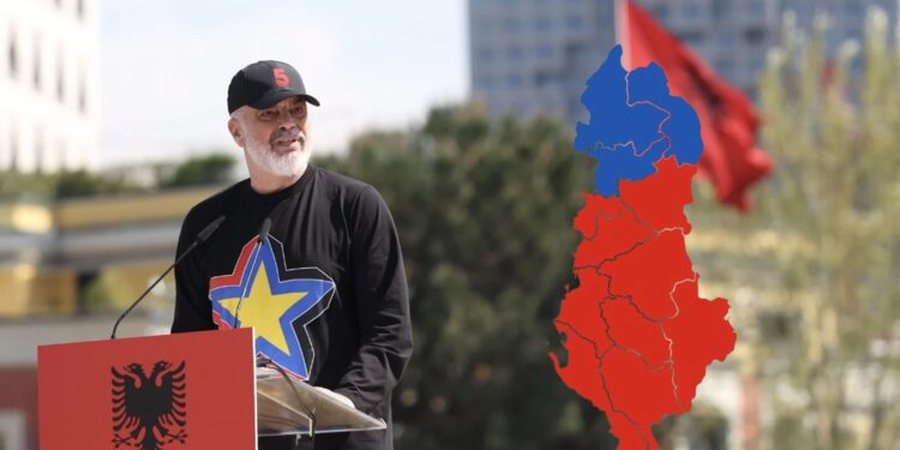
The map, colored almost ¾ of it in pink, gives the impression that the result of the May 12, 2025 elections is a plebiscite victory for the Socialist Party.
Edi Rama has secured a majority of seats in the Assembly that further strengthens his power until the amendment of the aforementioned laws and eliminating the conditioning power that the opposition had until yesterday in the parliament, in the face of the large number of cards that the Socialists will have in their hands. But a more in-depth reading of the popular vote figures shows a different reality than the enthusiasm of the deep victory that the Socialists administer in the Assembly.
Fewer votes in 2021, more mandates in 2025
According to data from the Central Election Commission, the Socialist Party received 733,149 votes in the internal vote in these elections, or 52.16% of the total . Compared to the 2021 parliamentary elections, when the Socialist Party received 768,134 votes (48.67%) , there is a decrease of about 35 thousand votes . So, a part of the socialist electorate has shrunk in absolute figures, although it has increased in percentage terms, and this is a direct effect of the decline in voter turnout.
In 2021, 1,662,274 voters participated in the elections , while this year 1,461,258, or 201 thousand fewer. This means that the increased percentage on a smaller base of voters does not really indicate an increase in support for the Socialists, but rather a lack of strong competition against the SP and a demotivation of the opposition electorate that has suffered a significant decline from four years ago.
The system that "produces" more deputies with fewer votes
What is most striking is that, although the SP has fewer votes than four years ago, it has managed to produce a greater number of parliamentary mandates. How did this happen?
The answer is simple: the Albanian electoral system. The formula for distributing mandates (the regional proportional system with minimal correction) favors the force that comes out first in each district, especially in districts where the distribution of mandates is done with few votes.
This makes a vote for the SP "worth" more than a vote for the opposition, which in these elections was also fragmented into a coalition led by Berisha and with separate lists of new parties.
This is also proven by the results in districts such as Fier (97 thousand votes, 62%) and Elbasan (79 thousand votes, 60%), where Belinda Balluku and Arbian Mazniku each managed to add 2 more mandates than in the 2021 elections, even though expectations were for only 1 more mandate.
Even in the famous prediction he made in Kuç, Rama calculated that there would be 1 more MP in Fier and Elbasan, respectively, but the electoral system has helped the Socialists to disproportionately increase their numbers in parliament.
To make it clearer, it is enough to calculate that to obtain a mandate in these elections, based on the internal vote, about 10,400 votes were needed, while the Socialist Party has about 733,000 votes among all Albanian voters, so in a national proportional system there would be only 70 deputies, while in the current system there are almost 83 deputies.
The illusion of broad popular support
The Socialist Party is celebrating a strong majority in parliament where it can now easily pass laws that require a qualified majority, but it has not actually won the overwhelming majority of Albanians' votes, as can be perceived from the number of mandates.
Rama has the support of only half of the voters who participated in the elections, while the rest either voted against or stayed home. Without taking into account the decline in voter turnout, with the crushed opposition and the misuse of the media and state institutions, it must be calculated that the electoral system has given the SP an advantage of maximum benefit from every vote.
This means that, while Rama may celebrate a "numerical" victory in the Assembly, real support on the ground remains fragile, and the legitimacy of the new majority depends more on the formula than on a popular enthusiasm that is eagerly awaiting what will happen in the fourth term./Lapsi.al





Lini një Përgjigje