


 Shkruar nga Pamfleti
Buying an apartment in the capital has become an impossible mission for many individuals, who earn their income through salaries in both the private sector and the public administration. Apartment prices in recent years have increased at a much faster rate than salaries, extending the time it takes to work to secure your own home.
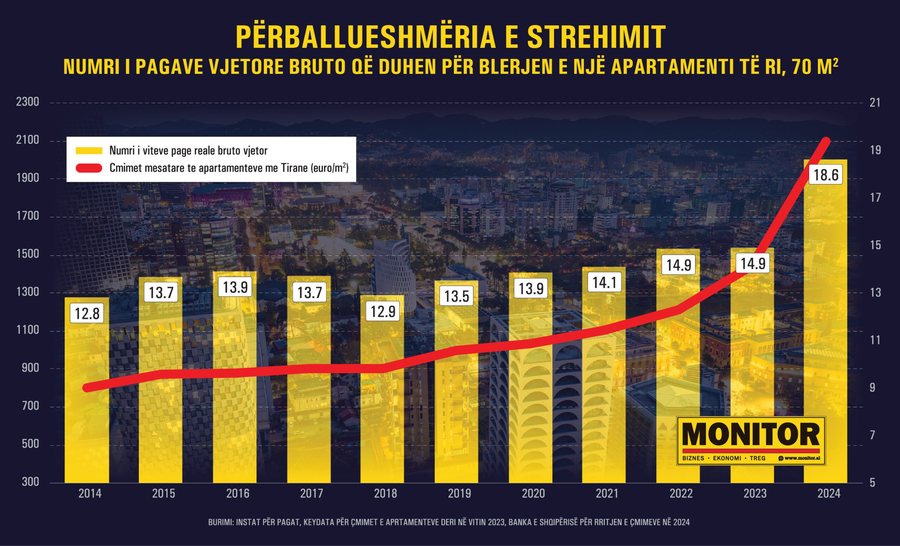
"Monitor" has calculated the housing affordability indicator, or purchasing power for a home, which measures how much real gross annual salary is needed to purchase a new apartment, with a standard size of 70 square meters.
In 2014, an apartment cost an average of 820 euros per square meter, according to data from KeyData, a unit that tracks apartment sales and prices in the capital. In that year, the average real salary (indexed with inflation, with the year 2020 as the base) was about 51 thousand lek, according to official INSTAT data. A 70 square meter apartment cost about 56 thousand euros.
In that year, the exchange rate was at the buyer's disadvantage, as the euro was exchanged for an average of almost 140 lekë and as a result, an apartment, converted into the local currency, cost about 8 million lekë. To buy a house, an individual needed to work for an average of 13.1 years.
In 2024, the average price of an apartment in Tirana was 2,100 euros per square meter, or almost three times higher than a decade earlier. Price increases have been particularly rapid in the last three years, averaging 30-40% per year, according to data from Keydata through 2023 and the Bank of Albania, which measures the annual change in apartment prices according to the Fischer index, in 2024.
A 70 square meter apartment costs 147 thousand euros, up from 56 thousand euros a decade ago. Although the average salary has reached 77.5 thousand lek/month, the average real salary (indexed with inflation, which measures real purchasing power) was 66.1 thousand lek, due to the strong price increase in recent years, which causes the salary to be spent more quickly on the purchase of the same products.
An advantage for the buyer in 2024 is the decline in the euro, which was exchanged for about 100.7 lekë, as an annual average, according to the Bank of Albania, which has somewhat amortized the strong increase in apartment prices.
Converted into lek, a 70 square meter apartment costs 14.8 million lek, up from 7.8 million lek a decade ago. To buy this apartment now requires almost 19 real gross annual salaries (18.6), or almost 6 years more than a decade ago.
Calculating with the nominal salary for 2024 (77.5 thousand lek per month), it would take 15.9 years of work to purchase an apartment in 2024.
In practice, this means that a young person or a family relying solely on their income from work finds it increasingly difficult to secure a home. The disparity between the pace of housing price growth and wage growth is deepening the social housing problem, pushing many citizens towards long-term rental or emigration, where the opportunities to buy a home are more real.
The reasons for the rapid increase in housing prices are related to several factors such as the increase in construction costs due to improved quality, the increase in employee salaries, the percentage of the surface area given to landowners, the increase in municipal taxes, such as housing and infrastructure taxes, or the increase in reference prices in the last two years that automatically increased housing and infrastructure taxes, which builders immediately passed on to the price. Another important factor that has driven up prices has been the informal economy, such as money laundering, or the high demand coming from corruption money. An additional element is the country's return to a tourist destination that has stimulated demand from foreigners, but the impact of the latter has been mainly on the coast.
Want a house, work much longer than in Europe
To provide a more detailed picture of housing affordability, this year’s edition of Deloitte’s Property Index included a comparative analysis of homeownership affordability in selected European cities. Data for Tirana was missing from this analysis, as the capital was mentioned in another indicator as one of the cities with the fastest price increases in Europe.
The assessment is based on cities where both data on average asking prices for new housing and data on average gross wages are available. Affordability is calculated as the number of average annual gross wages needed to purchase a standardized newly built apartment of 70 m2. This indicator provides a clearer understanding of how affordable home ownership is for local residents and highlights affordability differences within and between countries.
According to data collected by Deloitte’s national offices, the least affordable city in this survey is Amsterdam, where residents need 15.4 average gross annual salaries to buy a 70 m² apartment – a slight increase of 0.3 compared to a year ago. It is followed by Athens, with 15.3 annual salaries, while in third place is Prague, where 15 annual salaries are needed for a similar apartment.
In the next level of affordability (14.0–14.9 annual salaries) are cities such as Košice (14.2) and Brno (14.0). In the next group, with 12.0–13.9 annual salaries, are Banská Bystrica (12.8) and Bratislava (12.3).
Cities where affordability is calculated between 10.0 and 11.9 annual salaries include Ljubljana (11.7), Thessaloniki (11.4), Budapest (11.4), Ostrava (10.9), inner London (10.8) and Rotterdam (10.1).
At the more affordable end of the spectrum, residents of Odense in Denmark and Turin in Italy need just 4.9 average gross annual salaries to buy a new apartment – making these cities the most affordable in comparison. Other cities with relatively high affordability include Manchester (5.3), Aarhus (5.8) and Katowice (7.1).
According to the report, it is important to note that housing affordability is shaped not only by real estate prices, but also by local wage levels. In some cases, even cities with high prices can offer better affordability thanks to rising average incomes. For this reason, the balance between income growth and housing cost inflation remains a crucial factor determining access to housing across Europe.
By adapting this data to the Albanian capital, it results that Tirana, measured by both nominal wages (15.9 years) and real wages (18.6 years), is among the most expensive in Europe, measured by purchasing power.
A similar estimate was made by the global benchmarking data unit Numbeo, according to which Albania It takes an average Albanian family 16.3 years of work to buy an apartment. This is the longest time in all of Europe, according to the Numbeo indicator, which calculates the price-to-income index, which measures the affordability of buying an apartment, for mid-2025.
Albania, with the most expensive apartment prices in Europe, according to purchasing power
In countries where these indicators are high, housing is seen as unaffordable, which is associated with rising living costs, difficulties for young people to buy a home and often with increased emigration. This indicator is widely used to assess the housing crisis and the pressure on governments to intervene with supportive policies, such as subsidies, soft loans or increased supply of new housing.
Meanwhile, in Albania, among the poorest in Europe in terms of per capita income and minimum and average wages, the only indicator being used is the "boasting" that property values have increased, or that apartment prices will double when the country enters the European Union! / Monitor






Lini një Përgjigje