


 Shkruar nga Pamfleti
Albania remains among the countries with the lowest levels of worker protection and representation in Europe, according to Eurofound’s “European Working Conditions Survey 2024.” Only about 25% of workers in the country declare that they have a union, works council or other form of workplace representation, ranking Albania among the countries with the weakest coverage in Europe.
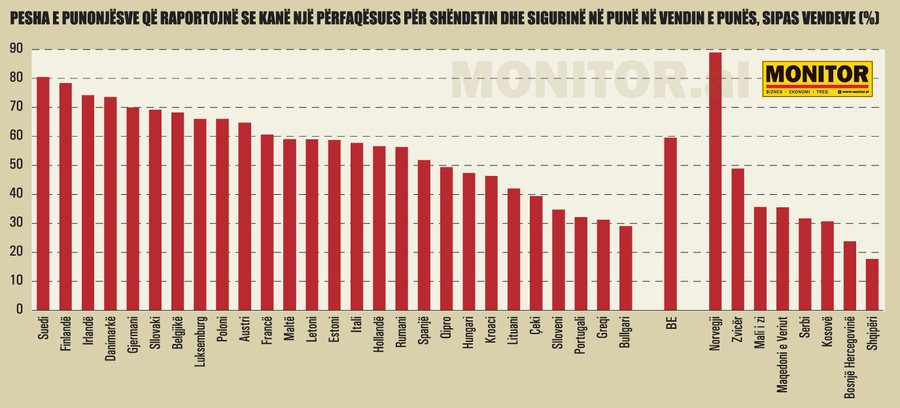
The situation with occupational health and safety structures is even more problematic. Less than one in four employees in Albania declare that the company they work for has a delegate or committee for occupational health and safety, while in the European Union, the average is around 60% of employees.
The report says the lack of such mechanisms leaves workers “qualitatively disadvantaged” in raising concerns or pursuing problems related to working conditions, safety and health in the workplace. The report also highlights that unclear and flexible forms of employment are expanding in Europe.
According to Eurofound data, 3% of European workers declare that they work without an employment contract, while in some countries, up to 15% of employees say that their working hours are not specified in their contract. The report warns of the growth of fragmented forms of work, such as “on-call” work, seasonal work or unclear employment relationships, which increase insecurity for employees and make it more difficult to guarantee safe working conditions.
According to the report, overall, in 2024, around 6 in every 10 employees in the EU reported that there was a health and safety representative or committee in their company or organization, compared to 59% in 2015.
Meanwhile, about 8% responded that they did not know whether such a role or structure existed, up from 6% in 2015.
The presence of this type of representation increases with the size of the workplace, being highest, 88%, in large workplaces, with over 250 employees.
It also varies significantly by sector of activity: it is very high in industry, at 75%, and in public administration, at 79%, while it is much lower in trade and hospitality, at 42%, and in agriculture, at 33%.
The report explains that the framework directive on the introduction of measures to encourage improvements in the health and safety of workers at work (Council Directive 89/391/EEC) sets out the obligations of employers regarding employee representation on health and safety matters at work.
The directive provides that employers must designate one or more employees to carry out activities related to the protection and prevention of risks at work.
It defines a workers' representative with specific responsibilities for health and safety as "any person elected, appointed or designated in accordance with national laws and/or practices, to represent workers in cases where problems arise relating to the protection of workers' safety and health at work".
Representation structures, selection methods and minimum workplace size limits for which such a structure is required vary significantly across European Union countries.
The graph presents the diverse European picture regarding the presence of a health and safety representative or committee in the workplace.
The prevalence of this representation varies significantly, from less than 25% in Albania and Bosnia and Herzegovina, to over 75% in Finland, Norway and Sweden.
These differences between countries, according to the report, should be interpreted taking into account national legal provisions, including different minimum thresholds for the obligation to appoint representatives or establish committees, as well as exemptions for certain sectors.
The specific economic structure of each country also has an impact, according to sectors and the size of enterprises or organizations./ Monitor





Lini një Përgjigje