


 Shkruar nga Pamfleti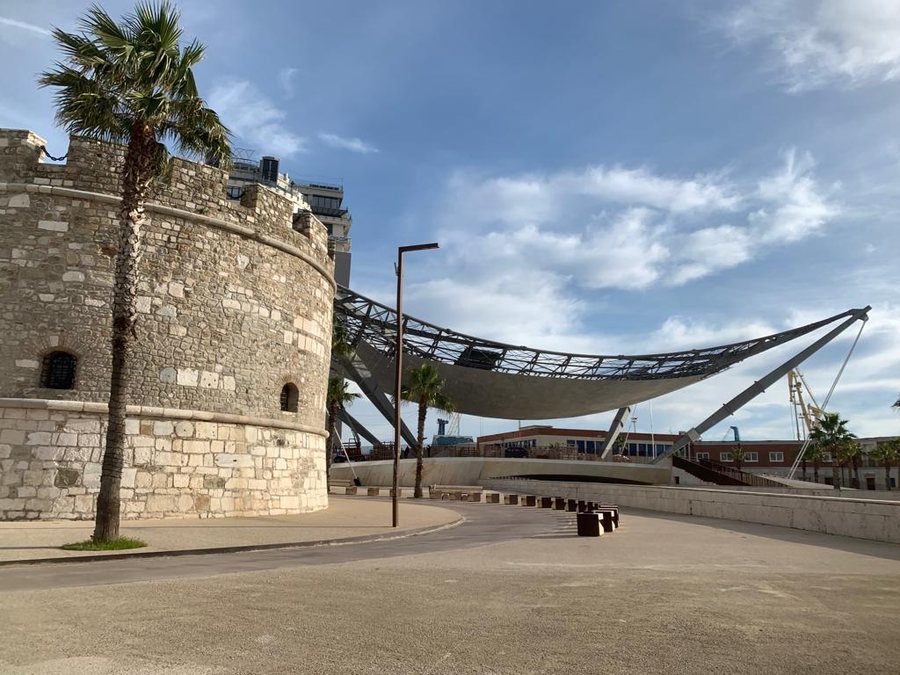
In the kingdom of Siam, which lay on the territory of present-day Thailand, white elephants were so highly valued as sacred animals that when one eyed was discovered, it immediately became the property of the king.
However, since they could not be used for work, their possession turned them into a financial burden for the monarch.
The kings of Siam gave white elephants to unfortunate subjects whom they had lost faith in, who were forced to keep these animals at the expense of great fortunes for their shelter and food.
In the modern world, the term "white elephant" is often associated with construction projects that are too costly and dysfunctional.
For experts and civil society activists, the "Veliera" project at the entrance to the port of Durrës, which cost around 11 million euros, has already turned into a white elephant.
The works have entered their eighth year and have reached their final stage, but no one in the city seems interested in their completion.
While the specialists are assembling the rectangular tiles, the heavy metal construction that has been erected at the end of "Epidamn" Boulevard does not attract anyone's attention.
"I believe that there will be another phase of work, when the metal plates are mounted on the upper concave face of the construction," port engineer Tomorr Spahiu told BIRN.
According to Spahiu, "hundreds of tons of weight of trusses and metal pillars on the bridge are added to the reinforced concrete, mainly in the area of the road underpass".
"It's all superweight that serves to keep the underground water pressure under control in the complex with an area of about one hectare."
Answering the question about the advantages of the road underpass built under "Veliera", engineer Tomorr Spahiu said that "the above-ground crossing that operated for several decades was very valuable for automobile connections with the city center, the promenade towards Currilava, the port entrance and that of "Egnatia" street.
In the same period as "Veliera" in the coastal area, the "Taulantia" promenade was reconstructed, but the new road complex made it even more difficult for pedestrians and vehicles to move from the city to the coast in the "Vollga" area.
The height of "Veliera", which was presented years ago under the name "Vela", has currently "taken under" the buildings built in the ancient city during the past five centuries, from the medieval Torra to the buildings of the port administration. that arose after 1928.
During the initial works of Veliera, archaeologists discovered medieval cannons, cannons, as well as several fortifications, the construction of which in different periods of time has been quite dynamic and not always based on previous lines.
According to the archaeologist who led the monitoring, prof. neither. Dr. Eduard Shehi, within the square of several hundred square meters that is now dominated by the Veliera bridge, at the beginning of 2017, wall structures and elements of material culture were discovered, belonging to Roman, medieval constructions and the bastion of the Ottoman period.
Shehi spoke out against the glass windows, from where it is claimed that the discoveries near Veliera can be seen. "The best solution for me as an archaeologist would be to leave all the findings open, but this is an assessment that other professionals such as urban planners, architects and engineers also give."
"On the other hand, I know very well that the archeologist's desire must also face the city and the fact that three thousand years old Durrës continues to be lived today", said Prof. neither. Dr. Eduard Shehi.
The civil society, whose representatives for years persistently demanded the suspension of construction works in the entire territory of Veliera, continues to demand the re-opening of investigative processes at all levels of the judiciary.
Although the construction of Veliera has reached its final stage, environmental activist Sazan Guri says that "this is not a lost battle".
Sazan Guri told BIRN that civil society aims to "reopen the investigations at all levels of the judiciary and from their results will be seen the possibility of filing a lawsuit in the international court".
Guri calls the metal structure erected at the entrance to the port of Durrës worthless.
"The construction of Veliera has taken 11 million euros from the taxpayers' pockets, double the amount originally anticipated", he emphasized.
Meanwhile, Durrës city planners feel worried about the negative changes that have occurred in the city during the last two decades.
Urbanist Artan Kacani told BIRN that "Veliera with its spoon shape has broken the 'Oltre Mare' concept." (across the sea) that began in 1928 with Italian investments in the old quarantine pier, today pier "0" of the port, continuing with "Epidamn'" Boulevard.
According to dr. In Kacan, in the mid-1930s, the construction of the Great Mosque began, which completely preserved the perspective.
"So, pier 0, with the boulevard 'Epidamn', together with the Great Mosque, without losing the horizon 'Oltre Mare', constitute a unique urban ensemble of the time", concluded the urbanist Artan Get over it. /BIRN




Lini një Përgjigje