


 Shkruar nga Pamfleti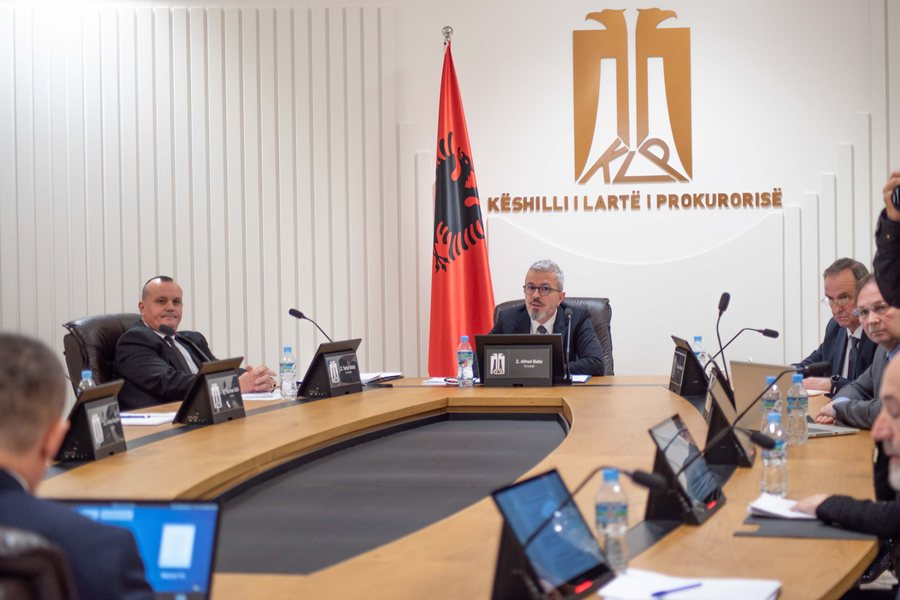
The review of some draft acts for some regulations at the plenary meeting of the High Council of Prosecution, KLP on Tuesday, September 19, took place with debates among the members of this council. With the 10 votes of the members present at the time of voting, the draft act for the regulation "On the criteria and procedure for the promotion of prosecutors at the Special Prosecutor's Office against Corruption and Organized Crime" was approved.
Member Ledina Riza stated that the regulation should have been discussed before among the members, in order to agree on the final version. The member Arta Mandro also requested that meetings be held between all the members to informally discuss the important project-acts and those for the regulations, in order not to remain isolated in the commissions. Member Bujar Sheshi requested that comments be submitted before the regulations come to the council for approval.
Another draft act that had to do with the "Approval of the regulation for the communication of the High Prosecution Council with the media", was withdrawn from the working group. The head of the working group, councilor Nurihan Seiti, stated that they had left it to discuss with the media in advance. "Let's leave it for another day", she said, and the same opinion was expressed by the chairman of the council, Alfred Balla, who asked for such a thing to be done as soon as possible.
Next, Riza discussed the draft act for the regulation "On setting rules and procedures on reducing the workload for prosecutors". She also listed the circumstances in which a prosecutor had to be found to request a reduction in workload, specifically for health reasons of the magistrate himself or of family members, parents and even grandparents, if the need for guardianship for them was proven with documentation.
Another reason was the continuation of studies after the school of magistracy or engagement in duties other than that of the prosecutor.
"There will be a situation that we will take the grandmother under guardianship", declared the member Sokol Stojani.
From what was discussed in the meeting, it was learned that the reduction of the workload will be determined based on the calculation of the average workload of the prosecutor's office where the applicant works, after he has proven with legal documentation the reason on which he bases the request for a reduction of the workload, as and that in case of acceptance of such a request, the payment will be in the amount of 75%.
Member Esmeralda Keshi pointed out that the legislation does not allow the reduction of working hours. According to her, it is necessary to first propose changes in the legal provisions, so that in reducing the work load, the reduction of the schedule is also foreseen.
"We cannot reduce the working hours because the law does not give us the right to reduce the physical working time", asserted Keshi. Again, Riza underlined that it is necessary for the regulations to be discussed among the members in advance, before they are presented for approval.
Member Bujar Sheshi proposed the removal from the draft regulation of the article on reducing working hours. Although it was put to a vote not to approve this regulation, with the four votes of the members who share this opinion, Keshi's proposal was not approved. KLP decided with 7 votes to fully approve the regulation for reducing the workload of prosecutors. During the voting by article, the proposal of Sheshi was also approved for the removal of the definition related to the reduction of working hours, with the argument that it contradicts the legislation in force.
Among the debates, the regulation "On the granting of unpaid permits" was also approved. The members were divided among themselves regarding the determination of the authority that will grant the unpaid leave to the heads of the prosecutions. In the end, the proposal was approved with 6 votes in favor, which stipulates that the permits of the heads of the prosecutor's offices will be granted by the General Prosecutor, in the capacity of the highest prosecutor. The minority of members estimated that it should have been the council that gave the permission, arguing that the General Prosecutor is the highest prosecutor only procedurally and not in the functional and organizational aspect of the prosecution offices, the powers that according to them the council has.
At Tuesday's meeting, six more draft acts were approved out of 14 that were foreseen in the agenda. /BIRN




Lini një Përgjigje